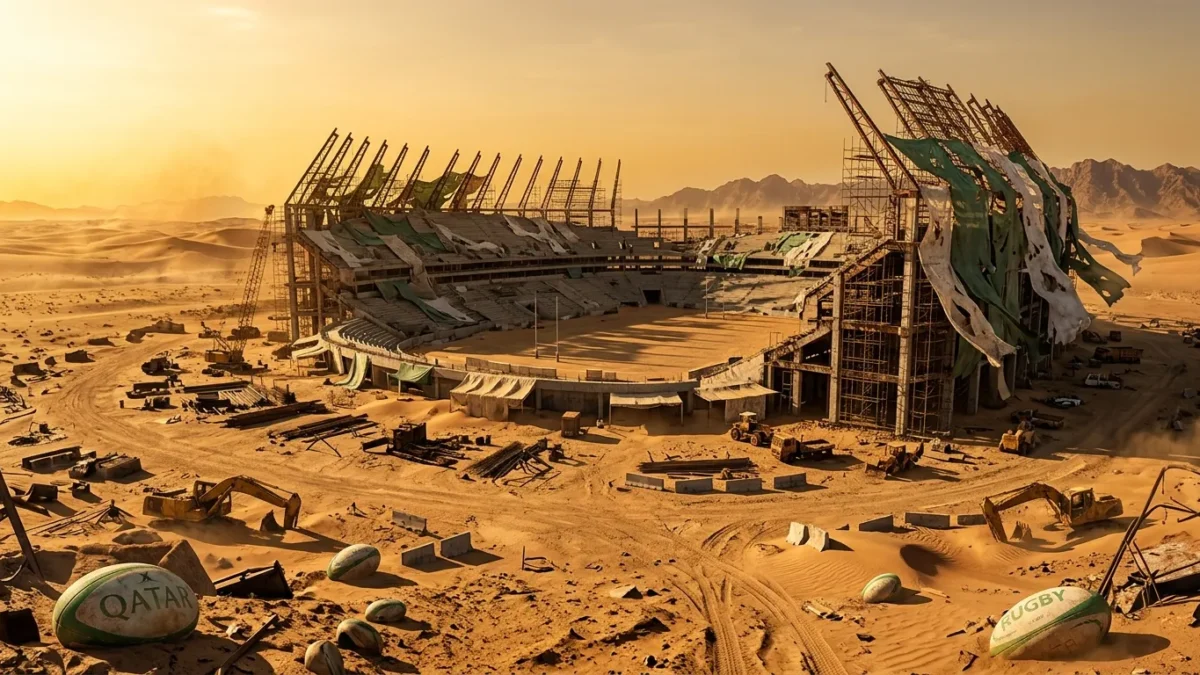
Saudi Arabia won’t be hosting the 2035 Rugby World Cup. The kingdom quietly stepped back from the bidding process — no formal expression of interest submitted to World Rugby, no joint Gulf bid materialised, and no indication that this will change before the October 2026 deadline. This isn’t a minor administrative delay. It’s a deliberate strategic retreat driven by hard financial choices at the top of the Saudi state.
PIF’s budget pivot : why Saudi Arabia pulled back from the 2035 Rugby World Cup bid
The Public Investment Fund (PIF) — Saudi Arabia’s sovereign wealth vehicle — published a new strategic framework this week, describing its current phase as “value realization.” Translation : money goes where it generates returns. Prestige projects that can’t demonstrate financial performance are being cut. The 2035 Rugby World Cup hosting ambition fell into that category.
Sports minister Prince Abdulaziz bin Turki al-Faisal had publicly expressed interest in bidding for the tournament as recently as last year. Around the same time, Qais al-Dhalai, president of Asia Rugby, floated the idea of a joint Middle East bid involving Saudi Arabia, Qatar and the United Arab Emirates. Neither path was pursued. Both collapsed before they reached a formal stage.
What’s replacing rugby on PIF’s priority list ? Domestic infrastructure tied to major confirmed events :
- Infrastructure development for the 2034 FIFA World Cup in Saudi Arabia
- A new Formula One circuit near Riyadh, scheduled to open in 2027
- Continued investment in domestic sports leagues and facilities
These projects share one trait : they’re locked in, contracted, and tied to measurable economic output. A Rugby World Cup bid for 2035 offered none of that certainty. Frankly, given rugby’s relatively modest global commercial footprint compared to football or F1, it’s hard to argue the financial logic was ever compelling for PIF.
Yasir al-Rumayyan, PIF’s governor and chair of LIV Golf, confirmed on Al Arabiya — the state-owned broadcaster — that all spending commitments are under active review. “It is a dynamic situation with or without war,” he said. “But the war would add more pressure to reposition some priorities.” The ongoing conflict with Iran adds external pressure, though the decision to exit the rugby bid was reportedly taken before hostilities began in late February.
LIV Golf, rugby, and the pattern of Saudi sports spending cuts
The rugby retreat doesn’t stand alone. LIV Golf — arguably PIF’s most high-profile and controversial sports investment — is also facing the axe. Funding for the rebel tour will be withdrawn in 2027, forcing its teams to seek significant private capital to survive. If LIV Golf, with its global broadcast deals and star-studded roster, can’t clear PIF’s new return-on-investment bar, a rugby hosting bid never stood a real chance.
This matters for the broader debate about sports washing and Gulf state investment in global sport. The assumption has long been that Saudi Arabia would keep spending regardless of financial logic, using events and tournaments as diplomatic tools. The PIF pivot challenges that narrative directly. Prestige alone no longer justifies the cheque.
| Project | Status (April 2026) | PIF involvement |
|---|---|---|
| 2035 Rugby World Cup bid | Abandoned | No expression of interest submitted |
| LIV Golf | Funding withdrawn from 2027 | Exit confirmed |
| 2034 FIFA World Cup infrastructure | Active investment | Priority project |
| Riyadh F1 circuit | Under construction, opens 2027 | Priority project |
The contrast is stark. Projects tied to confirmed global events with fixed timelines get funded. Open-ended bids for tournaments nearly a decade away do not. It’s a clear hierarchy, and rugby sits outside it.
What this means for the 2035 World Cup race — and where Qatar fits in
World Rugby’s bidding timeline remains on track. The process opened in October 2025, with Argentina, Japan and Spain among nations understood to have submitted initial expressions of interest. The formal bid deadline is October 2026. A preferred host will be identified in May 2027, with the World Rugby Council making the final appointment that autumn — timed to coincide with the 2027 tournament in Australia.
Saudi Arabia technically has months to reverse course. Nobody expects it to. The window exists on paper; the appetite does not. Qatar’s situation is meaningfully different, and worth understanding clearly.
Unlike its Gulf neighbour, Qatar already owns the stadiums and event infrastructure built for the 2022 FIFA World Cup. Hosting capacity isn’t a question. But Doha’s current focus is the 2036 Olympic Games bid, which takes priority over any rugby ambitions. Qatar did commit to hosting the second edition of rugby’s new Nations Championship in 2028 — the first event takes place at Twickenham this autumn — which signals genuine engagement with the sport at a tournament level, without the full commitment of a World Cup bid.
For World Rugby, Saudi Arabia’s exit probably simplifies things rather than complicates them. Japan, Argentina and Spain represent credible, rugby-established nations with proven event management track records. Japan hosted the 2019 Rugby World Cup to widespread acclaim, delivering record attendance figures and a commercially successful tournament. Argentina brings passionate domestic support and existing infrastructure. Spain offers European appeal and a growing talent pool.
The 2035 World Cup will almost certainly go to one of these three. Whether Gulf investment returns to rugby in any form — beyond Qatar’s measured engagement — depends entirely on how PIF’s “value realization” strategy evolves over the next decade. Watch the Riyadh F1 circuit’s performance when it opens. If it delivers the returns PIF is banking on, the appetite for big international events may return. Rugby will just have to wait its turn.
