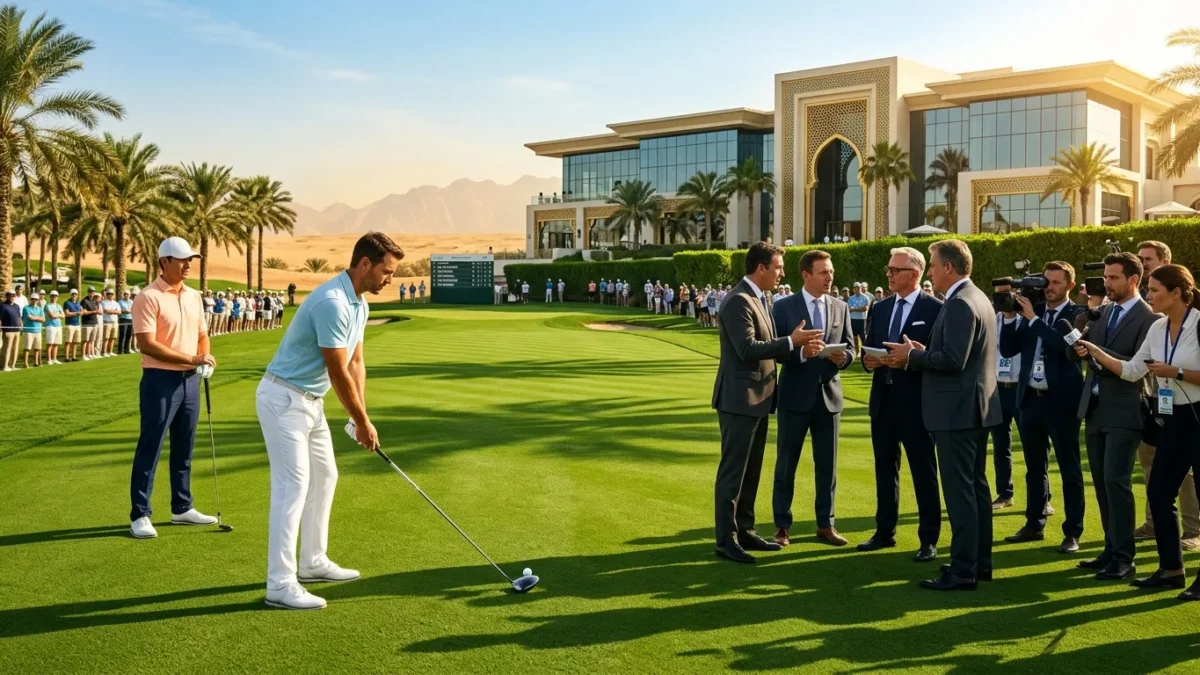
In April 2026, word spread fast : Saudi Arabia’s Public Investment Fund was preparing to pull its backing from LIV Golf. The league that shook professional golf to its core back in 2022 suddenly faced an existential threat. Billions spent, top players recruited, a broadcast deal signed with DAZN just a year prior — and now, the whole edifice looked shaky. This wasn’t just a golf story. It was a signal about how the kingdom manages its sporting empire, and what happens when the math stops working.
LIV Golf and the Saudi sports investment machine under pressure
LIV Golf was never a modest project. Launched with enormous fanfare in 2022, it was designed to challenge the PGA Tour and DP World Tour head-on. Saudi funding flowed in for years, yet the league consistently bled money without building the commercial self-sufficiency its backers needed. The Athletic reported that insiders were scrambling to understand their futures amid the chaos — not exactly the language of a stable organization.
What makes this moment particularly revealing is a detail that slipped past most observers : when PIF published its five-year investment strategy in April 2026, the word “sports” appeared nowhere in the press release. A small omission, perhaps intentional, but one that rattled boardrooms and locker rooms across multiple continents. A source familiar with PIF’s internal thinking insisted the fund remains committed to sports — but that commitment is clearly being recalibrated.
The broader financial context matters here. PIF’s overseas investments peaked at 30% of its portfolio in 2020, then steadily declined to 19% by the end of 2024. The kingdom is turning inward, channeling capital toward domestic infrastructure, the 2034 FIFA World Cup, and massive projects like NEOM. LIV Golf, a foreign-facing vanity project that generated losses instead of returns, fits uncomfortably in that revised strategy.
Here’s a snapshot of the Saudi sports investment landscape across key sectors :
| Sport | Main vehicle | Key development (2026) |
|---|---|---|
| Golf | PIF / LIV Golf | Funding withdrawal under review |
| Soccer | PIF (4 clubs) + Ministry of Sport | Al Hilal stake sold; World Cup 2034 focus |
| Tennis | SURJ / GEA | WTA Finals deal not renewed; ATP Masters deal secured |
| Boxing | GEA / Turki Al-Sheikh | Continues under Al-Sheikh’s personal drive |
| MMA | SURJ / PFL investment | PFL MENA events postponed |
| Broadcasting | SURJ / DAZN (10% stake) | $1 billion acquisition; LIV Golf broadcaster |
The picture is mixed. Some investments look durable; others, like LIV Golf and the PFL’s MENA expansion, show cracks. Frankly, anyone who assumed Saudi sports spending was a permanent fixture misread the strategy from the start.
Soccer, tennis and boxing : which investments actually survive ?
Soccer received the most spectacular Saudi investment, and it retains the most strategic logic. Cristiano Ronaldo’s move to Al Nassr at the end of 2022 cost £173 million ($234 million) per year — a figure no European club would sanction for a 37-year-old. That transfer opened the floodgates. Karim Benzema, Neymar, Sadio Mané followed in 2023, with PIF-owned clubs Al Nassr, Al Hilal, Al Ahli and Al Ittihad spending over £700 million ($760 million) that season alone. The pace has slowed, but the ambition clearly hasn’t disappeared.
In April 2026, PIF sold a 70% stake in Al Hilal to Kingdom Holding Company — run by Prince Alwaleed Bin Talal — valuing the club at SAR 1.4 billion ($373 million). That sale signals something important : PIF is beginning to extract value from its soccer assets, not just pour money into them. Newcastle United, where PIF holds an 85% stake and injected £491.9 million ($665.7 million) over five years, remains categorized as a “strategic” investment. Daily contact between club executives and PIF board member Jacobo Solis continues.
Tennis tells a more complicated story. The original Saudi vision — a combined ATP/WTA 1000 event running nearly two weeks, backed by a $1 billion PIF proposal — was far too aggressive and ran into fierce opposition from Grand Slam organizers. What emerged instead was a 56-player men’s event slated for 2028. Meanwhile, the WTA Tour Finals deal, which offered record prize money exceeding $15 million per year and produced Elena Rybakina’s historic $5.235 million winner’s check in 2025, will not be renewed. Saudi interest shifted toward the men’s game.
Boxing is the sector most insulated from PIF’s uncertainty, for one simple reason : Turki Al-Sheikh. The chairman of Saudi Arabia’s General Entertainment Authority built his boxing operation through the GEA and entertainment company Sela, not solely through PIF channels. His passion for the sport is well-documented — Eddie Hearn put it plainly : “He has a huge passion for boxing. If he didn’t, I think he would have left.” A Joshua-Fury fight on Netflix, Usyk versus Rico Verhoeven in May, Canelo Alvarez expected in September — these deals don’t disappear because LIV Golf is struggling.
- MMA : SURJ invested over $100 million in the PFL in 2023; PFL MENA events have since been postponed
- Cycling : The AlUla Tour was upgraded to UCI ProSeries level in 2026, but the breakaway “One Cycling” project collapsed under UCI pressure
- Motorsport : Aramco’s Formula 1 partnerships with FOM and Aston Martin run long-term; a new Qiddiya circuit targets F1 races from 2028–2029
- Broadcasting : SURJ’s 10% stake in DAZN, acquired for $1 billion in February 2025, underpins a broader media strategy for the MENA region
What Saudi soft power through sport actually means going forward
The LIV Golf crisis invites a harder question : was sports ever really about sport ? The kingdom’s Vision 2030 program uses athletics as geopolitical currency — a tool to normalize international relationships, attract tourism and build domestic identity. Hosting the 2034 FIFA World Cup requires 11 new stadiums, including the 92,500-capacity King Salman International Stadium. That commitment dwarfs any golf league in scale and political symbolism.
The 2034 Asian Games and the Olympic Esports Games — the latter part of a 12-year IOC deal before being canceled in 2025 — illustrated both the ambition and the limits of this strategy. Trojena, the $40 billion Red Sea ski resort built to host the 2029 Asian Winter Games, was declared unready in January 2026. The Games moved to Almaty, Kazakhstan. A $1.5 trillion NEOM giga-project doesn’t guarantee delivery, apparently.
For investors, broadcasters and athletes now watching LIV Golf’s turbulence, the lesson is clear : Saudi sports money isn’t unconditional. It follows strategic priorities, responds to domestic pressure and can be redirected overnight. The kingdom will keep spending — but increasingly on its own turf, its own infrastructure, its own 2034 narrative. If your sport fits that frame, funding continues. If it doesn’t, prepare to scramble.
