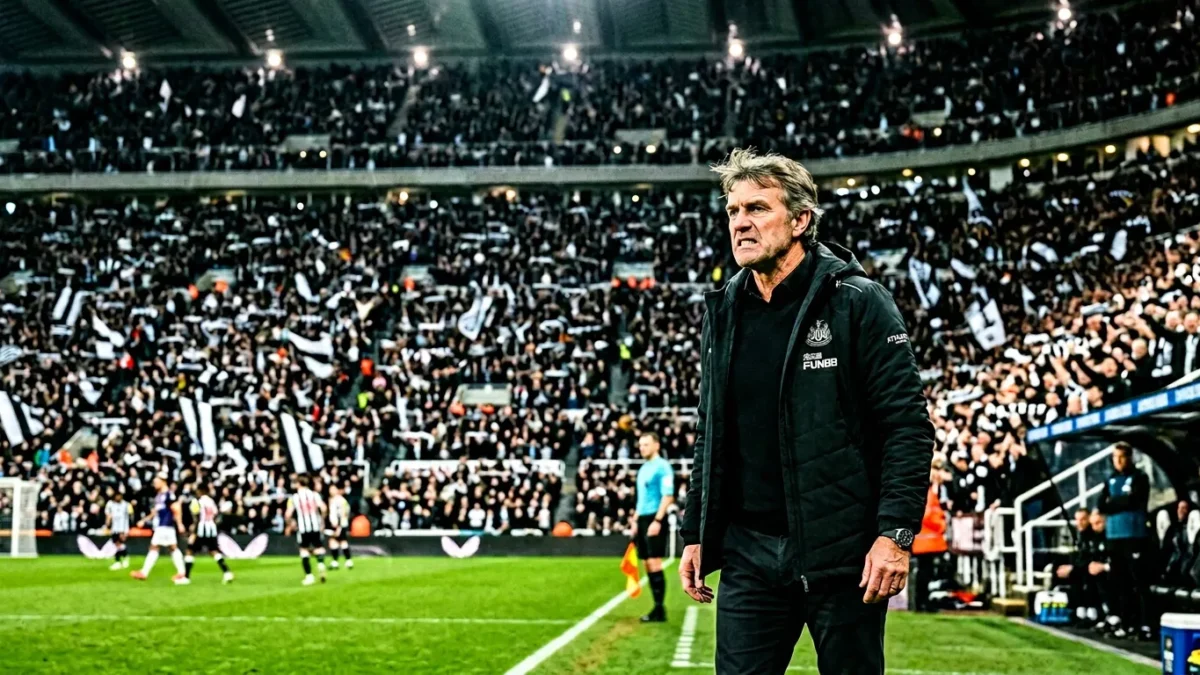
William Osula scored his second goal in two games. Newcastle still drew. Bournemouth’s manager Andoni Iraola was caught on the touchline telling his players “not to panic” — even after the equaliser. That tells you everything you need to know about where Newcastle United currently stand.
A squad stripped bare : the worrying reality of Howe’s selections
Against Bournemouth, Eddie Howe named Newcastle’s youngest starting XI in a Premier League game since 2005, with an average age of just 24 years and 191 days. That is not a bold tactical decision — it is a reflection of how thin the squad has become. Bruno Guimarães, recovering from illness and injury, would have started had he been fit. He wasn’t. Beyond him, the entire leadership group was absent from the first eleven : Nick Pope, Dan Burn, Kieran Trippier and Jacob Murphy all started on the bench.
Think about that for a second. Four experienced starters relegated to substitutes, not through rotation or tactical choice, but because Howe judged none of them ready enough to begin. The depth this squad was supposed to offer is simply not there right now.
What makes it worse is the contrast with the recruitment investment. Nick Woltemade and Yoane Wissa represent a combined £124 million in attacking options — yet both watched from the bench. Osula, who nearly joined Eintracht Frankfurt on deadline day last September, is the man leading the line. He is doing his best, but the bigger picture is damning.
Here is how Howe’s striking options have shifted across this exhausting season :
| Period | Primary striker used | Result |
|---|---|---|
| Early season | Nick Woltemade | Inconsistent |
| Mid-season | Yoane Wissa | Underwhelming |
| Post-January | Anthony Gordon | Injuries disrupted |
| April 2026 | William Osula | Goals, but not enough |
This constant pivoting is not a sign of tactical flexibility. It is a desperate search for a formula that simply has not materialised. The Alexander Isak situation, where the striker pushed to join Liverpool last summer, created a void that a £100 million-plus recruitment drive has failed to fill convincingly.
Blunt, leaky and lacking ideas : the tactical crisis on the pitch
Strip away the individual personnel issues and look at the team itself. Newcastle are, frankly, not good enough right now on either side of the ball. Going forward, they lack aggression, creative quality and clear attacking patterns. Defensively, they are conceding goals they should not be conceding — and that combination is dangerous for any side with ambitions.
The Bournemouth goal that snatched the points told its own story. Truffert, one of several smart additions Bournemouth made last summer following the sales of Dean Huijsen, Milos Kerkez and Illia Zabarnyi, hooked the ball into the roof of the net late on. Bournemouth rebuilt intelligently after cashing in on key assets. Newcastle, by contrast, spent heavily and are still searching for the same cohesion.
The irony is painful. Newcastle had more time on the training ground this week after a relentless fixture schedule finally eased. Those sessions did not translate into a performance improvement. When preparation time produces no visible progress, that raises harder questions about the coaching methods and the message getting through to players.
There are three core problems Howe must address urgently :
- Defensive fragility — conceding late goals despite apparent control phases
- Attacking bluntness — over-reliance on individual moments rather than systemic creation
- Squad confidence — a group that does not look cohesive or settled in its identity
Howe himself did not hide from the criticism. “It’s disappointing when you are not delivering for your supporters,” he admitted. “If they are critical of us, we have to accept that — that’s the game we are in.” For a manager who built genuine goodwill at St. James’ Park, those words carry weight. But goodwill has limits, especially when results do not improve.
Howe’s future and what the next transfer window must deliver
The scrutiny around Eddie Howe’s position at Newcastle is no longer background noise — it is a legitimate conversation. His involvement in a £100 million-plus net spend that has not yielded the expected returns puts him in a difficult spot. Managers are judged on results, and right now, the results are not good enough for a club with Newcastle’s resources and ambitions.
Survival in the short term may depend on the players returning to fitness. If Guimarães, Trippier, Pope and Burn can all come back at the same time, the team looks different. But relying on injury recovery as a tactical plan is not a strategy — it is hoping the problem solves itself.
The more pressing issue is the summer window. Newcastle cannot enter another season without a reliable, proven striker. The Isak departure created a structural problem that recruitment has failed to fix. Woltemade and Wissa cost serious money and are not starting games. That is a recruitment failure, regardless of who made the final calls.
Howe’s ability to influence the next window — and to retain the trust of Newcastle’s hierarchy — may ultimately define whether he is still in the dugout come August. The challenge ahead is not just tactical, it is institutional. Can he rebuild confidence in the squad, fix the structural weaknesses and convince those above him that he remains the right man ? For someone who transformed this club from relegation candidates to Champions League contenders, writing him off feels premature. But the clock is ticking louder than it ever has before.
