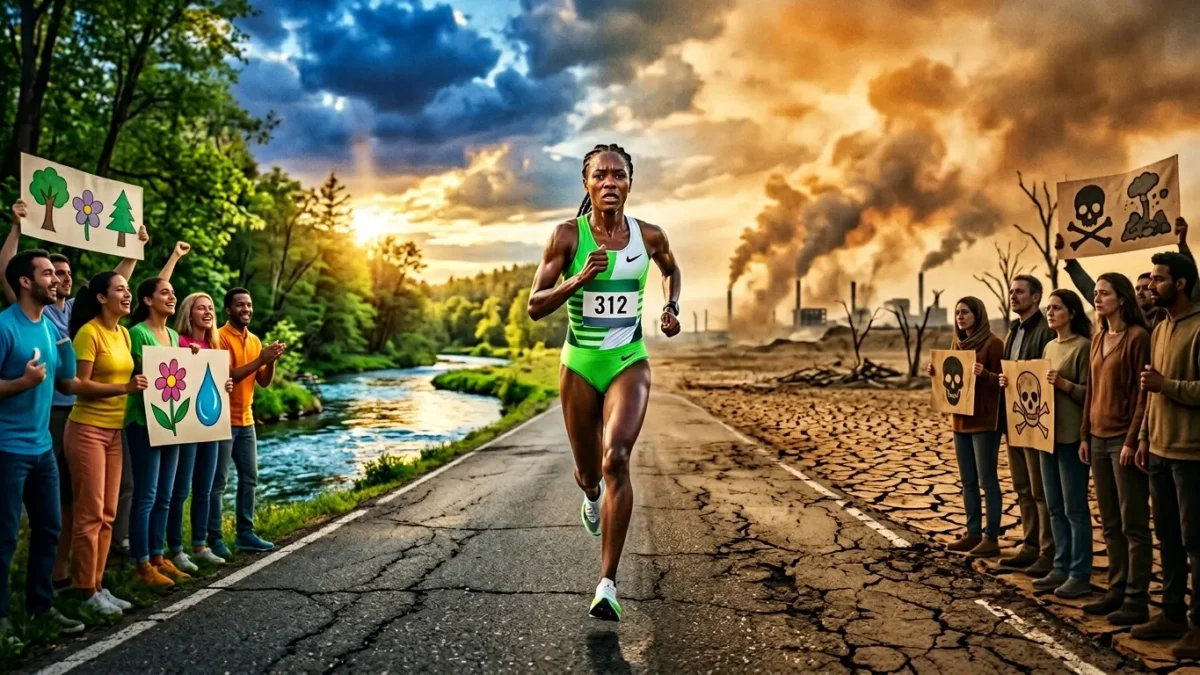
Thirty percent. That single figure — the share of global greenhouse gas emissions driven by our food systems alone — rarely makes headlines the way a record-breaking heatwave does. Yet it sits at the heart of one of the most underexplored connections between everyday life and the climate emergency. And sport, of all things, might be the most powerful channel we have to make that reality land with the public.
Why sport is a uniquely powerful messenger for the climate crisis
Scientific reports pile up. Governments issue statements. Environmental NGOs campaign tirelessly. And still, for most people, the climate and nature emergency feels distant — abstract, someone else’s problem. Sport doesn’t work that way. It’s local. It’s emotional. It’s watched by billions of people who would never pick up an IPCC report.
Prof Paul Behrens, sustainability scientist and British Academy Global Professor at Oxford University, puts it plainly : “Sport reaches people in a way that scientific reports never will.” He’s not speaking theoretically. A third of grassroots football clubs in the UK are already losing between six weeks and two months of playing time each year — not because of budget cuts, but because of flooding. Cricketers are collapsing in extreme heat. These aren’t projections. They’re happening now, on pitches and courts across the country.
The connection runs deeper than disrupted fixtures. Behrens also highlights the link between sport and diet, which many people overlook entirely. Several high-profile elite athletes across football, tennis, motor sport, and endurance disciplines have shifted to plant-rich diets — and the science backs them up. Those diets happen to align almost perfectly with what’s best for the planet. Better for your performance, better for your health, better for the climate. That’s a rare triple win, and sport is the ideal arena to communicate it.
Here’s why athletes and clubs carry exceptional influence when it comes to raising awareness about environmental issues :
- Athletes are aspirational figures — their choices influence fans’ behaviours far beyond the pitch
- Sports clubs are embedded in local communities, creating direct, trusted relationships
- Sporting events gather diverse audiences who would never attend an environmental briefing
- The physical, outdoor nature of sport makes climate impacts visceral and impossible to ignore
When Laura Baldwin, British Olympic sailor, addressed a screening of The People’s Emergency Briefing in Weymouth, she spoke about grief — “fully seeing what is happening to our precious world.” That emotional honesty, coming from an elite athlete rather than a scientist, hits differently. It bypasses scepticism and lands somewhere real.
From Tokyo to grassroots pitches : concrete examples of climate disrupting sport
The 2020 Tokyo Olympics provided one of the starkest illustrations of climate change reshaping competitive sport. The marathon was relocated 800 miles north to Sapporo specifically to avoid dangerous heat levels in Tokyo — and even then, race organisers pushed the start time to dawn. That decision, affecting the world’s most-watched athletics event, signals something fundamental : the conditions in which we play sport are shifting, fast.
But you don’t need to look at the Olympics to see this. The impact is local and immediate for millions of amateur players across the UK. Flooded pitches, cancelled matches, heat-related health risks for recreational runners — these are experiences that connect directly with communities.
| Sport | Climate impact | Example |
|---|---|---|
| Football (grassroots) | Flooding, pitch cancellations | Up to 2 months lost per year in the UK |
| Cricket | Extreme heat, player health risks | Collapses reported during matches |
| Marathon running | Dangerous temperatures | Tokyo Olympics marathon moved to Sapporo |
| Sailing | Changing weather patterns, storm intensity | Increased race disruptions globally |
This is precisely why The National Emergency Briefing — held in London in November 2025 before over 1,000 guests including MPs — matters. It brought together specialists across climate science, food security, national security, health, and economics. A condensed 45-minute film, The People’s Emergency Briefing, was created to reach wider audiences. Backed by the British Ecological Society and the Campaign to Protect Rural England, it’s been screened in church halls and community centres across the UK, and even in Paris.
The goal is straightforward : once enough people have engaged with the content, political pressure builds on government to hold a formal, non-partisan national briefing. Sport clubs hosting screenings could dramatically accelerate that momentum — pulling in audiences who would never otherwise engage with this kind of material.
Turning sports fans into climate advocates — a practical path forward
World champion cyclist Kate Strong is already hosting briefings. Laura Baldwin is involved in multiple screenings along the UK south coast. These aren’t symbolic gestures — they’re strategic moves that use sport’s social infrastructure to spread an urgent message beyond the usual environmental echo chambers.
The organisation Sport Positive, founded by Claire Poole, has been instrumental in pulling together international sports federations, governing bodies, athletes, and agents around this kind of initiative. The sports community has reach, trust, and emotional currency that no think-tank or government department can replicate.
If you’re involved in sport — as a player, a coach, a club volunteer, or even just a fan — consider what your community could do. Hosting a screening of The People’s Emergency Briefing at your club is genuinely one of the most effective things you can do to move the climate conversation into new territory. Not a protest, not a petition — just a room full of people who love sport, watching a film together and talking about what it means.
Prof Mike Berners-Lee, chair of The National Emergency Briefing, frames it simply : “there’s an escalating polycrisis… but everything to play for.” That last phrase isn’t accidental. Sport gives us a language for collective effort, for not giving up when the scoreline looks grim. That’s exactly the mindset the climate emergency demands right now.
