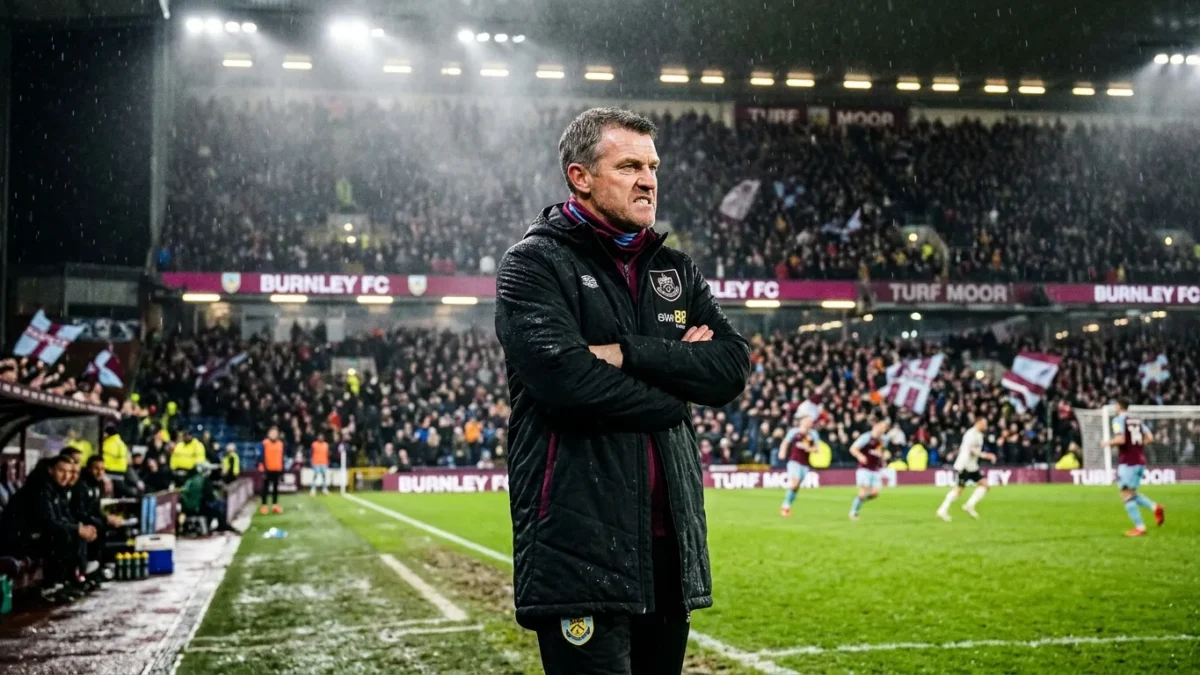
Wednesday night at Turf Moor. Final whistle. A father and son simply shrug at each other and walk to the car. No tears, no outrage — just a quiet, hollow indifference. That reaction, shared by many Burnley supporters after the club’s relegation from the Premier League in April 2026, arguably says more about the state of the relationship between Scott Parker and the fanbase than any banner or chant ever could.
Scott Parker’s disconnect with Burnley supporters
The post-match interview after the decisive defeat was revealing. Parker made no mention of the fans — no empathy, no rallying call, not even a brief acknowledgement of the disappointment felt across the terraces. For many supporters, that silence spoke volumes. It wasn’t an oversight; it felt like a pattern.
To be fair, the tension isn’t entirely one-sided. Burnley fans have been vocal — sometimes brutally so — about their frustration with the manager’s tactical approach throughout the season. The rift between the dugout and the stands built gradually, through a series of performances that left supporters cold long before the relegation was confirmed. A manager who struggles to connect with his fanbase faces an uphill battle even when results are decent. When they’re not, the divide becomes a chasm.
What made this particular drop feel so different — so flat — was the absence of any emotional charge. Relegations usually come loaded with grief, fury, or at least some grim catharsis. This one, for many supporters, simply felt like the inevitable end of a chapter nobody enjoyed reading. The conversation on the way home wasn’t about tactics or transfers. It was about driving in Europe and fixing a leaking sink. Football had, briefly, become background noise.
| Aspect | Fan sentiment |
|---|---|
| Parker’s post-match communication | Perceived as cold, no acknowledgement of supporters |
| Tactical performances | Widely criticised throughout the season |
| Emotional response to relegation | Predominantly indifference, not anger or sadness |
| Parker’s future at the club | Under discussion, no decision confirmed as of late April 2026 |
The Championship challenge and what comes next for the club
Reports circulating in late April 2026 suggest that Parker’s position is under active review by the board, though no decision has been announced. Speculating on replacements at this stage feels premature — he may still be in the dugout come the first Championship fixture in August. But the squad picture is harder to ignore.
The club faces what looks like a significant exodus of first-team players over the summer. Of those currently at the club, only Kyle Walker has publicly committed to the Championship campaign. That’s one confirmed name in a squad that needs rebuilding almost from scratch — again. Since ALK Capital took over the club, this would mark the third major rebuild. That’s not a statistic that inspires confidence.
The board’s reluctance to sack managers too hastily is understandable. Stability matters, and a club that cycles through coaches every eighteen months rarely develops the kind of identity that sustains success. But there’s a difference between patience as a strategy and passive drift toward a prolonged spell in the EFL. Burnley spent 2016 to 2022 bouncing between the top two divisions — another yo-yo cycle would be damaging for the club’s infrastructure, finances, and supporter trust.
Here are the key questions the board must now address before the summer window opens :
- Does Parker have a credible plan to compete at Championship level ?
- Can the squad be rebuilt quickly enough around a new identity ?
- Who replaces the players likely to leave on free transfers or reduced fees ?
- How does the club reconnect with a fanbase that has grown disengaged ?
None of these questions have easy answers. But asking them clearly — and acting on the responses — is what separates clubs that bounce straight back from those that stagnate for years in the second tier.
Building something real for the Championship campaign
One silver lining, minor as it sounds : no VAR in the Championship. It’s a small thing, but supporters who spent the season grinding their teeth at overturned goals will at least get that back. That said, a functioning football club needs more than relief from a video review system.
The one positive angle here is clarity. Relegation, for all its pain, removes ambiguity. Burnley now knows exactly what division it’s playing in, what budget pressures it faces, and what standard of squad it needs to assemble. The Championship in 2026-27 will be fiercely competitive — clubs like Leeds United and Leicester City have recent experience of navigating these waters at pace.
A fresh start isn’t necessarily a failure. It’s only a failure if the same mistakes get repeated. Appointing the wrong manager again, assembling an incoherent squad, or underestimating the physical and tactical demands of the second tier — those are the traps to avoid. Whether Parker is the man to lead that charge remains genuinely open. But if change does come, the priority must be getting it right rather than getting it done quickly.
The supporters deserve a project they can actually believe in. Not just a squad capable of scraping promotion, but a manager who looks them in the eye after a defeat and makes them feel like they’re part of the same fight. That basic connection — between club, coach, and fans — is what’s been missing. Fixing it starts with honest conversations, not press conference platitudes.
