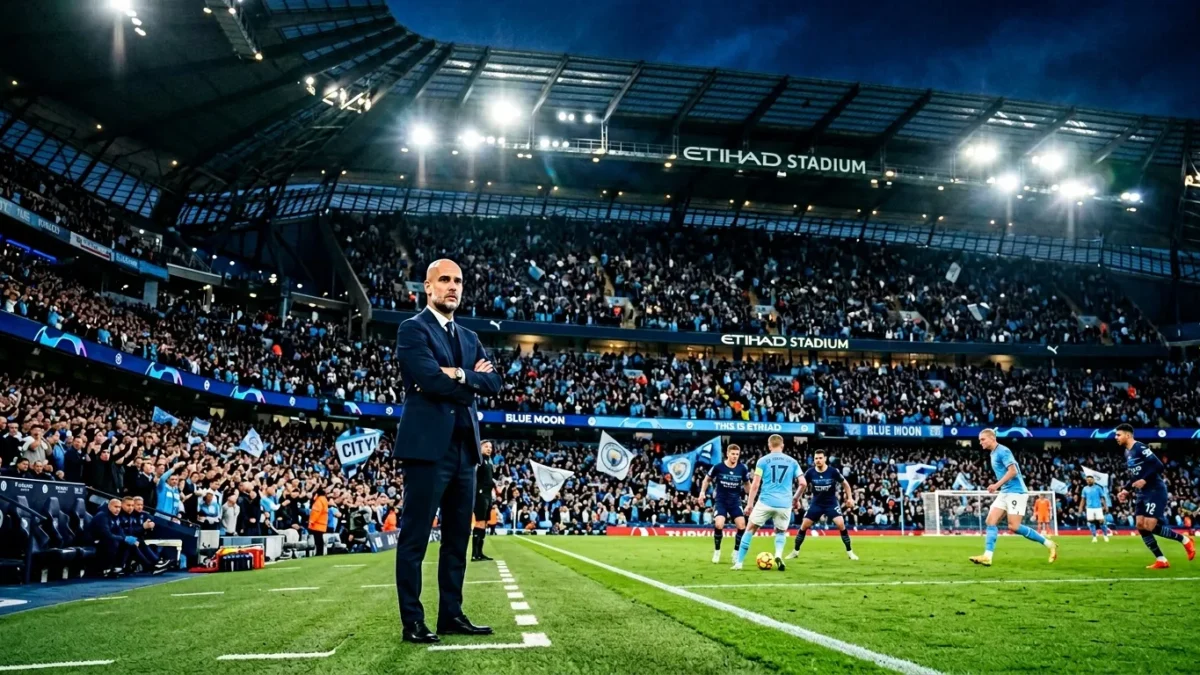
Manchester City are staring down a brutal fixture congestion in May — three games in seven days, extensive travel, and a domestic treble still on the line. The scheduling row behind it has been simmering for months, and City’s frustration is now fully out in the open.
A scheduling dispute months in the making
The core of City’s grievance isn’t just the congestion itself — it’s how long it took the Premier League to confirm the rescheduled fixture against Crystal Palace. City’s position is clear : the need to rearrange that match became obvious on 4 February, the night they beat Newcastle to secure their place in the Carabao Cup final. From that moment, the clock was ticking. Yet nearly three months passed before any official decision landed.
The Premier League, for its part, chose to wait until after the FA Cup semi-finals before making the announcement — the reasoning being that supporters deserved more certainty before dates were locked in. Reasonable in principle, perhaps. But from City’s perspective, that patience came entirely at their expense.
City hadn’t been sitting idle during that wait. They put forward three separate alternative windows for the Palace match : the weeks starting 20 April, 27 April, and 4 May. None of them stuck. The first was taken up by the rescheduled Burnley fixture. The other two were ruled out because Oliver Glasner’s Crystal Palace side were still involved in the UEFA Europa Conference League, which blocked midweek availability.
That’s the scheduling puzzle in a nutshell — every option City proposed ran into a wall, and the solution they eventually got left them with arguably the worst possible outcome.
The UEFA constraint and a telling double standard
There’s another layer to this that City have flagged, and frankly it deserves scrutiny. UEFA have made clear they don’t want any Premier League fixtures to clash with the Europa League final on Wednesday, 21 May — which is why City’s match against Bournemouth has been moved to the day before, Tuesday, 20 May. Fair enough on the surface.
| Fixture | Date | Context |
|---|---|---|
| Man City vs Bournemouth | Tuesday, 20 May | Moved to avoid Europa League final clash |
| Crystal Palace vs Brentford | Sunday, 17 May | FA Cup final takes place on Saturday, 16 May |
| Man City vs Crystal Palace | TBC — late May window | Rescheduled after Carabao Cup final confirmed |
Yet City point to a precedent that cuts through the UEFA argument. Arsenal were granted permission to play their league match at Wolves on 18 February — a night when four Champions League knockout ties were simultaneously taking place. If that was acceptable, the consistency of applying a stricter rule to City’s situation feels, at best, selective.
City had actually proposed a scenario where they’d face Bournemouth on 12 May and play Palace sometime the following week. That arrangement would have given them an extra day of recovery before the Wembley showpiece and allowed them to play their final two home league matches in a more manageable sequence. It was rejected.
Why the Palace date never had a realistic chance
City’s preferred slot for the Palace game was Tuesday, 19 May. On paper, it fits. In reality, it was never going to happen — and here’s why :
- The FA Cup final takes place on Saturday, 16 May.
- Crystal Palace’s fixture against Brentford is locked in for Sunday, 17 May — the earliest slot available given the Cup final the previous day.
- Asking Palace to play again on Tuesday, 19 May would mean back-to-back matches within 48 hours, with other viable scheduling options still on the table.
- No realistic governing body would impose that on a club when alternatives exist.
So City’s Tuesday 19 May proposal, whatever the internal logic behind it, didn’t fully account for Palace’s own fixture constraints. The Premier League also referenced a principle stating that all FA Cup semi-finalists should play in the first available midweek before those matches — yet City’s Bournemouth game has been slotted into the week after, not before, those semi-finals. That inconsistency is another sticking point.
What this fixture pile-up actually means for City’s treble bid
Strip away the procedural arguments and the core issue is simple : second-placed City now face three matches in seven days during the most decisive stretch of their season, with significant travel demands on top of it. They’re chasing a domestic treble — Premier League, FA Cup, Carabao Cup — and this schedule hands them the most gruelling run-in of any title contender.
For context, squad depth becomes everything in these situations. Pep Guardiola has historically rotated effectively under fixture pressure, but three high-stakes games in a week — with Wembley in the mix — tests even the deepest squads. Injuries, fatigue, and form all compress into one brutal window.
The Premier League’s scheduling rules may have been followed to the letter. City’s frustration, though, goes beyond rule-checking — it’s about whether the spirit of those rules, particularly the principle of rescheduling at the earliest opportunity, was genuinely applied here. Almost three months between the trigger event and the confirmed decision is a long time to wait when a title race and a cup run hang in the balance. Whether the outcome was avoidable or not, City head into May carrying that grievance alongside an already punishing schedule.
