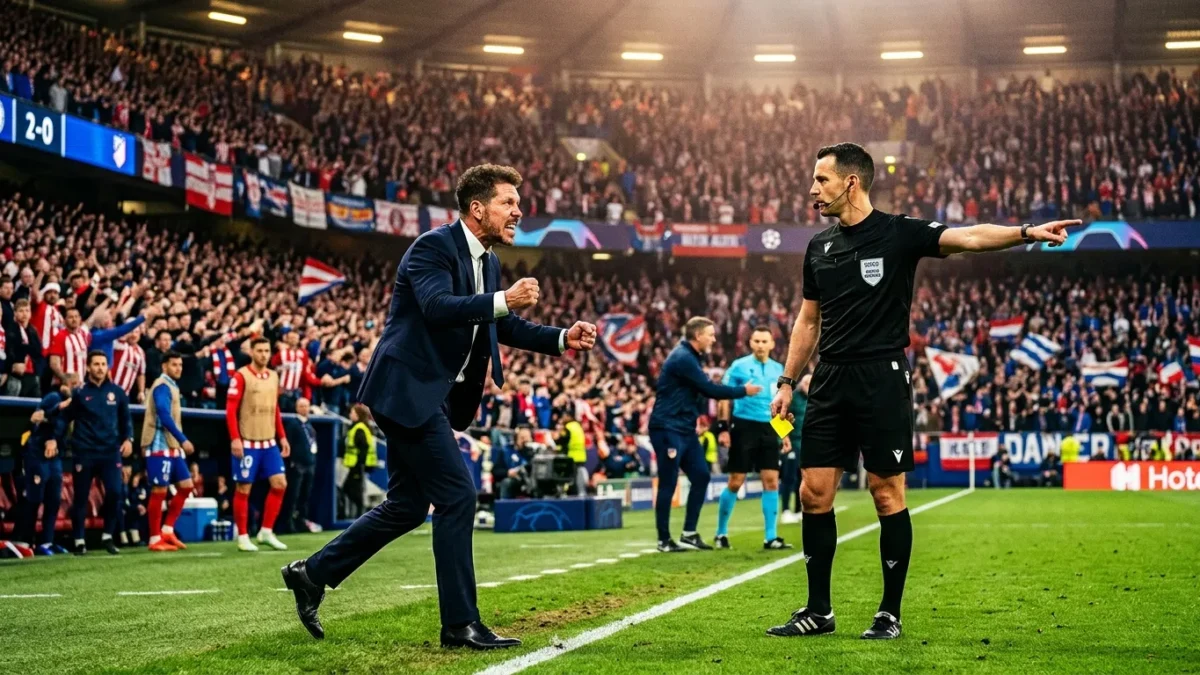
Three penalties, one overturned decision, and a manager who didn’t bother hiding his anger. The first leg of Arsenal’s Champions League semi-final at Atletico Madrid ended 1-1 on Wednesday evening, but the scoreline barely scratches the surface of what unfolded at the Metropolitano.
A night defined by referees, not players
Just 24 hours after PSG and Bayern Munich delivered a goals fest in Paris, the second semi-final took a very different shape. The officials became the story — and not in a way anyone connected to Arsenal will remember fondly.
Viktor Gyokeres broke the deadlock before half-time, converting from the spot after being brought down in the box. Arsenal were ahead and looking composed. Then came the handball decision against Ben White, and everything shifted. Referee Danny Makkelie pointed to the spot, Julian Álvarez stepped up and levelled for Atletico. A debatable call — but not the most controversial of the night.
That came late on. Makkelie initially awarded Arsenal a penalty when David Hancko caught Eberechi Eze‘s boot after Eze had already played the ball. VAR intervened, sent Makkelie to the monitor, and the decision was reversed. Mikel Arteta was, by his own description, incredibly fuming.
“There is no clear and obvious error,” Arteta said post-match. “And this changes the course of the game. At this level, I’m sorry, but this cannot happen.” When pushed on whether he received an explanation, he added : “A referee has to watch it 13 times — what’s more clear than that ? It’s impossible.”
Frankly, Arteta has a point. The VAR protocol for overturning an on-field decision requires a clear and obvious error. Hancko did catch Eze’s boot. Soft ? Sure. But the standard for intervention was not met. BBC Sport’s discussions with a senior figure in UEFA’s refereeing body after Arsenal’s last-16 tie against Bayer Leverkusen are telling here : in the Noni Madueke incident, where contact was similarly slight — Malik Tillman landing on Madueke’s boot — UEFA confirmed the VAR had no grounds to intervene. If that logic holds, the Eze call should never have been overturned.
The Premier League operates the same way. This penalty would have stood in an English domestic game, no question.
Was Ben White’s handball really a penalty ?
Two consecutive Champions League nights, two handball controversies. On Tuesday, Alphonso Davies conceded a spot-kick for Bayern Munich against PSG. On Wednesday, White found himself in the spotlight. The situations share a surface similarity — deflection off the body before the ball hits the arm — but the details matter enormously.
Here’s how UEFA and the Premier League differ on handball rulings :
| Scenario | UEFA ruling | Premier League ruling |
|---|---|---|
| Ball deflects off body onto arm close to body | Generally no penalty | Generally no penalty |
| Arm moves away from body before contact | Penalty expected | Borderline |
| Clear change of ball trajectory from arm | Key factor | Key factor |
| Deflection off shin before handball | Less relevant if arm is extended | Can reduce likelihood of penalty |
White’s arm started a long way out from his body and moved inward to make contact with the ball. Under UEFA’s framework, that’s a straightforward penalty. The ball deflecting off his shin before reaching his arm adds a layer of nuance in the Premier League context, but in Europe, the position of the arm is the determining factor. Álvarez’s goal was legitimate by UEFA standards — borderline for the Premier League, clear-cut in this competition.
Former Liverpool captain Steven Gerrard, speaking on TNT Sports, suggested referees were influenced by the Davies decision the previous evening : “They saw the handball by Alphonso Davies and thought they needed to follow suit — even if White was trying to move his arm out of the way.” Stephen Warnock, another ex-Liverpool defender and Match of the Day pundit, agreed the call would almost certainly not have been made in England : “I just don’t think it gets given in the Premier League.”
What Arsenal take back to Emirates Stadium
A 1-1 draw away from home in a Champions League semi-final is, on paper, a decent result. Arsenal remain in control of their own destiny ahead of the second leg at Emirates Stadium. But the manner of the draw will linger.
Nedum Onuoha, appearing on Match of the Day, acknowledged the ambiguity of the evening : “You could argue that all three penalties, if given, were quite soft. Some people will believe he was always going to overturn it at the monitor — but we’ve seen referees go the other way.” His point is fair. Makkelie had every right to confirm his original call. He didn’t.
Three decisions shaped this match. Consider what each one produced :
- Gyokeres penalty (Arsenal) : converted, Arsenal lead 1-0
- White handball penalty (Atletico) : converted by Álvarez, game level at 1-1
- Hancko foul on Eze (Arsenal) : awarded, then overturned by VAR — no goal
Had that third penalty stood, Arsenal would travel back to north London with a 2-1 advantage. Instead, it’s level. The Emirates second leg now carries full weight — and Arteta’s frustration, however justified, will need to be channelled into that match rather than debating decisions that won’t be reversed.
One thing worth watching : how UEFA’s refereeing body responds to this publicly. After the Leverkusen incident earlier this season, UEFA officials were willing to discuss their logic openly. If their own standards weren’t applied consistently on Wednesday, that conversation needs to happen again — and quickly, before the second leg changes everything.
