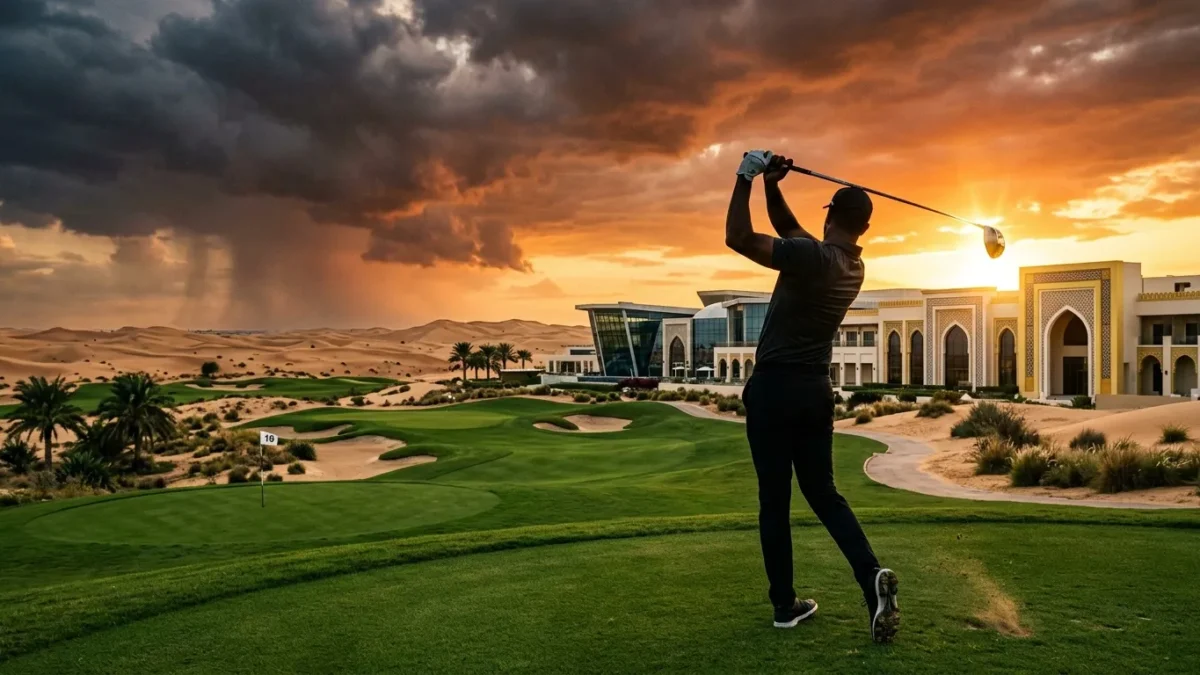
LIV Golf has burned through billions of pounds since its 2022 launch, and the question is no longer whether Saudi Arabia’s sports revolution is stalling — it’s how far the retreat will go. The Public Investment Fund (PIF) built its reputation on audacious bets : buying Newcastle United, flooding golf with petrodollars, luring boxing’s biggest names to the desert. Now, with the 2034 FIFA World Cup looming and geopolitical pressures mounting, those bets are being reassessed with brutal pragmatism.
PIF’s strategy shift : from prestige to purpose
The writing was on the wall for LIV Golf long before the official signals emerged. PIF was never a bottomless pit of money — it’s a sovereign wealth fund designed to generate returns and improve Saudi citizens’ quality of life. Pouring cash into a golf circuit that struggled to build a genuine global audience ran directly against that core mandate.
Dr Johan Rewilak, a sport management expert at Loughborough University, frames it clearly : hosting a World Cup carries enormous infrastructure and delivery costs, and with 2034 just eight years away, capital reallocation isn’t a surprise — it’s a necessity. Rising construction bills and regional security pressures are accelerating that shift, pushing spending away from prestige sports assets toward roads, stadiums and essential facilities.
So what does PIF actually prioritise now ? According to sources with direct knowledge of the fund’s direction, the criteria have tightened considerably :
- Sports with an existing Saudi fan base (combat sports being the prime example)
- Disciplines where Saudi athletes can realistically break through at international level
- Investment models focused on talent pathways rather than spectacle imports
- Events aligned with the country’s youth demographic, which skews heavily toward esports and action sports
That last point matters more than most analysts acknowledge. Saudi Arabia has one of the youngest populations in the region, and spending on golf — a sport with negligible local participation — was always a tough sell internally. The pivot toward combat sports, esports and cricket reflects a sharper understanding of what actually resonates domestically.
Sports that survive the Saudi spending reset
Not every sport is facing the same headwinds. Boxing, for one, is doubling down. Saudi boxing chief Turki Alalshikh flatly dismissed slowdown rumours in 2025, calling reports of reduced spending “100% not true.” The proof comes in July, when Riyadh hosts Anthony Joshua’s heavyweight bout against Kristian Prenga — a card that will draw global pay-per-view attention.
Esports sits alongside boxing as a clear winner. The Esports World Cup, also scheduled for July in Riyadh, confirms that digital competition remains a strategic pillar. With Saudi youth spending more time gaming than watching golf, the alignment is obvious.
| Sport | Status under new PIF strategy | Key upcoming event |
|---|---|---|
| Boxing | Maintained / expanding | Joshua vs Prenga, July 2026 (Riyadh) |
| Esports | Maintained / expanding | Esports World Cup, July 2026 |
| Cricket (T20) | Exploring global competition format | Women’s tournament postponed (Iran conflict) |
| Football | Core priority (2034 World Cup) | AFC Asian Cup 2027 |
| Formula 1 | Infrastructure investment ongoing | New Riyadh circuit under construction |
| LIV Golf | Deprioritised | — |
Cricket tells a more complicated story. Saudi Arabia is reportedly exploring a global T20 competition, an ambitious move given the sport’s massive following across South Asia and the diaspora. However, a women’s tournament planned for 2026 has already been shelved because of the ongoing conflict in Iran — a sharp reminder that geopolitics can derail sporting ambitions overnight.
Football remains the undisputed spine of the entire strategy. Hosting the 2027 AFC Asian Cup serves as a dry run before the World Cup machine kicks into full gear. A brand-new Formula 1 circuit near Riyadh adds another layer to the motorsport calendar, signalling that infrastructure investment hasn’t stopped — it’s simply being redirected.
Newcastle United, LIV Golf and the limits of Saudi patronage
Newcastle United fans have watched the LIV saga with understandable anxiety. If PIF can walk away from a multi-billion-dollar golf experiment, what guarantees their club’s future ? The BBC has reported that PIF’s long-term commitment to Newcastle United remains unchanged, with a major capital injection set to be confirmed imminently. That’s welcome news — but the relief itself reveals something important.
Franchement, the LIV Golf collapse is a lesson every sports entity relying on Saudi money should study carefully. Nothing in this ecosystem is structurally guaranteed. LIV wasn’t abandoned because it failed commercially in the traditional sense — it was abandoned because priorities changed and the cost-benefit calculus shifted. That can happen to any property.
The fund’s selective approach going forward means that sports organisations courting Saudi investment need to demonstrate two things : genuine alignment with local culture and a credible path to self-sustainability. Turning up with a famous name and a sponsorship deck is no longer enough.
For LIV specifically, the collapse of its merger talks with the PGA Tour — which dragged on through 2024 and 2025 without resolution — left the circuit stranded between two worlds. Without PIF’s unconditional backing, LIV’s operating model simply doesn’t hold together. That’s the uncomfortable truth the golf world must now sit with.
The broader Saudi sports revolution isn’t unravelling. It’s recalibrating — and the distinction matters. What’s ending is the era of spending without a clear return thesis. What’s beginning looks more disciplined, more domestically rooted, and frankly more sustainable. Whether that tighter framework can still produce world-class sporting moments remains the open question worth watching through 2026 and beyond.
