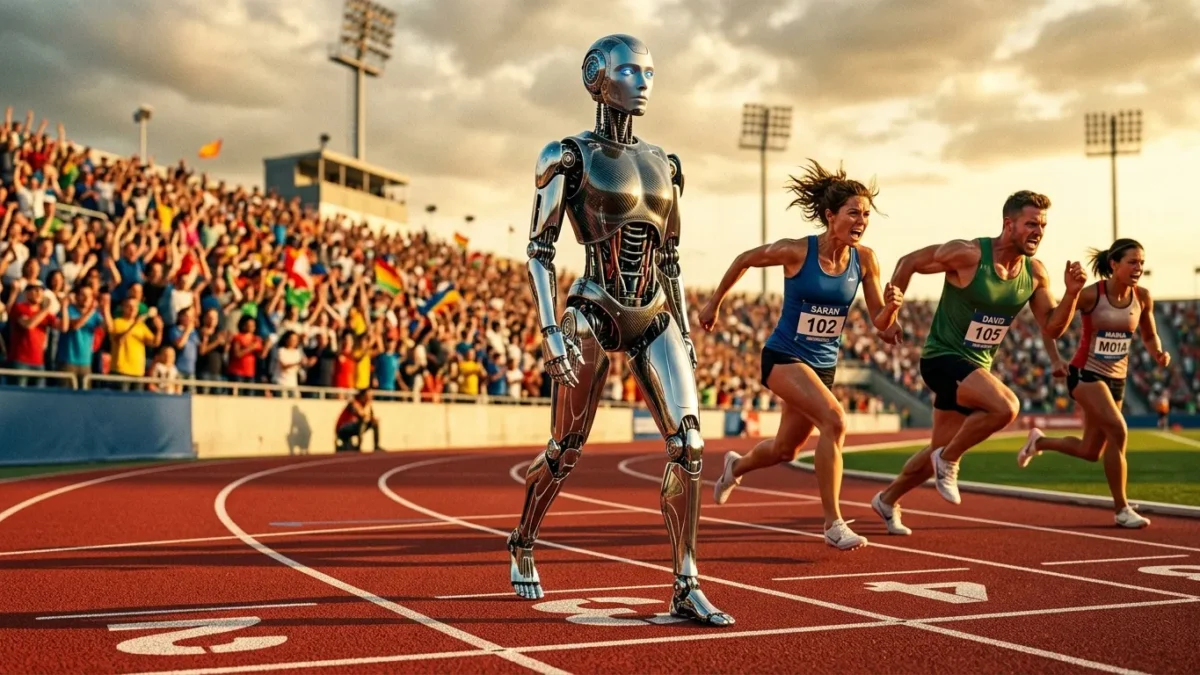
In April 2026, a 7-foot-2 robot wearing a basketball team’s jersey missed a free throw — and briefly looked devastated about it. Head down, wheels rolling away from the basket : the reaction was uncannily human. Except, of course, it felt absolutely nothing. That robot is CUE7, built by Toyota for Alvark Tokyo, and its half-time exhibition sparked a debate that goes far beyond basketball courts or engineering labs.
What robot athletes can actually do today
The pace of progress is genuinely startling. Three distinct sporting disciplines have seen robotic competitors make headlines in just the past few months, and each one forces a different question about the future of athletic competition.
Take the Beijing half-marathon held last month. Humanoid robots ran alongside human competitors — in separate lanes, yes, but on the same course. A robot named Lightning, manufactured by smartphone brand Honor, clocked a time nearly seven minutes faster than the half-marathon world record of 57 :20 set by Jacob Kiplimo in Lisbon in March 2026. One year earlier, in 2025, most robotic entrants couldn’t even clear the start line. That kind of leap in twelve months is not incremental — it’s a rupture.
Meanwhile, Sony AI released footage of their table tennis robot, Ace, winning three out of five matches against elite-level human players. Ace is not built for spectacle : it’s essentially a robotic arm on a wheeled platform, more factory floor than sports hall. But the results are undeniable. Then there’s CUE7 itself — visually the most polished of the bunch, fitted with a LeBron James-style headband and beard, cameras styled as a single cyclops eye, and metallic limbs that catch the light like an athlete mid-sweat. Watching it line up at the foul line, you feel anticipation. That’s the design working on you.
| Robot | Sport | Creator | Notable performance |
|---|---|---|---|
| CUE7 | Basketball | Toyota | 2,020 consecutive free throws (CUE3, 2019) |
| Lightning | Half-marathon | Honor | Sub-world-record half-marathon time |
| Ace | Table tennis | Sony AI | 3/5 wins vs elite human players |
| Tiangong | Half-marathon | Undisclosed | Finished 2025 race in 2hr 40min (3 battery swaps) |
The breadth of robotic sport is wider than most people realise. Beyond basketball, running and table tennis, machines are now being trained in badminton, archery, pool, parkour, skiing and even martial arts. There is reportedly a Tesla robot that practices yoga — though what it derives from the experience remains genuinely unclear.
Why machines training humans matters more than machines beating them
Here’s the thing most coverage gets wrong : the point of sporting robots was never competition. Peter Stone, chief scientist at Sony AI and a former president of RoboCup, has said plainly that after the initial buzz of robots matching or surpassing human athletes, public interest “tends to get less interesting.” He’s right, and frankly, that framing misses what’s actually valuable here.
The real application is training and performance development. Bowling machines in cricket have been faster and more consistent than any human bowler for decades — nobody suggests replacing a paceman with one in a Test match. The value lies in the repetition, the precision, the data. Ace already demonstrated this clearly : a former Olympian watching the Sony footage spotted a table tennis shot he had previously believed physically impossible for a human to play. That single observation could reshape training methodology for an entire generation of players.
Chess offers the clearest historical precedent. Deep Blue beat Garry Kasparov exactly thirty years ago, in 1996. Rather than destroying chess, that defeat launched a new era where AI became the sport’s most effective coaching tool. The parallel for physical sports is obvious — and already underway.
- Repetition without fatigue : robots can simulate opponent patterns for hours without degrading quality
- Data-rich feedback : every movement generates exploitable performance metrics
- Psychological pressure training : practicing against a machine removes social anxiety from skill acquisition
- Injury risk reduction : contact sport drills can be simulated without putting human partners at risk
RoboCup — the annual football tournament celebrating its 30th anniversary this year — has an audacious stated goal : fielding a robot team capable of beating the FIFA World Cup winners by 2050. Last year’s final featured half-height humanoids shuffling around a pitch at walking pace and occasionally falling over. Ambitious doesn’t begin to cover it. But whether that target is ever reached is almost beside the point : the technology developed along the way already benefits search-and-rescue operations, logistics automation, and medical robotics.
The philosophical gap that no algorithm can close
Sport, at its core, is a story about vulnerability. The missed shot hurts because something was at stake — reputation, momentum, pride. CUE7’s older sibling, CUE3, set a world record in 2019 by sinking 2,020 consecutive free throws over six and a half hours. Perfect. Flawless. Also, profoundly boring. Perfection without risk isn’t athletic achievement — it’s a stress test.
This is the philosophical gap that robotic competitors cannot cross. Human sport exists because bodies fail, nerves interfere, and pressure distorts judgment. A machine experiences none of that. Watching two robots exchange table tennis shots or race a half-marathon generates curiosity, not tension. Tension requires the possibility of suffering — and suffering requires something to lose.
What CUE7’s April miss accidentally demonstrated is the one thing that makes sport worth watching : the moment of genuine uncertainty. Not because the robot felt doubt, but because we projected it onto the machine. That projection — that instinctive anthropomorphism — is precisely what robotic athletes cannot earn on their own. It has to be borrowed from us. And maybe that’s the most revealing thing about where this technology is heading : the emotional stakes will always belong to the humans in the room, never to the machines on the court.
