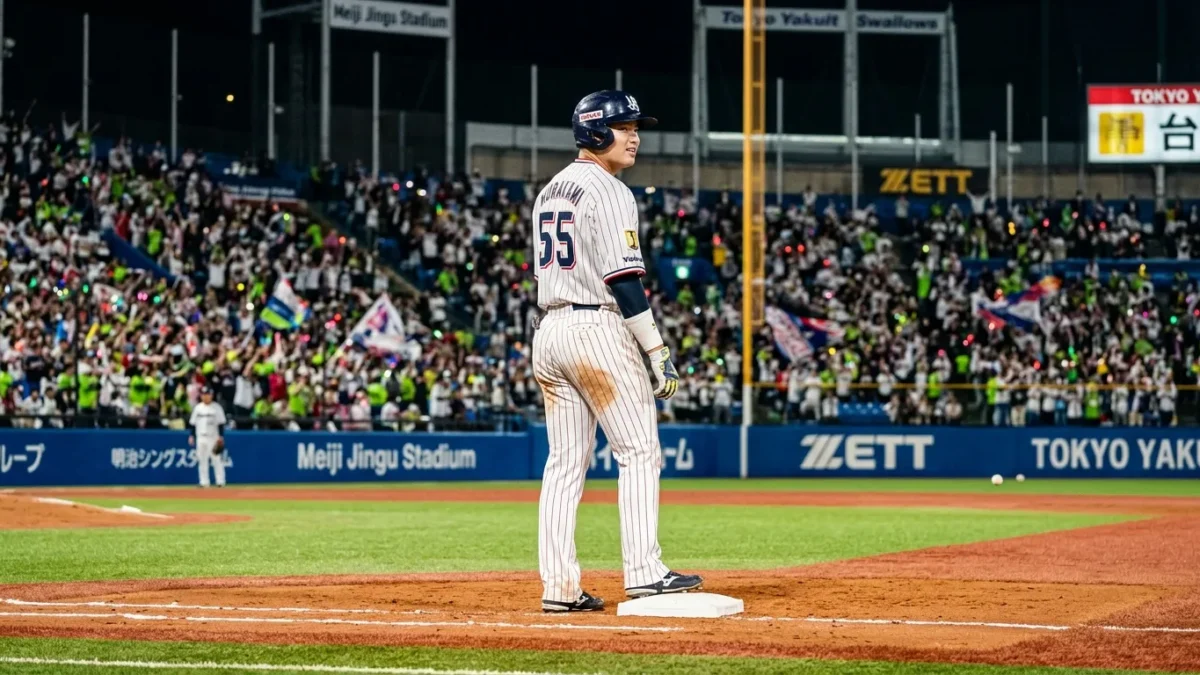
Thirty-five games into his MLB career, Munetaka Murakami has already forced every front office in baseball to seriously question their judgment. The Chicago White Sox rookie arrived this offseason with skeptics lining up — doubts about his contact ability, concerns about handling high-velocity pitching — and signed for just two years and $34 million, a figure that now looks almost embarrassingly low.
A record-breaking start nobody saw coming
When Murakami left Nippon Professional Baseball to test the MLB market, scouts acknowledged his power and his exceptional eye at the plate. Still, the consensus leaned heavily on his perceived weaknesses : could he make enough contact ? Would big-league fastballs expose him ? Those questions pushed teams away, including the Los Angeles Dodgers, and pushed his market value down sharply.
Fast-forward to early May 2026, and the answer is staring everyone in the face. Tied for the MLB lead with 14 home runs and tied for the American League lead with 28 RBI through 35 games, Murakami hasn’t just held his own — he’s dominated. What makes those numbers genuinely extraordinary, though, is how he got there.
Entering Monday’s game against the Los Angeles Angels, every extra-base hit Murakami had recorded in his MLB career was a home run. Not a single double. Not a triple. Just 14 consecutive home runs as his only extra-base production — the longest such streak to open a career since at least 1900, according to MLB researcher Sarah Langs. That kind of historical oddity doesn’t happen by accident; it reflects both his elite power and the peculiar contact profile critics had flagged before he crossed the Pacific.
Against Angels starter Jose Soriano in the fourth inning, Murakami extended that streak further, launching a high fastball deep into center field for home run number 14. Pure authority. The ball left the bat the way it tends to leave his bat — with no argument.
The double that ended the streak — and what Murakami’s numbers really tell us
Then came the sixth inning. Off reliever Mitch Farris, Murakami laced a double, and just like that, the streak was over. His first career extra-base hit that wasn’t a home run. It felt almost anticlimactic — a routine double — but in reality, it rounded out one of the more bizarre stat lines any rookie has ever produced.
Here’s how his hit distribution breaks down across his first 35 MLB games :
| Hit type | Count |
|---|---|
| Singles | 15 |
| Doubles | 1 |
| Home runs | 14 |
| Total hits | 30 |
Add 28 walks to that picture, and Murakami’s slash line sits at .240/.377/.584 — numbers that draw immediate comparisons to Kyle Schwarber. That was, frankly, the best-case scenario anyone dared project for him before the season. He’s meeting it head-on.
His contact rate and strikeout numbers remain high, and that part of the scouting report holds true. But the fear about high-velocity pitching ? Completely dismantled. Murakami is the only MLB player this season to homer off multiple pitches exceeding 98.1 mph, per Sarah Langs. Against fastballs overall, he’s hitting .270 with a staggering .714 slugging percentage. Critics said hard throwers would neutralize him. The data disagrees, loudly.
What Murakami means for the White Sox’s unexpected run
Chicago’s rebuild has been painful. Fans know this well — years of losing, roster teardowns, and a fan base testing its patience. So when the White Sox signed Murakami at a below-market rate, expectations were carefully managed. Nobody predicted he’d carry the offense.
Yet here we are. Following Monday’s 6-0 victory over the Angels, Chicago sits at 17-18 — just half a game behind the AL Central division leader. For a team that entered 2026 projected near the bottom of the standings, that’s not a minor surprise. That’s a legitimate shake-up.
Several factors explain why this is working beyond just Murakami’s bat :
- His plate discipline forces pitchers to work deep into counts, wearing down starters faster
- His power threat opens gaps for teammates lower in the lineup
- His adaptability suggests the adjustments he made from NPB to MLB were deeper than surface-level mechanical tweaks
The real test, of course, is coming. Pitchers will refine their game plans. Scouting reports will thicken. The league will make adjustments — it always does. Whether Murakami can counter-adjust is the defining question of his rookie season.
For me, though, the evidence already points somewhere interesting. Most players who struggle with contact at this level don’t suddenly develop elite plate discipline overnight — that skill travels. Murakami brought it from Japan, and it’s protecting him even when his swing-and-miss tendencies flare up. A slump may come. Baseball is baseball. But the underlying quality is real, and the White Sox — whether by design or fortunate accident — landed a player who could anchor their lineup for years beyond this $34 million deal. Twenty-nine other franchises will be watching that contract figure with growing discomfort as the season unfolds.
