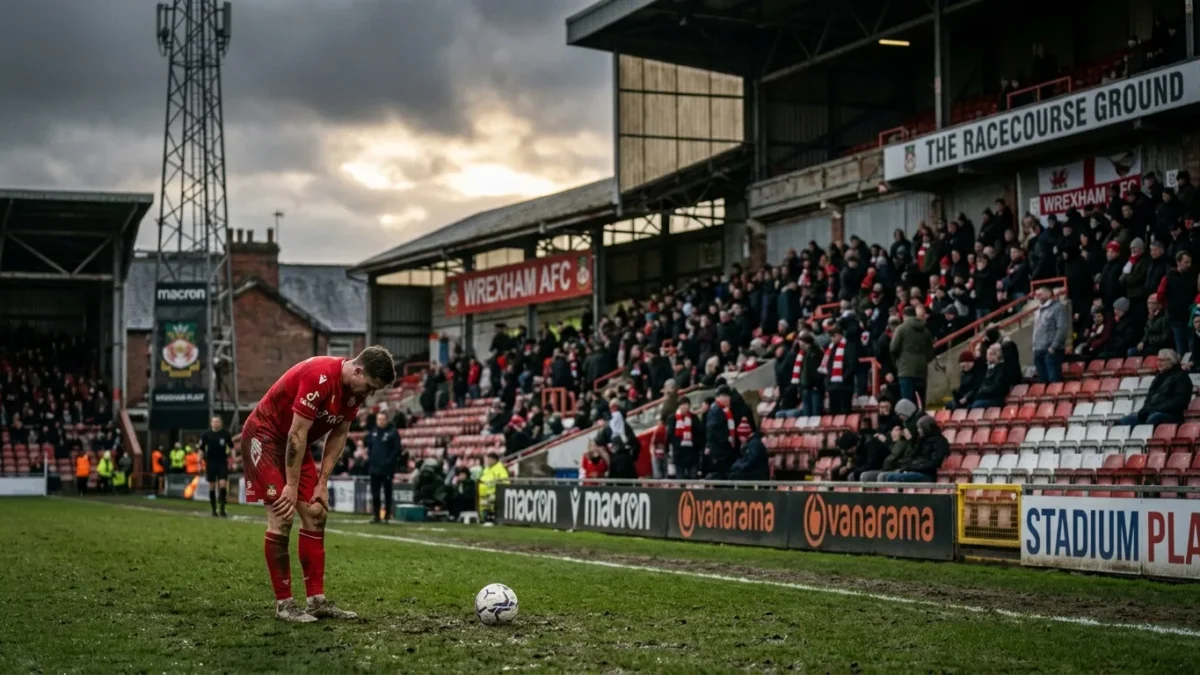
Seventh place in the Championship. For a club that spent decades in non-league football, that sentence alone should feel extraordinary. Yet after Wrexham’s final-day defeat to Middlesbrough at Stok Cae Ras, the overriding emotion wasn’t celebration — it was the sharp sting of what might have been. Hull City edged them out of the play-off spots on goal difference, and a fourth consecutive promotion slipped away in the cruellest possible fashion.
Co-chairman Ryan Reynolds captured the mood honestly : “I am completely gutted by today’s result but incredibly proud of our season. We’ve come a long way in five years.” Director Shaun Harvey framed it differently, describing the campaign as one of nearly making it rather than simply missing out. Both readings are valid. Both also leave the same questions hanging.
The injury toll that derailed Wrexham’s promotion push
No honest post-mortem of this Wrexham season can avoid the injury crisis that tore through Phil Parkinson’s squad. It wasn’t one or two absences — it was relentless and, at times, almost farcical in its timing.
Matty James missed two months with a toe injury. His central midfield partner Ben Sheaf was out for even longer. George Dobson served a three-game ban. From the very start of the campaign, Ollie Rathbone, Jay Rodriguez and Andy Cannon were all working their way back from long-term problems. The engine room of the team never had a full complement of parts.
The wing-back positions, so crucial in previous promotion seasons, were similarly ravaged. Liberato Cacace — earmarked as a first-choice option — started just eight Championship matches all season. Issa Kabore also missed significant chunks of the campaign. George Thomason, a midfielder by trade, found himself covering those wide defensive roles for extended periods in his debut Championship season.
Kieffer Moore’s story is perhaps the most telling. He was outstanding in the first half of the season, scoring 12 goals across all competitions up to and including a 5-3 win over Sheffield United on 26 December. Then two separate hamstring injuries effectively ended his threat : just one goal in his next 19 appearances. Goalkeeper Danny Ward sustained an elbow injury in only his fourth appearance of the season, adding yet another name to an ever-growing list.
Injuries hit every club. But the sheer volume and timing of Wrexham’s problems meant Parkinson was regularly patching gaps rather than picking his best side.
Where the points went — and what the January window failed to deliver
Beyond the injury list, specific results stand out as moments where the promotion dream quietly unravelled. Three matches after the March international break produced just one point. Hull City — the side that ultimately pipped Wrexham to sixth — were faced twice in the league, and Wrexham were below their best on both occasions. A draw conceded in the 90th minute against relegated Leicester City at home will stay long in the memory.
Home games against Millwall and Norwich City felt like dropped opportunities. A Sheffield Wednesday side that won only two of their 46 league matches managed to take points at Stok Cae Ras. These are the margins that define promotion campaigns.
The January transfer window added another layer of frustration. Previous winters saw Wrexham use the market decisively — Sam Smith arrived in January 2025, Ollie Palmer three years before that, both bringing an immediate lift to the dressing room. This time, moves for Adam Armstrong, Sidiki Cherif and Terry Devlin all failed to materialise. The players who did arrive made minimal impact :
- Davis Keillor-Dunn (from Barnsley) : 81 league minutes after his arrival
- Bailey Cadamarteri (from Sheffield Wednesday) : just 27 minutes of league action
- Zak Vyner (from Bristol City) : arrived injured, deployed out of position in midfield, then missed the final five games with a groin problem
The squad streamlining that dominated the winter window made sense logistically. But the absence of that January freshness the players themselves have spoken about in previous seasons was a tangible loss when the final stretch arrived.
What next season’s Championship looks like — and why Wrexham must raise their ceiling
Finishing seventh would feel different in 2026-27. The play-off system has expanded from four clubs to six, meaning that exact position will now earn a shot at promotion. It’s a structural change worth noting, though it’s small comfort right now.
The more pressing concern is who will be competing next season. Wolverhampton Wanderers, relegated from the Premier League, have been building toward a return under Rob Edwards since November. Burnley — linked with Wales manager Craig Bellamy — know the Championship route well. And Tottenham Hotspur, West Ham United and Nottingham Forest all face potential relegation from the top flight, bringing Premier League parachute payments with them.
| Potential new rivals | Parachute payments | Recent top-flight experience |
|---|---|---|
| Wolverhampton Wanderers | Yes | 2024-25 Premier League |
| Burnley | Potentially | Recent yo-yo club |
| Nottingham Forest / Spurs / West Ham | Yes (if relegated) | Current Premier League |
Wrexham’s hierarchy knew last summer that fewer clubs were receiving parachute payments that season — one reason ambitions were allowed to grow. That calculation shifts dramatically next year.
The club has talked publicly about three transfer windows as the benchmark for rebuilding a squad to Championship standard. Having already targeted top-half Championship players, falling short suggests the next step may require investment at a higher level — and a higher cost. New financial backing, stadium upgrades and three further years of their global documentary series give Wrexham genuine commercial power that few clubs at this level possess. The notion that the Hollywood ownership will lose interest looks increasingly thin. The infrastructure is there. The direction is clear. The question is simply how much higher they’re willing to reach.
