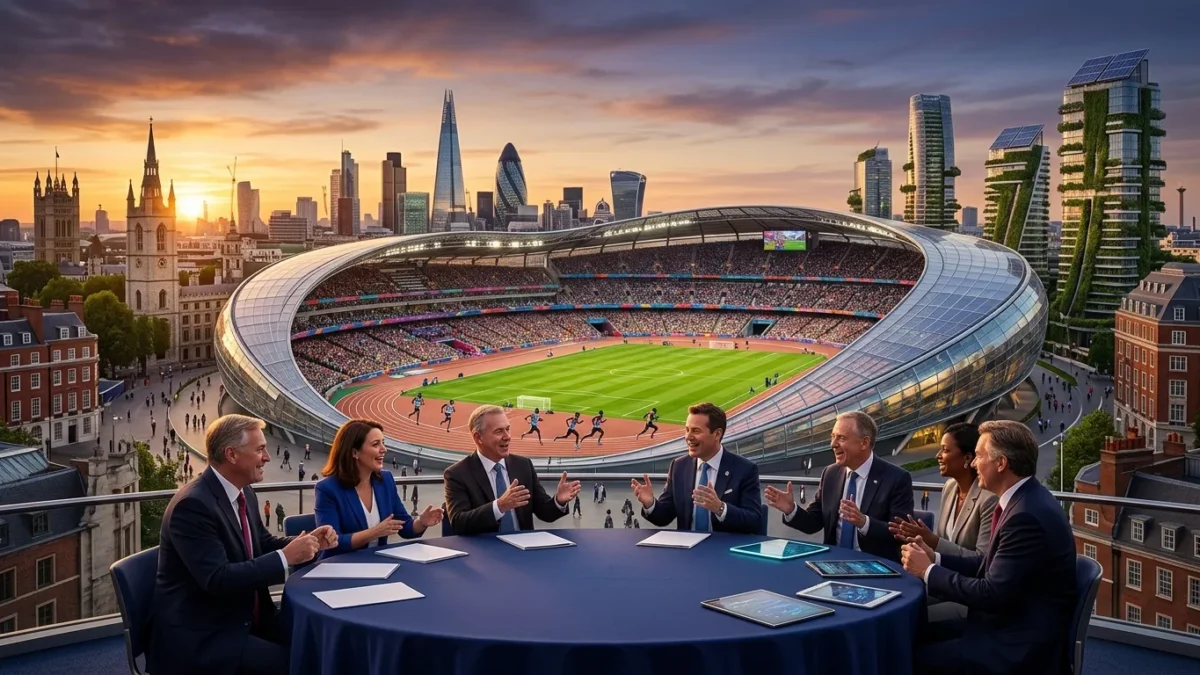
The UK hasn’t hosted the Olympic Games since London 2012 — and that gap may be about to close, at least on paper. The British government has officially confirmed it is engaged in discussions about supporting potential bids to host the Olympics and Paralympics in the 2040s. This isn’t wishful thinking from sports enthusiasts; it’s a formal policy process, with ministers instructing officials to assess potential costs, socio-economic benefits and realistic chances of success.
For context : Los Angeles hosts in 2028, Brisbane takes the baton in 2032, and the International Olympic Committee (IOC) hasn’t yet selected host cities for 2036 or beyond. That window is precisely where UK ambitions are being aimed.
A fourth Olympics on British soil : who’s pushing for it ?
The momentum behind this bid talk has been building for months. London mayor Sadiq Khan publicly declared last year his desire to see the capital bid for the 2040 Games. That wasn’t an isolated statement — it reflected a broader push across British politics and sport.
UK Sport’s funding chair went further in December, telling BBC Sport that a bid “has to be an aspiration”, while also floating the idea of a co-hosted Games between Liverpool and Manchester. That suggestion landed with real weight in the north of England, where political leaders moved quickly. In February, a cross-party group formally urged the government to anchor any future bid in the north, calling the case for it “compelling”.
Frankly, the northern England angle makes strategic sense. London has already had its moment — three times, in fact (1908, 1948 and 2012). Spreading Olympic infrastructure investment to cities like Manchester or Liverpool would align with ongoing regeneration goals and give the bid a stronger political narrative nationally.
Here’s a quick snapshot of the UK’s Olympic hosting history and the cities in the current conversation :
| Year | Host city | Status |
|---|---|---|
| 1908 | London | Hosted |
| 1948 | London | Hosted |
| 2012 | London | Hosted |
| 2040s | Manchester / Liverpool / London | Under discussion |
The government’s initial feasibility work will weigh all key variables before any formal bid moves forward. Nothing is guaranteed — but the political will is clearly present.
Golf’s major tournaments : Ryder Cup and Solheim Cup in the UK’s sights
The Olympics aren’t the only prize on the table. Ministers are also actively considering supporting bids for the Ryder Cup and Solheim Cup in the 2030s — two of golf’s most prestigious team competitions.
The Ryder Cup, held every two years, pits 24 of the world’s best players from Europe against their American counterparts in a three-day matchplay format. The last time it was staged on UK soil was 2014 at Gleneagles in Scotland. The Solheim Cup — the women’s equivalent, Europe versus the USA — was last held in the UK in 2019, also at Gleneagles.
Bolton is already making moves. The town is actively bidding to host the Ryder Cup in 2035, which would mark the first time in over 30 years that England stages the event. That’s a significant milestone, and one worth backing if the government’s support materialises.
For the Solheim Cup, England Golf pushed the government last year to underwrite a hosting bid — and notably, England has never hosted the Solheim Cup. There’s clear appetite from the sport’s governing bodies; what’s needed is political and financial commitment.
- Ryder Cup last UK edition : 2014, Gleneagles (Scotland)
- Solheim Cup last UK edition : 2019, Gleneagles (Scotland)
- Bolton’s Ryder Cup bid target year : 2035
- England Golf’s Solheim Cup ambition : first-ever England hosting
Tackling ticket touting : the government’s broader sporting events strategy
Behind the headline bids lies a structural shift in how the UK approaches major sporting events. The government has rolled out a new sporting events framework, and one of its sharpest edges is the plan to make unauthorised ticket resale a criminal offence for designated events.
Events like Euro 2028 — co-hosted by England, Scotland, Wales and the Republic of Ireland — would fall under this protection. The UK is also the sole bidder to host the 2035 Women’s World Cup. Making touts face criminal penalties isn’t just about fairness to fans; it also strengthens the UK’s pitch to international bodies when competing for event allocations.
It’s worth noting that in November, the government had already announced anti-touting legislation for sports tickets sold at inflated prices. The catch ? Football was excluded. That inconsistency drew criticism, and the new framework appears to address it more comprehensively — at least for the specific events explicitly covered.
For me, this is the piece most people overlook. Winning a hosting bid is only half the battle — delivering it safely, affordably and fairly for fans is what defines legacy. Criminalising resale for major events sends a clear signal that the UK is serious about the full package, not just the ribbon-cutting moments. If Britain genuinely wants to become the default destination for global sport in the 2030s and 2040s, the infrastructure around events — legal, logistical, financial — needs to match the ambition of the bids themselves.
