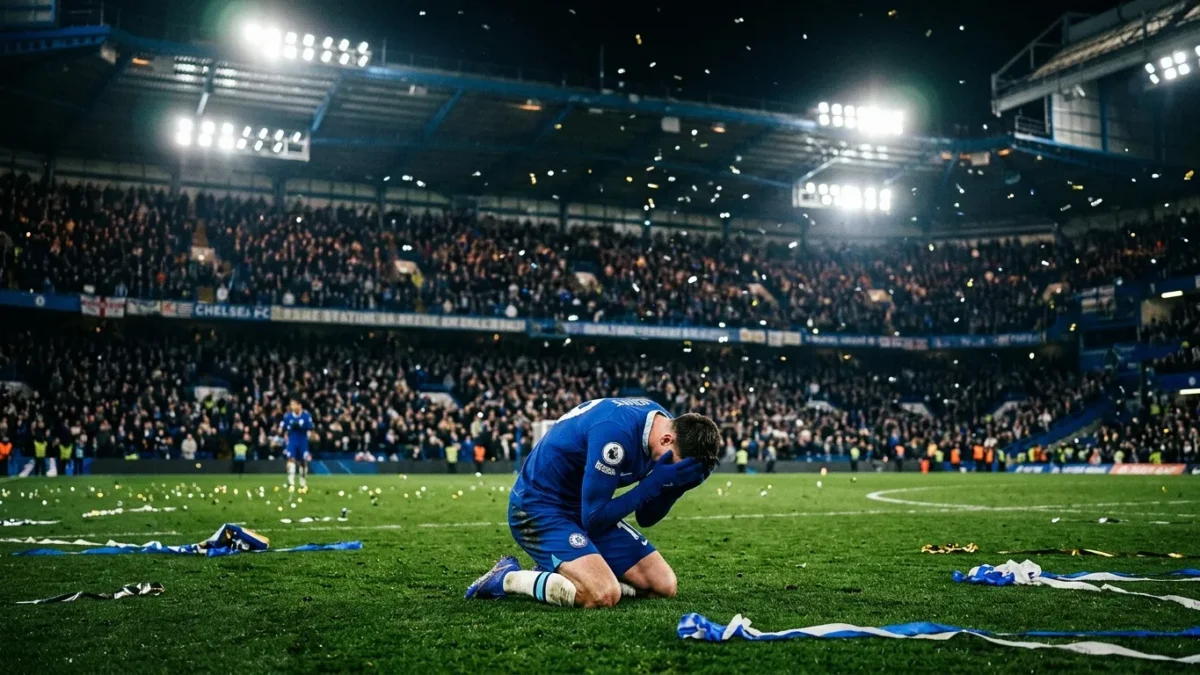
Missing out on the Champions League isn’t just a sporting disappointment for Chelsea — it’s a financial earthquake. With more than £1.5 billion spent on talent since Todd Boehly and Clearlake Capital took over, the club has yet to deliver the consistent Premier League success that ownership promised. The pressure is building, and the stands at Stamford Bridge are starting to reflect it.
A business model under serious strain
The chants say it all. “We don’t care about Clearlake, they don’t care about us, all we care about is Chelsea FC” — that line has become the soundtrack to a deeply unsettled season. The protest group Not A Project CFC has already organised demonstrations, with one planned on the steps of Wembley Way before the FA Cup final against Manchester City, and another inside Stamford Bridge itself, where supporters are urged to turn their backs in the 22nd minute of the final home match against Tottenham.
Some fans still chant the name of Roman Abramovich. Frankly, that’s nostalgia playing tricks. Towards the end of his reign, Chelsea were largely a cup team, trailing rivals on commercial revenues. The £490.9 million turnover recorded last season was the club’s second highest ever — yet it still fell well short of the other so-called ‘big six’ clubs. That gap doesn’t close on its own, and it certainly doesn’t close without European football at the top level.
The 22 Holdco business model — structuring long-term contracts for young players to generate transfer profits and avoid Bosman exits — was designed as a hedge fund-style strategy. As analyst Maguire noted, player sales have consistently generated more revenue than ticket sales over the past decade. The logic holds on paper. But the whole system depends on one critical variable : Champions League participation.
| Financial indicator | With Champions League | Without Champions League |
|---|---|---|
| UEFA prize money | €50–100m+ | €0 |
| Sponsorship value | Premium tier | Reduced leverage |
| Player recruitment appeal | Elite draw | Significantly weakened |
| Manager profile attraction | Top targets accessible | Limited pool |
Inside the club, debt is framed as part of a structured investment approach, common across elite sport, with sustainability built into the long-term plan. That may well be true. But the amortisation bill — spreading transfer fees across contracts of up to five years — currently exceeds £200 million, the highest in the Premier League. That’s not a footnote. That’s a flashing warning sign.
What Champions League absence actually costs Chelsea
Strip away the PR framing and the consequences of failing to qualify for Europe’s top competition are stark. Chelsea spent the most on agents’ fees last season, ranked third on both transfer spending and wages — despite overall outlay dropping from the unprecedented early BlueCo years. That spending level is unsustainable without the revenues that come with Champions League nights at Stamford Bridge.
Recruiting a high-profile manager becomes dramatically harder. Top-tier coaching candidates — the kind that transform clubs — want European football. Without it, Chelsea’s negotiating position weakens considerably. The same logic applies to players. While the club flatly denies any intention to sell stars like Cole Palmer, Moises Caicedo or Levi Colwill, the reality is that some player sales have always been necessary to balance the books, going back to the Abramovich era and continuing into the Boehly years.
- Loss of direct UEFA prize money, potentially €50–100 million per campaign
- Reduced commercial leverage with shirt sponsors and kit partners
- Weakened appeal to elite free agents and transfer targets
- Difficulty attracting ambitious coaching candidates
- Greater pressure on PSR compliance with no elite European income
What makes this moment particularly damaging is what the current ownership inherited and then surrendered. The Profit and Sustainability Rules position Chelsea held when Boehly’s consortium completed their takeover in May 2022 was genuinely strong. That PSR cushion has been eroded through relentless spending. More than £1.5 billion on talent, and the league title remains out of reach.
Rebuilding credibility without a blank cheque
Chelsea are reportedly looking to bring in experienced players at the end of the season. More sweeping structural changes, however, aren’t being discussed openly — mid-season upheaval has been deliberately avoided, particularly with an FA Cup final still on the calendar. That caution is understandable, but it can’t last forever.
Club sources have been clear on one point : accountability runs through every level of the organisation, enforced through annual reviews. No one is immune if performance falls short. That’s a significant statement, and it suggests that — regardless of what’s said publicly — some hard conversations are coming.
The priority now is getting back into the Champions League as quickly as possible. Every season outside that competition widens the revenue gap with rivals, weakens the squad-building strategy, and chips away at the credibility of a project that has already cost an extraordinary amount of money. For supporters singing those chants on the terraces, results on the pitch matter above all else. For Boehly and Clearlake, the clock on their long-term plan is ticking considerably louder than it was twelve months ago. Rebuilding trust with fans while also restoring financial health — without European football — is arguably the toughest challenge this ownership has faced since buying the club.
