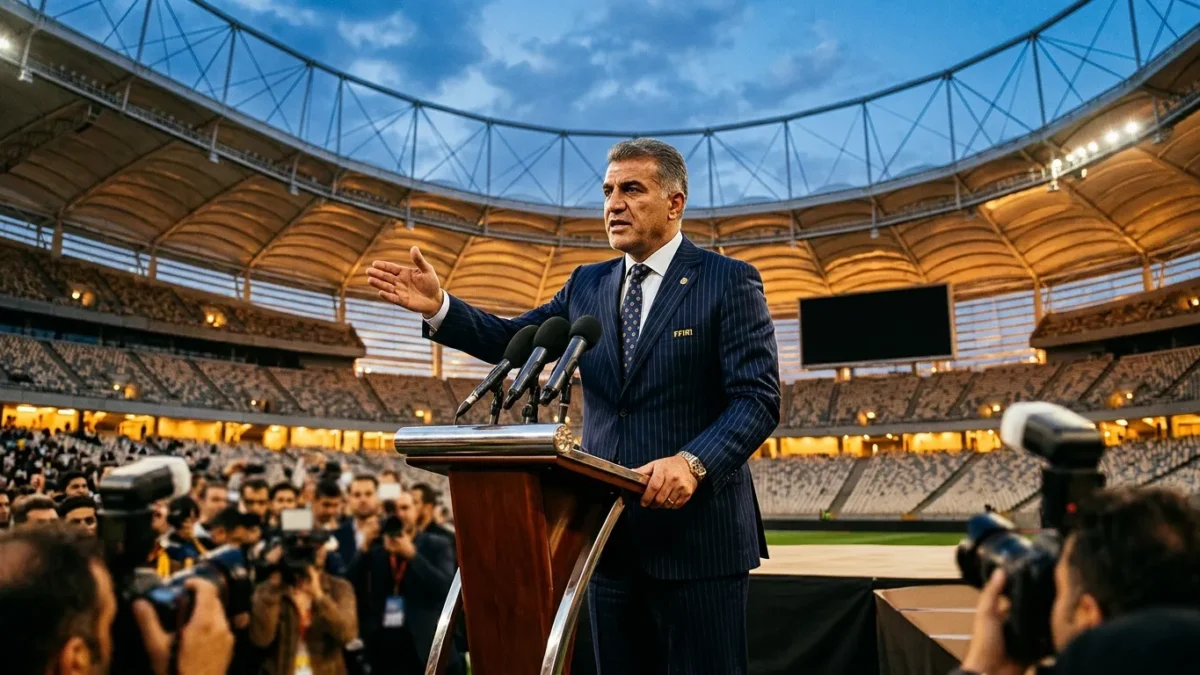
Iran’s football federation chief Mehdi Taj made his position crystal clear this week : his team is going to the 2026 World Cup, and the only host that matters is FIFA. Not Donald Trump. Not the United States government. That statement, blunt and deliberate, lands in the middle of one of the most politically charged footballing disputes in recent memory.
Iran’s stance on the 2026 World Cup host
Mehdi Taj didn’t mince his words. “We are going to the World Cup, for which we qualified, and our host is FIFA — not Mr Trump or America,” he declared. That single sentence captures the entire tension swirling around Iran’s participation in the tournament co-hosted by the United States, Canada, and Mexico, scheduled from June 11 to July 19, 2026.
The background matters. US Secretary of State Marco Rubio stated last week that anyone with ties to the IRGC (Islamic Revolutionary Guard Corps) would be denied entry into the United States. That’s a sweeping statement with direct implications for Iran’s squad, staff, and officials. Taj’s response was equally sweeping : if the host country cannot guarantee that Iran’s military institutions won’t be publicly insulted, then the same kind of crisis that nearly unfolded in Canada could repeat itself.
What happened in Canada ? Taj alluded to an earlier episode where Iran came close to withdrawing due to diplomatic friction. The warning is unmistakable. Iran wants guarantees — real, tangible ones — before sending its delegation to American soil.
Here’s what makes this particularly significant : Iran had already requested, back in March 2026, that its group-stage matches be relocated to Mexico. FIFA president Gianni Infantino rejected that request and confirmed Iran would play as originally scheduled. So the draw stands, the fixtures are locked, and the political pressure is building fast.
Iran’s scheduled World Cup fixtures in the US
Understanding the geography of the problem helps. Iran’s three group-stage matches are all set to take place on American soil. There is no flexibility built into the current schedule, which makes the diplomatic standoff all the more concrete and urgent.
| Match | Opponent | Date | Location |
|---|---|---|---|
| Group stage | New Zealand | June 15, 2026 | Los Angeles |
| Group stage | Belgium | June 21, 2026 | Los Angeles |
| Group stage | Egypt | June 26, 2026 | Seattle |
Two matches in Los Angeles, one in Seattle. Every single game on US territory. Taj’s demand for “peace of mind” before traveling is, frankly, understandable given the current geopolitical climate. The February 2026 US and Israeli air strikes on Iran cast a long shadow over any notion of a routine sporting visit to America.
Taj put it plainly : if the host accepts Iran’s participation, it must also accept that Iran’s military institutions cannot be publicly insulted. That’s the red line. Cross it, and the whole thing could collapse. Whether that’s a negotiating posture or a genuine ultimatum, only the coming weeks will tell.
Iran isolated at FIFA congress — a telling detail
One fact stands out starkly from the recent FIFA congress held in Vancouver : Iran was the only one of FIFA’s 211 member federations that sent no representative. Not a single delegate. Every other nation managed to show up — or at least send someone. Iran’s absence wasn’t accidental. It reflects exactly the kind of logistical and political barriers Taj is talking about.
Getting Iranian football officials into North America is already complicated. Visas, travel restrictions, the IRGC-related entry bans — these aren’t abstract threats. They’re operational realities that affect how, and whether, Iran can participate in the tournament at all. Missing a congress is one thing. Missing three World Cup group games would be something else entirely.
FIFA’s position, as stated by Infantino, is that Iran will play. Full stop. The federation isn’t entertaining relocation requests. That’s a firm stance, but it puts FIFA in a delicate position : how do you enforce participation when entry to the host country is controlled by a government applying its own foreign policy filters ?
- Iran qualified for the 2026 World Cup through the AFC qualification process
- FIFA has 211 member federations, all of which except Iran were present at the Vancouver congress
- The US-Iran diplomatic relationship has been severely strained since at least the 1979 revolution
- The February 2026 air strikes represent the most direct military escalation in years
Taj’s broader argument is about sporting sovereignty. A country that qualifies for a World Cup deserves to compete — regardless of the bilateral tensions between its government and the host nation. That principle is sound. The question is whether FIFA has the diplomatic muscle to enforce it against a US administration that seems willing to weaponize entry visas.
What happens next between FIFA, Iran and Washington
The real test is coming fast. With less than six weeks until Iran’s opening match against New Zealand, the window for resolution is narrow. FIFA needs the US to issue clear, workable visa guarantees for Iran’s travelling party. Without that, Taj’s warning about a potential withdrawal isn’t scaremongering — it’s a genuine scenario.
Frankly, FIFA should be pushing Washington hard behind closed doors right now. Gianni Infantino has shown he can navigate political landmines — his relationship-building across contentious geopolitical divides has been a hallmark of his presidency. This situation demands exactly that kind of direct engagement. A World Cup without Iran, after they earned their place on the pitch, would be a reputational failure for everyone involved.
Watch the visa announcements. That’s where this actually gets resolved — or doesn’t.
