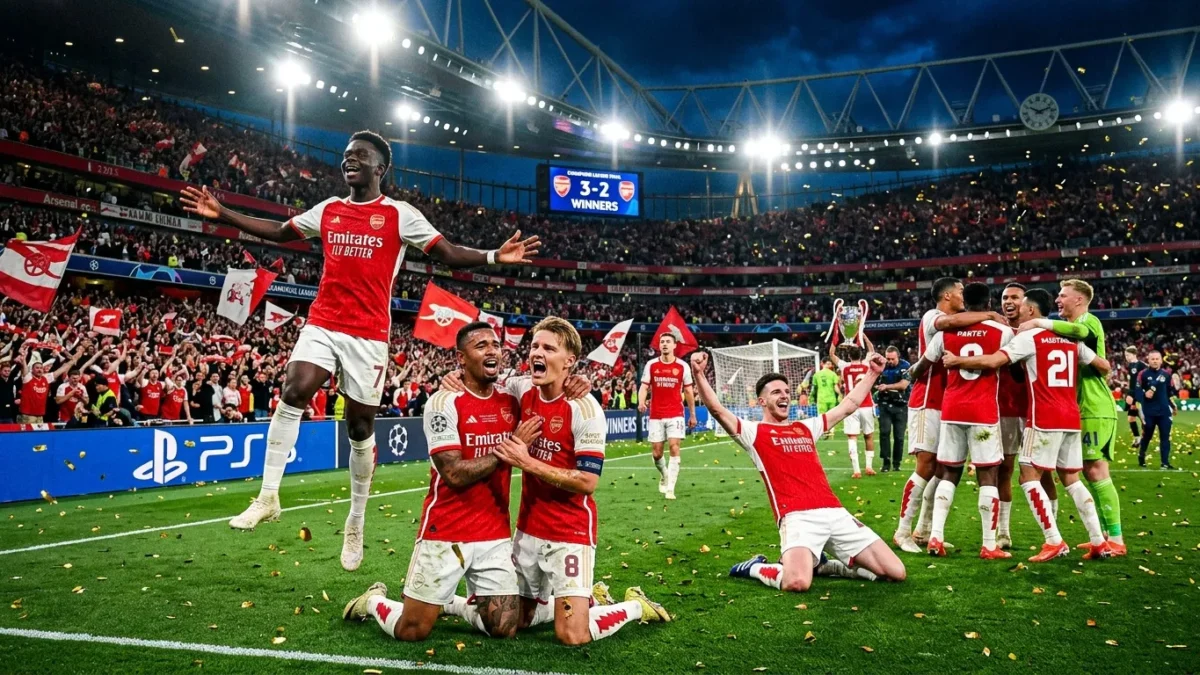
Arsenal beat Atlético Madrid in their Champions League semi-final, and what followed on the Emirates pitch sparked an argument that football fans never seem to tire of : did the Gunners go too far with their celebrations ? Mikel Arteta and his squad joined hands and ran together toward both ends of the ground, a moment that split opinion almost immediately. Some called it euphoric and deserved. Others cried excess.
What actually happened after the final whistle
The scenes at the Emirates were raw and unfiltered. Players embraced, staff flooded the pitch, and Arteta led his squad in a collective sprint toward the supporters at each end of the stadium. It looked less like a choreographed gesture and more like a genuine outpouring — the kind you get when a group of people has been living and breathing a single goal for months on end.
That detail matters. Reaching a Champions League final is not a routine achievement for Arsenal. The club last appeared in the competition’s final back in 2006, losing to Barcelona in Paris. Twenty years of near-misses, early exits, and seasons without European football at all make this moment genuinely significant. The weight of that history was visible in every celebration on that pitch.
Critics who labeled the reaction excessive were quick to point out that no trophy had been lifted yet. Fair point, technically. But football doesn’t operate in a vacuum of pure logic — the emotional release that follows a high-stakes victory is part of what makes the sport compelling to watch in the first place.
The psychology behind the celebration — and why it’s healthy
Bradley Busch, a chartered sports psychologist who runs Inner Drive, a sports psychology training centre, offered a clear framework for understanding what unfolded. Speaking to BBC Sport, he pointed to a well-documented research concept to explain the group dynamic at play.
“The technical phrase used in research for this is known as emotional contagion,” Busch explained. The idea is straightforward : behaviours, attitudes and a sense of unity can spread rapidly through a team when individuals feed off each other’s energy. Celebrating together, physically and publicly, is one of the most direct ways to trigger that effect.
Here’s what distinguishes healthy celebration from the kind that genuinely causes problems :
- Celebrating together strengthens team cohesion and shared identity
- It provides a necessary psychological release after sustained high-pressure periods
- It signals collective ownership of success rather than individual glory-seeking
- It becomes problematic only when it disrupts preparation for the next match
Busch was direct : the celebration at the Emirates fits none of the warning signs. No one was showboating mid-game, no one lost concentration during play, and the team’s preparation for the final was not disrupted by a pitch-side run with linked hands.
He defined over-celebration with precision : anything that negatively impacts future performance. That threshold could be reached during a match — a team that acts as if it has already won can quickly drop its intensity and invite a comeback. But post-match euphoria shared between teammates ? That’s an entirely different situation.
| Type of celebration | Context | Risk to performance |
|---|---|---|
| Mid-match showboating | Goal scored before full time | High — can reduce intensity |
| Excessive post-match partying | Disrupts next-match preparation | Medium — depends on timing |
| Collective pitch celebration | Immediately after a semi-final win | Very low — builds team unity |
Busch also dismissed the criticism with a sharp analogy : calling the Arsenal reaction excessive felt, in his words, like the old celebration police going on there. Frankly, that description fits. The reflex to tone-police a football team’s joy says more about the observer than the players.
Arsenal’s moment, the bigger picture, and what comes next
There’s an important distinction worth making here. Celebrating a semi-final win is not the same as celebrating a title. Nobody at Arsenal claimed the Champions League trophy on Tuesday night. What they did was acknowledge — loudly, visibly, collectively — that reaching a final is an achievement worth marking. It is.
Busch himself was honest about his personal bias on the question. A self-declared Tottenham supporter, he admitted he personally hopes Arsenal’s celebrations turn out to be premature. But he was careful to separate that instinct from his professional assessment. The psychology is clear : shared emotional release after sustained pressure reflects a healthy squad mindset, not arrogance or complacency.
That distinction — between wanting something to be true as a rival fan and what the evidence actually shows — is one more football supporters should sit with. The noise around Arsenal’s celebrations reveals a broader cultural tension in the sport : we want players to care deeply, but punish them when they show it too openly.
If you want a genuinely useful measure of whether these celebrations were justified, watch how Arsenal prepare and perform in the final. That’s the only test that actually matters. A team that loses focus after linking arms on their own pitch would be easy to spot — and equally easy to criticise, with evidence. Until then, the emotion you saw at the Emirates was exactly what high-stakes football is supposed to produce.
