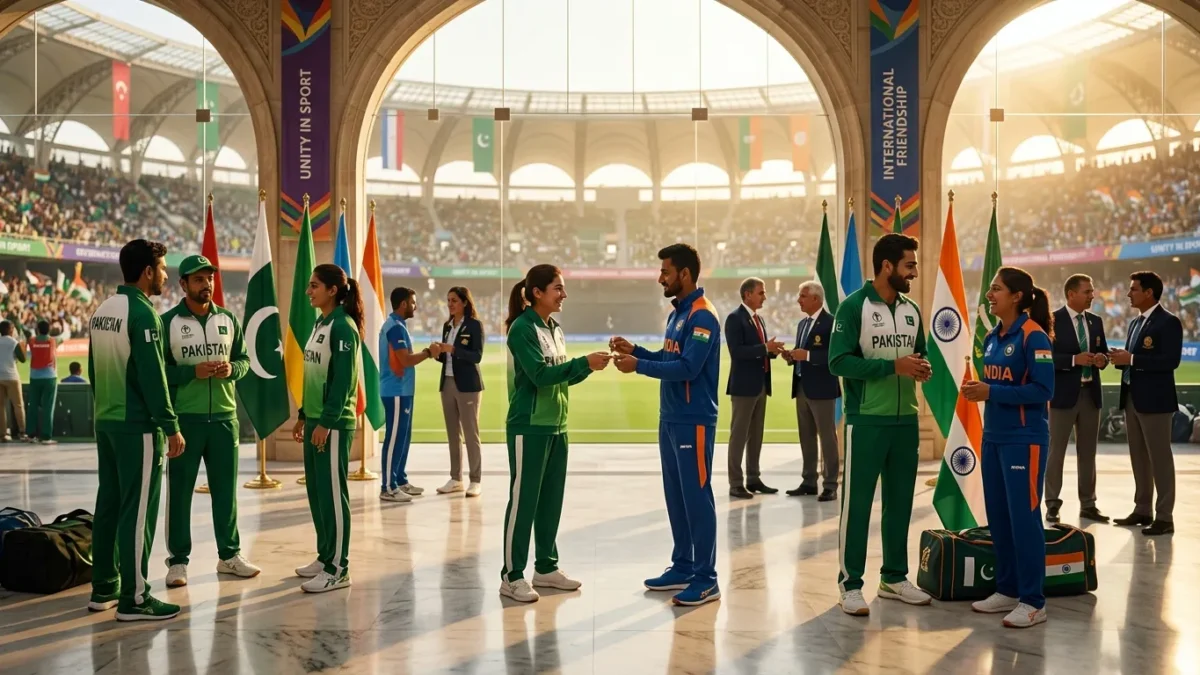
May 6, 2026. India’s sports ministry dropped a significant policy statement that cuts right through the tension between two nuclear-armed neighbors : Pakistani athletes will be allowed to compete on Indian soil, but only within the framework of multilateral and international events. Bilateral cricket ? Still frozen. The distinction matters enormously — and the timing is no accident.
A carefully drawn line between multilateral access and bilateral freeze
India’s position is surgical in its precision. The sports ministry’s official memorandum states clearly : “With regard to international and multilateral events, in India or abroad, we are guided by the practices of international sports bodies and the interest of our own sportspersons.” That single sentence does a lot of heavy lifting. It opens the door for Pakistani participation in global competitions hosted by India, while slamming it shut on anything resembling a direct, bilateral face-off.
The same document leaves zero ambiguity on bilateral contests : “Indian teams will not be participating in competitions in Pakistan. Nor will we permit Pakistani teams to play in India.” Two lines. No diplomatic softening, no vague language. This is a government drawing a border inside the world of sport.
Why does this distinction exist ? The two countries came dangerously close to full-scale military conflict in 2025 — a confrontation that rattled the entire region. Against that backdrop, allowing any bilateral sporting event would carry a symbolic weight that New Delhi is clearly not prepared to accept. Multilateral events, however, operate under the authority of international governing bodies, which gives India political cover to participate in global sport without appearing to normalise relations with Islamabad.
The memorandum also acknowledges something India’s officials rarely say out loud : “It is also relevant to take into account India’s emergence as a credible venue to host international sports events.” Translation — India needs to look like a reliable host nation, not a country that blocks athletes based on passport color.
| Event type | Pakistani athletes allowed in India ? | Indian athletes allowed in Pakistan ? |
|---|---|---|
| Multilateral / international events | Yes | Guided by international bodies |
| Bilateral competitions | No | No |
| Cricket series | No (last full series : 2012-13) | No |
Cricket remains the sharpest symbol of a broken relationship
No sport illustrates the India-Pakistan diplomatic freeze better than cricket. The two nations haven’t played a full bilateral series since 2012-13. That’s over a decade of silence between two of the sport’s most passionate fanbases. When they do meet now, it happens at neutral venues — most often during ICC tournaments.
The T20 Cricket World Cup earlier in 2026 offered a telling example. India co-hosted the tournament, yet Pakistan played every single one of their matches in Sri Lanka, including their group-stage clash against India itself. The match technically happened — but Pakistan never set foot on Indian soil to play it. That arrangement wasn’t an accident; it was a diplomatic choreography dressed up as a scheduling decision.
The core issue goes beyond sport. Cricket between India and Pakistan carries a weight that football or athletics simply don’t. It’s woven into partition history, national identity, and decades of conflict. Frankly, expecting bilateral cricket to return while military tensions simmer is unrealistic — and any official who suggests otherwise isn’t reading the room.
- Last full India-Pakistan cricket series : 2012-13
- Current meeting format : neutral venues, ICC tournaments only
- T20 World Cup 2026 : Pakistan played all matches in Sri Lanka, including vs. India
- Bilateral status : officially blocked by India’s sports ministry
India’s hosting ambitions and the visa reform that comes with them
Here’s where the policy gets genuinely interesting. India has massive sporting ambitions on the world stage. The country will host the Commonwealth Games in 2030. Beyond that, India has submitted bids for the 2036 Olympic Games and the 2038 Asian Games, with Ahmedabad positioned as a central hub for the latter. These are not small events — they represent billions in infrastructure investment and decades of nation-branding.
Hosting the Olympics or the Asian Games while blocking athletes from a neighboring country would be diplomatically catastrophic. The International Olympic Committee and other governing bodies have strict non-discrimination clauses. India’s new policy on Pakistani athletes in multilateral events is, at least in part, an answer to that pressure.
The ministry didn’t stop at athlete access. The memorandum also announces a simplified visa process for sportspersons and team officials. More notably, office bearers of international sport governing bodies will receive multi-entry visas — a direct signal to the IOC, the Commonwealth Games Federation, and similar organizations that India is serious about becoming a global sports hub.
That’s a smart move. International sports federations don’t just evaluate stadiums and logistics when choosing host cities — they watch how governments treat visiting delegations. A streamlined visa process for officials removes one of the most common friction points in hosting major events, and it sends a message that India understands how the global sport ecosystem actually works.
The practical takeaway for athletes and federations is straightforward : competing in India as part of a multilateral event is now officially possible for Pakistani participants, backed by a government memorandum. The road to bilateral normalization — particularly in cricket — remains closed, with no sign of a key in sight. For now, the boundary between geopolitics and sport runs exactly where New Delhi says it does.
