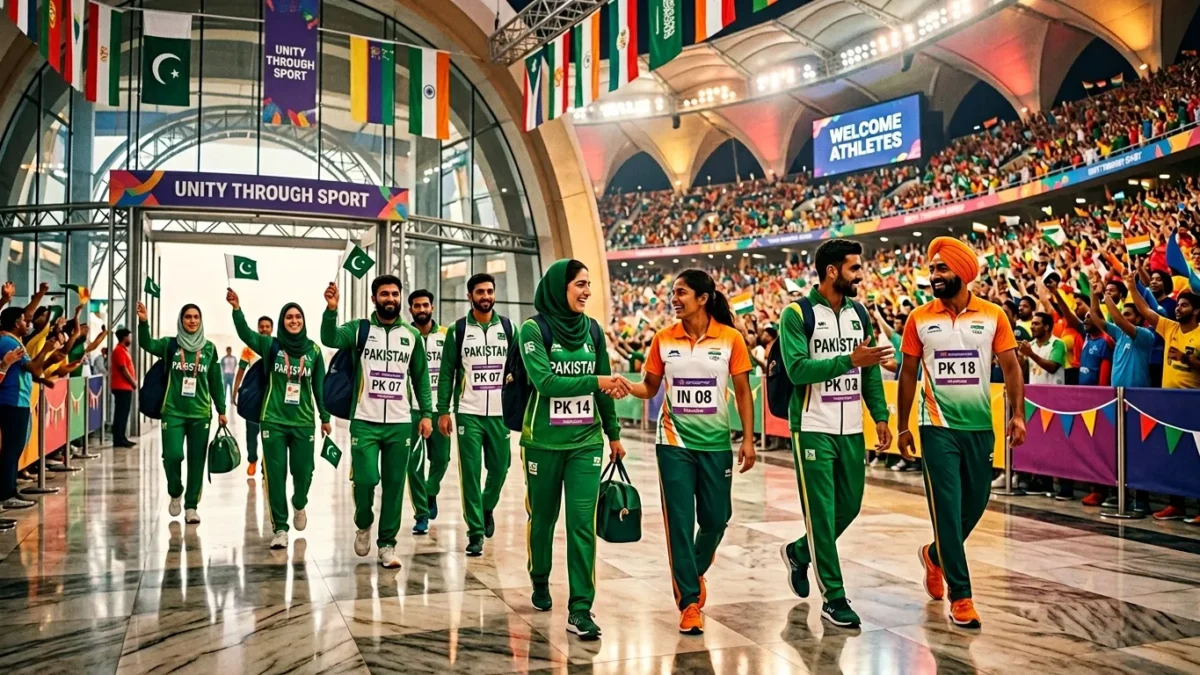
India’s sports ministry dropped a significant policy update on May 6, 2026 : Pakistani athletes will be permitted to compete on Indian soil, but strictly within multilateral sporting events. Bilateral competitions remain completely off the table. This distinction matters more than it might seem at first glance.
A carefully drawn line between multilateral and bilateral sport
The memorandum issued by India’s sports ministry leaves little room for interpretation. Pakistani players and teams can participate in international tournaments hosted in India, provided those events fall under the umbrella of recognized international sports governing bodies. The moment a competition involves only India and Pakistan — think a bilateral cricket series — the answer is a flat no.
The ministry framed its position in practical terms : “With regard to international and multilateral events, in India or abroad, we are guided by the practices of international sports bodies and the interest of our own sportspersons.” That’s a calculated statement. It signals that India won’t isolate itself from global sport diplomacy, while still drawing a hard line on direct engagement with Pakistan.
Two additional measures came with the announcement. First, the visa process for athletes and sports officials will be simplified — a pragmatic step for a country hosting increasingly high-profile events. Second, office bearers of international sports governing bodies will receive multi-entry visas, reducing bureaucratic friction for organizations like the IOC or World Athletics when coordinating events in India.
| Event type | Pakistani participation in India | Indian participation in Pakistan |
|---|---|---|
| Multilateral / international tournaments | ✅ Allowed | ✅ Allowed (per international body guidelines) |
| Bilateral competitions | ❌ Banned | ❌ Banned |
This table sums up what the ministry actually said — no ambiguity, no diplomatic fog. Bilateral sport between the two nations remains frozen, and frankly, given the military escalation that nearly spiraled into full-scale conflict in 2025, nobody should be surprised.
Cricket, the most visible casualty of this diplomatic freeze
Cricket sits at the center of this story, and the numbers tell you why. India and Pakistan last played a full bilateral series in 2012–13 — that’s over a decade without a proper home-and-away contest between the sport’s two most passionate fanbases. Since then, they meet only at neutral venues during major ICC events.
The T20 Cricket World Cup earlier in 2026 illustrated the absurdity of the situation perfectly. India co-hosted the tournament, yet Pakistan played every single one of their group stage matches in Sri Lanka. That includes their fixture directly against India. Two co-host nations, unable to share the same ground. It’s a logistical workaround that satisfies nobody, least of all the ICC.
The ministry’s language on cricket was unambiguous : “Indian teams will not be participating in competitions in Pakistan. Nor will we permit Pakistani teams to play in India.” That sentence covers all bilateral formats — Tests, ODIs, T20Is. Every format, every surface, every city. Off limits.
- Last bilateral series between India and Pakistan : 2012–13
- Current meeting format : neutral venues at ICC events only
- Pakistan’s matches during India-co-hosted T20 World Cup 2026 : all played in Sri Lanka
- India’s bilateral cricket ban on Pakistan : still fully in effect as of May 2026
For cricket administrators, this remains one of the sport’s most commercially frustrating impasses. An India-Pakistan bilateral series would generate revenues that dwarf almost any other cricket product. Yet geopolitics consistently overrules economics here.
India’s hosting ambitions and why this policy shift makes sense now
Here’s the part that often gets buried under the cricket headlines : India has enormous sporting infrastructure ambitions for the next decade, and those ambitions require playing by international rules.
The country is already confirmed to host the Commonwealth Games in 2030. Beyond that, India has filed bids for both the 2036 Olympics and the 2038 Asian Games, with Ahmedabad positioned as the central host city for the Olympic bid. These aren’t casual aspirations — they represent billions of rupees in infrastructure investment and decades of soft power strategy.
Hosting the Commonwealth Games or the Olympics means accepting every eligible nation’s athletes. Pakistan competes at both events. A blanket ban on Pakistani athletes entering India would disqualify India from hosting these tournaments under international federation rules. The ministry’s own memo acknowledges this reality : “It is also relevant to take into account India’s emergence as a credible venue to host international sports events.”
So this policy isn’t generosity toward Pakistan. It’s strategic self-interest — and there’s nothing wrong with that. India is protecting its hosting credentials while maintaining political pressure through the bilateral ban. The two positions are entirely compatible.
What this decision reveals is a government threading a needle with considerable skill. The sporting boycott of Pakistan remains intact where India controls the terms. But where international bodies set the rules — the Commonwealth Games, the Olympics, World Athletics championships — India will comply, simplify visas, and welcome all competing nations. That’s the deal, and it’s a coherent one. Whether it eventually thaws the cricket relationship is a different question entirely, and one that 2026 shows no sign of answering.
