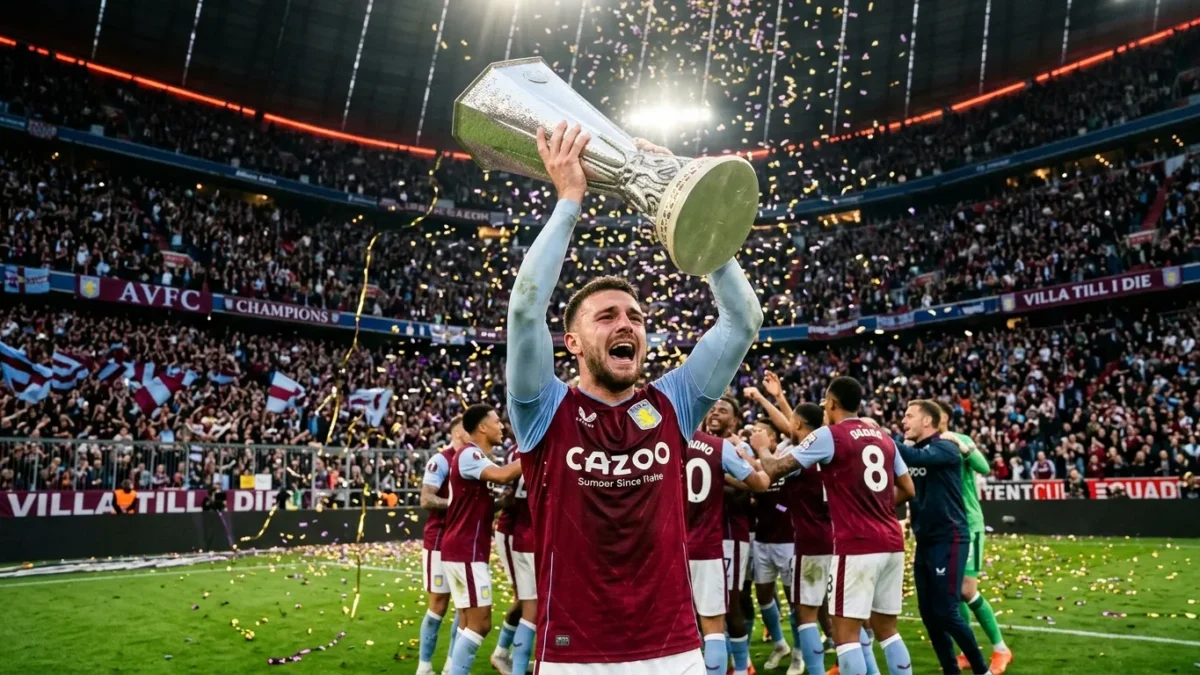
Aston Villa stand 90 minutes away from ending a 30-year trophy drought, and everything about their Europa League semi-final second leg against Nottingham Forest confirmed they deserve to be there. A 3-0 win at Villa Park, with John McGinn scoring twice late on to seal the tie, sent the Birmingham club into a European final for the first time since that legendary night in Rotterdam in 1982. The banner commemorating Peter Withe’s winner against Bayern Munich still hangs above the Doug Ellis Stand. In two weeks, a second one might join it.
A performance that left Forest with no answer
Nottingham Forest arrived at Villa Park already diminished. Manager Vitor Pereira named Morgan Gibbs-White, Ibrahim Sangare and Murillo on the bench, but none were fully fit. Only Murillo made it onto the pitch — for a mere two minutes, with the game already decided. Even if all three had been available from the start, it is hard to imagine them stopping a Villa side operating at this intensity.
Ollie Watkins opened the scoring, then Emi Buendia converted a penalty to put the hosts ahead on the night and in the tie overall. After that, the outcome was never seriously in doubt. Villa did not sit on their lead — they accelerated. The tempo kept rising, the pressure kept building, and Forest simply could not cope. McGinn’s late double added a deserved gloss to what had been a dominant, commanding display.
The match also received an unusual stamp of approval. Prince William visited the Villa dressing room after the final whistle to offer his congratulations to the squad — a moment that underlined just how much this run means beyond the club itself.
Here is a snapshot of how the goals fell on the night :
| Goal | Scorer | Type |
|---|---|---|
| 1st | Ollie Watkins | Open play |
| 2nd | Emi Buendia | Penalty |
| 3rd | John McGinn | Open play |
| 4th | John McGinn | Open play |
Emery, the Europa League specialist reshaping Villa’s identity
Nobody in football history has reached more Europa League finals than Unai Emery. This will be his sixth, with four wins and one defeat — that sole loss came against Chelsea in 2019, when he was Arsenal manager. The Spaniard spoke after the match with characteristic clarity : “Europe is very important. In my first press conference here I was speaking about Europe, I was speaking about trophies as well, but it’s very difficult. It’s difficult to get trophies.”
His record in this competition puts him ahead of virtually every other manager in the game’s history. Only Giovanni Trapattoni, who reached seven major European finals, has more appearances at this stage. Emery’s preparation for the semi-final was meticulous — he spoke of planning the match “emotionally” beforehand, of managing momentum and leveraging the energy of a packed Villa Park.
Watkins paid tribute directly : “There’s no better manager than this to get us prepared for this game and take us into the final. His track record speaks for itself. We need to go and win it now.” That last sentence carries real weight. Watkins himself acknowledged that significant squad changes are expected this summer, making this Europa League run potentially the final opportunity for this particular group of players to win something together.
- Ollie Watkins — joined Villa from the Championship
- Ezri Konsa — also arrived from the second tier
- Matty Cash — Championship background before Villa
- Morgan Rogers — same route up through the divisions
Emery has extracted remarkable performances from players whose origins were modest by top-flight standards. The squad understands internally that a rebuild is coming. Winning in Turkey first would change everything.
McGinn, legacy, and what this final really means for Villa
Captain John McGinn was direct about the stakes. He pointed to names like Dennis Mortimer — who lifted the European Cup in 1982 — and Paul McGrath, part of the sides that won the League Cup in 1994 and again in 1996. “It’s a historic club and it’s been a long time without success,” McGinn told TNT Sports. “There’s been massive lows, like relegation, and it has built itself back up.”
Three decades without a major trophy is a long time for a club of Villa’s stature. The 1982 European Cup remains the peak, and everything since has been measured against it. McGinn described sensing something different on the morning of the match : “I felt it this morning, but now it is about embracing it and trying to be legends.”
Victory in the Europa League final would also secure a return to the Champions League, regardless of where Villa finish in the Premier League — a detail that makes the prize in Turkey even more significant from a sporting and financial perspective. The tie is not just about silverware. It is about confirming a trajectory, about proving that the club’s revival under Emery has produced something lasting rather than a temporary spike.
For a fanbase that has endured relegation and decades of near-misses, the final represents far more than a cup. It is the clearest shot at genuine history this generation of Villa supporters has ever seen — and this squad knows it.
