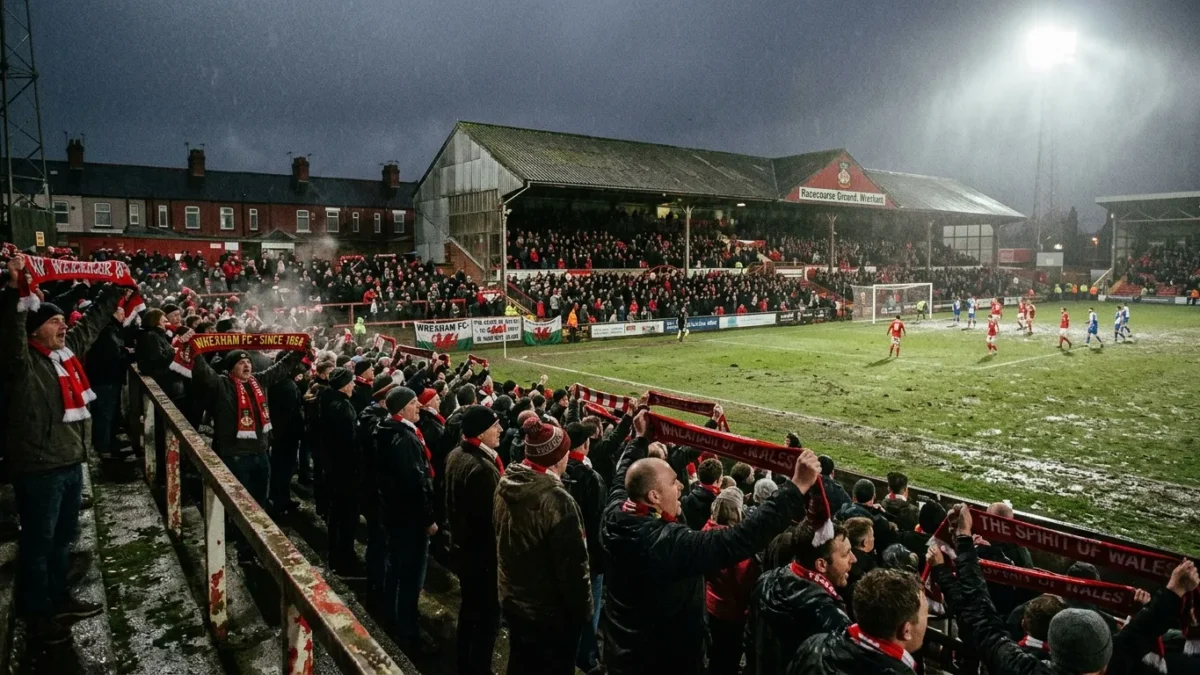
£2-3 million. That’s the figure Wrexham’s academy manager Gus Williams put on the infrastructure investment already committed by owners Rob McElhenney and Ryan Reynolds. Not a vague promise — real money, already spent. And the club is planning to go further. Behind the headlines about Hollywood glamour and successive promotions, something more significant is quietly taking shape in north Wales.
The academy gap that cost Wrexham a generation of talent
For years, Wrexham’s youth system was a cautionary tale. Financial instability and the club’s long exile outside the Football League left the academy underfunded and unable to compete for local talent. The result ? Promising youngsters from the area simply went elsewhere. The two most striking examples are Harry Wilson and Neco Williams — both born in Wrexham, both eventually developed by Liverpool’s academy, and both now established Premier League players.
That’s not a minor miss. Those are full Welsh internationals who grew up in the club’s backyard. For a club rebuilding its identity around its community, losing homegrown talent to a top-flight academy 60 miles away is exactly the kind of structural failure that no Hollywood narrative can paper over. It happened because the club lacked the infrastructure, the resources and — crucially — the EFL status required to attract and retain serious prospects.
The contrast with earlier generations is stark. Wrexham produced genuine talent for decades : Joey Jones, Mickey Thomas, and more recently Max Cleworth, who logged more minutes than any other Wrexham player this season. That history proves the pipeline exists — it just needs the right conditions to function.
| Player | Born in Wrexham | Developed by | Career level |
|---|---|---|---|
| Harry Wilson | Yes | Liverpool FC Academy | Premier League / Wales international |
| Neco Williams | Yes | Liverpool FC Academy | Premier League / Wales international |
| Max Cleworth | North Wales area | Wrexham AFC | EFL Championship |
| Joey Jones | Yes | Wrexham AFC | Top-flight / Wales international |
How Wrexham is rebuilding its youth structure from the ground up
The club’s return to the EFL in 2023 wasn’t just a sporting milestone — it was the trigger that unlocked a serious rebuild of the entire youth setup. Wrexham rejoined the Elite Player Performance Plan (EPPP) system and secured Category Three status, which opened the door to formally developing players across a much broader age range. The academy now runs programmes from under-nines all the way through to under-21s — a full development pathway that simply didn’t exist a few years ago.
The women’s side hasn’t been left behind either. Wrexham Women received a Football Association of Wales (FAW) National Girls Academi licence, which means the FAW will actively support the club in growing women’s participation. That’s not a token gesture — it gives the club institutional backing and resources to develop female players at junior level with proper structure.
Gus Williams, appointed as academy manager in October 2025, has been direct about what he’s seen from the owners. “Rob and Ryan view the academy with high respect and high expectations,” he said. His assessment of the ownership’s commitment goes beyond rhetoric : the £2-3 million already invested in facilities backs it up. Williams framed the challenge simply : “acknowledge the past, admire the present, plan for the future.” Frankly, that’s the right mindset — no nostalgia, no shortcuts.
- Category Three EPPP status secured since returning to the EFL
- Academy age groups now span from under-9s to under-21s
- FAW National Girls Academi licence awarded to Wrexham Women
- £2-3 million already invested in academy infrastructure
- New training facility planned in partnership with Darland High School
The Darland partnership and what it signals about Wrexham’s long-term vision
The most telling detail in Wrexham’s academy strategy isn’t the money already spent — it’s where the next investment is going. The club has announced a multi-million-pound training facility to be built in partnership with Darland High School, combining new pitches with improved educational spaces. That dual focus matters enormously.
Most academy facilities are purely football-driven. Tying the development hub to a school sends a different message : player welfare and education are not afterthoughts. For families deciding where to send their talented 12-year-old, that combination — serious football coaching alongside genuine academic support — is a compelling offer. It’s the kind of environment that builds trust with the local community in a way that a glossy social media campaign never could.
Think about what that means structurally. Wrexham is no longer just hoping to catch the next Harry Wilson before Liverpool does — they’re building the kind of environment that makes talented young players from north Wales want to stay. Sustainable success at club level never comes from buying players alone; it comes from owning the development pipeline in your own territory.
Promotions generate momentum, cash and visibility. But every club in England’s second and third tiers has learned the hard way that momentum fades fast without foundations. The Darland project is Wrexham betting on those foundations — infrastructure that will outlast any single manager, any Hollywood owners’ involvement, and any particular run of results. That’s the real story worth watching here.
