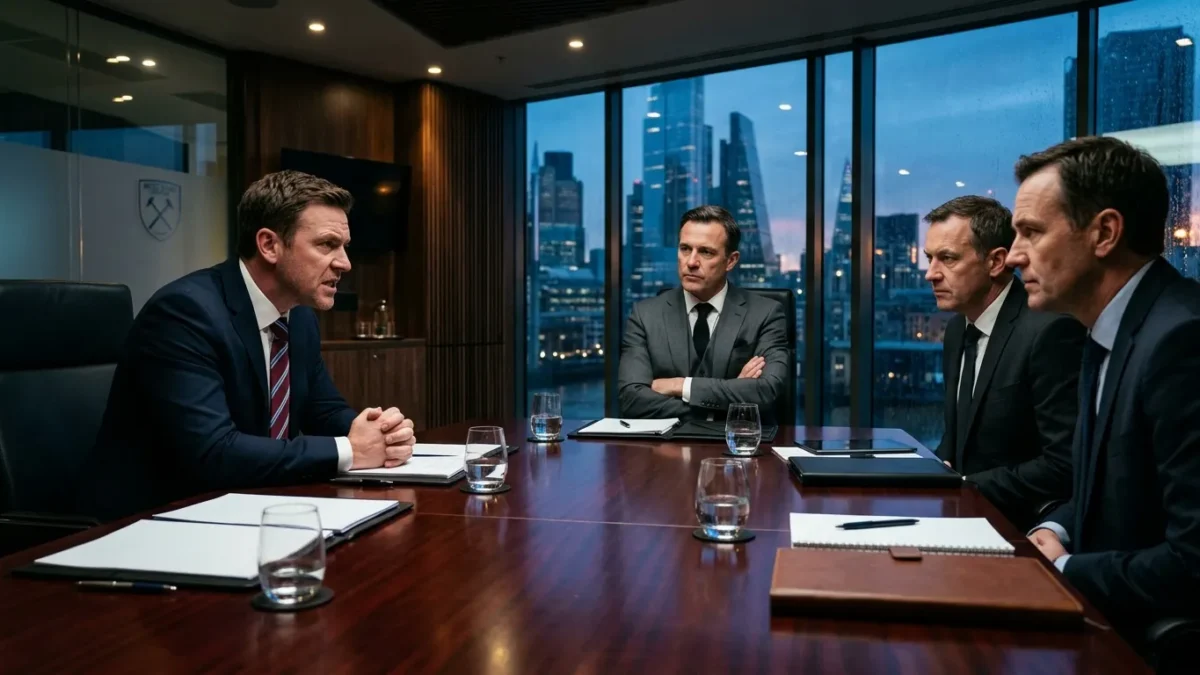
A single VAR decision has thrown the Premier League title race — and relegation battle — into fierce debate. On May 11, 2026, West Ham’s late equaliser against Arsenal was disallowed following a VAR intervention by official Darren England, who ruled that Raya had been fouled in the build-up. The call has since been described by former assistant referee Darren Cann, speaking on Match of the Day, as the biggest VAR decision in Premier League history. Strong words. But judging by the fallout, they feel justified.
West Ham set to take the VAR controversy directly to PGMO
The east London club is planning to formally contact PGMOL — the Professional Game Match Officials Limited — to challenge the legitimacy of the ruling. This isn’t just venting frustration on social media. It’s a structured complaint aimed at the governing body responsible for referee standards in England’s top flight.
At the heart of West Ham’s case lies a thorny question : why this foul, and not the others ? Former West Ham goalkeeper Rob Green, speaking on BBC Radio 5 Live, put it plainly : “There were five or six fouls going on at the same time in there but it’s where the ball landed.” Green was unequivocal — in isolation, it’s a foul. But the absence of consistency is what makes the decision so hard to swallow.
Here is a breakdown of the key incidents that observers flagged in the build-up to the disallowed goal :
- Gabriel holding an opponent before Raya was fouled
- Odegaard involved in physical contact prior to the decisive moment
- Trossard also holding before the whistle was blown
- Multiple simultaneous challenges inside the Arsenal penalty area
The selector’s dilemma is stark : Darren England picked one specific foul out of a cluster of infractions. Former Liverpool midfielder Danny Murphy acknowledged on Match of the Day that the call itself was technically correct — “it’s a clear foul” — but stressed that the elephant in the room is Arsenal’s identity. “The controversy and discontent is because it’s Arsenal,” Murphy said, adding that the decision shouldn’t be distorted by which club benefits.
Consistency — or the lack of it — at the core of the debate
This isn’t an isolated incident. Throughout the 2025-26 Premier League season, goalkeeper protection in set-piece situations has been one of the most divisive topics in English football. Former Newcastle goalkeeper Shay Given, also on Match of the Day, raised what many supporters have been saying for months : on multiple occasions this season, goalkeepers and defenders have been blocked off — and the goal stood. So what changed on Sunday ?
| Pundit | Platform | Verdict on the call |
|---|---|---|
| Darren Cann | Match of the Day | Correct decision, biggest VAR call in PL history |
| Danny Murphy | Match of the Day | Technically a foul, but distorted by Arsenal bias perception |
| Shay Given | Match of the Day | Frustrated by inconsistency across the season |
| Rob Green | BBC Radio 5 Live | Clear foul in isolation, but zero consistency |
Given was particularly direct : “Everyone is frustrated about the consistency of the refereeing decisions. Why are some goals allowed to stand and this was disallowed ?” With so much at stake — both at the top and bottom of the table — these calls carry enormous financial and sporting consequences. Relegation from the Premier League costs clubs an estimated £100 million in lost revenue. Title-winning decisions are worth hundreds of millions more in commercial terms.
Rob Green’s perspective adds weight to the consistency argument. He noted that goalkeeper obstruction at set pieces has been “such a talked-about topic” all season. To have it crystallise in a match of this magnitude feels, to many, like a systemic failure rather than a one-off error. “There hasn’t been any [consistency],” Green concluded flatly.
What West Ham’s formal complaint could actually achieve
Contacting PGMOL doesn’t reverse the decision. No formal protest in English football history has succeeded in changing a match result after the final whistle. But that’s not entirely the point. West Ham’s formal approach to PGMOL serves two purposes : it creates an official record of the complaint, and it forces the governing body to respond publicly or privately about how Darren England reached his conclusion.
Darren Cann, who spent years as an assistant referee in the Premier League, was measured but clear : “He stepped up to the plate, he made the right decision.” Cann’s defence of England matters — it suggests the official followed the rulebook. The issue isn’t whether England was wrong by the letter of the law. It’s whether the law is applied uniformly across 380 matches a season.
Murphy’s point deserves repeating here. West Ham cannot hold Arsenal — or any club — accountable for decisions made in other games. The anger should be directed at the system, not the opponents. And that’s precisely where a PGMOL complaint lands most effectively.
If West Ham’s contact with PGMOL prompts even a public clarification on how goalkeeper protection is officiated at corners and free kicks, it benefits every club. Referees, clubs, and fans all need the same rulebook applied the same way — whether the team in question plays in claret and blue or red and white. That’s the real ask here, and frankly, it’s a reasonable one.
