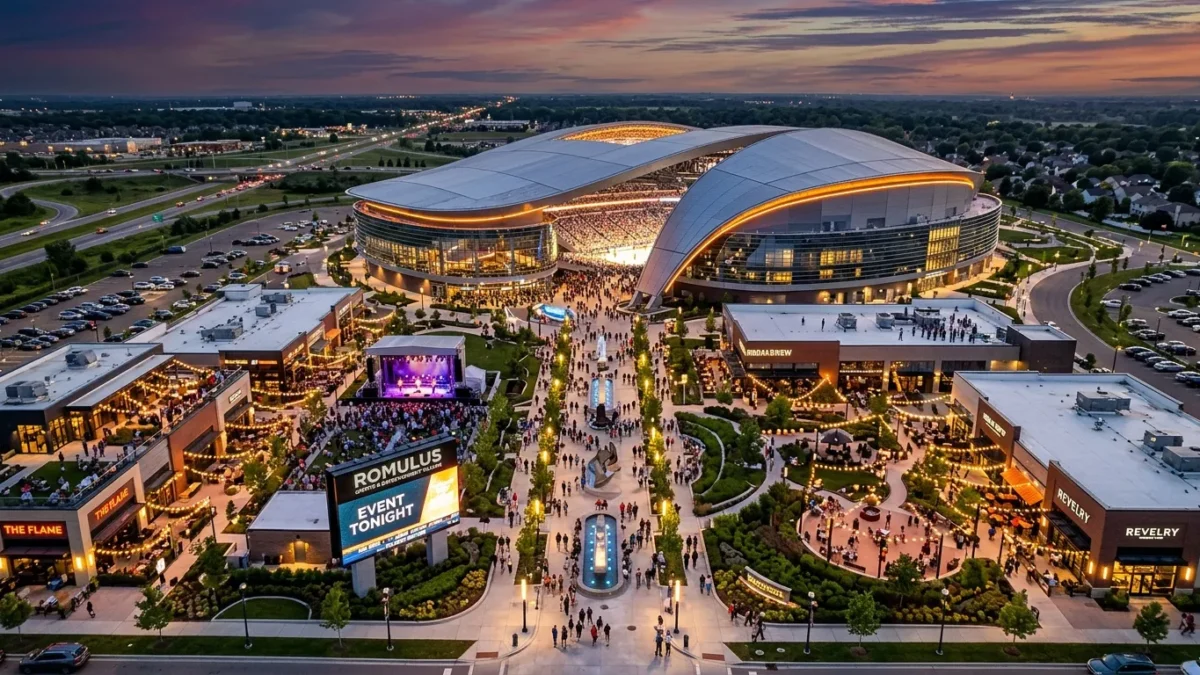
A $3 billion project is about to reshape the map of Wayne County. The Motown Sports Village development in Romulus was officially announced in May 2026, positioning this Michigan city as a serious contender in the booming sports tourism market — a sector that generated $47.1 billion in direct spending in 2024 alone. This is not a minor local initiative. We’re talking about 452 acres of sports, entertainment, and hospitality infrastructure, right next to Detroit Metropolitan Airport.
A strategic location that makes all the difference
Romulus didn’t land this project by accident. The site sits along Interstate 94, directly adjacent to Detroit Metropolitan Airport, which immediately puts it in a different league from typical inland entertainment developments. Twenty miles from downtown Detroit, 25 miles from Ann Arbor — the geography here is genuinely compelling.
JLL Capital Markets, the global real estate advisory firm engaged to secure project financing, was blunt about the numbers : 2.5 million residents live within a 25-mile radius, and 8.6 million people within 100 miles. Add roughly 100,000 vehicles passing daily on I-94, and you have a visibility and accessibility profile that most developers can only dream about.
Romulus Mayor Robert A. McCraight didn’t hold back his enthusiasm. “Romulus is uniquely positioned to host a project of this magnitude,” he stated, adding that the city would fast-track approvals and coordinate infrastructure to support the development. That kind of municipal alignment matters — it’s often what separates a project that stays on paper from one that actually breaks ground.
For context, the youth sports tourism market — the primary driver behind this concept — is one of the fastest-growing segments in recreational spending, fueled by club leagues and travel-oriented competitions. Families alone spent $40 billion on youth sports in 2024. Motown Sports Village is clearly aiming straight at that market.
What the Motown Sports Village will actually offer
Let’s be direct : the scope of this project is staggering. The development isn’t just a sports complex — it’s designed as a full-spectrum destination where a family could spend an entire weekend without ever leaving the property. Here’s what’s planned inside the 1,150,000-square-foot youth sports complex :
- 12 basketball and volleyball courts
- Four hockey rinks convertible to indoor soccer fields
- A half-mile indoor running track
- Arcade, bowling, rock climbing, and an IMAX theater
Beyond the sports complex, the development includes a 9,000 to 11,000-seat arena designed to host major tournaments, basketball, volleyball, tennis, gymnastics, concerts, and family shows. That capacity puts it in legitimate mid-tier venue territory — not a minor local gym, but a real regional draw.
The entertainment and hospitality layer adds serious weight to the project. A 450,000-square-foot indoor water and surf park, outdoor football and soccer fields, a 96-tee golf center, and three hotels combining 2,000 rooms round out the offering. Frankly, the hotel component alone signals that this project is betting on multi-day stays, not just day-trip attendance. That’s a fundamentally different economic model — and a smarter one.
| Facility | Details |
|---|---|
| Main arena | 9,000–11,000 seats (tournaments, concerts, family shows) |
| Youth sports complex | 1,150,000 sq ft, 12 courts, 4 rinks, indoor track |
| Water & surf park | 450,000 sq ft indoor facility |
| Golf center | 96 tees |
| Hotels | 3 properties, 2,000 total rooms |
| Entertainment | IMAX, arcade, bowling, rock climbing |
The financial architecture and the people behind it
Kenneth W. Bardwell, chairman and CEO of Motown Sports Group Holdings, Inc., is the driving force behind this project. His decision to bring in JLL Capital Markets as exclusive capital advisor is telling. JLL isn’t a local boutique — it’s a global real estate powerhouse with more than 3,000 specialists across nearly 50 countries. Choosing them signals an intent to attract institutional capital, not just regional investors.
The financing structure reflects the project’s phased ambition. The total estimated cost reaches $3 billion, but the immediate focus is on securing $40 million to $50 million in predevelopment and land financing for the initial phase. That’s a sensible approach — prove the concept, de-risk the early stage, then unlock larger capital tranches.
Bardwell described the JLL engagement as “a pivotal milestone,” specifically referencing the firm’s track record in sports and entertainment-anchored mixed-use developments. That language matters. Mixed-use is the operative model here — sports as the anchor, hospitality and entertainment as the revenue diversifiers. It mirrors what successful venues like those tied to major sports districts have done across the U.S.
Mayor McCraight directly tied the project to job creation, calling it a potential generator of thousands of positions for the Romulus area. No specific figure was attached to that claim yet, but given the scale — three hotels, multiple venues, year-round operations — the employment impact could be substantial across both construction and permanent roles.
Why Romulus could become Michigan’s next major sports hub
Michigan already has serious sports infrastructure in Detroit, but nothing quite like what Motown Sports Village proposes on this scale outside the urban core. The airport adjacency is the game-changer. Families flying in for weekend tournaments — a completely normal behavior in the youth sports circuit — get off the plane and are minutes from the venue. That friction reduction is worth more than any marketing campaign.
If you’re a tournament organizer, a youth sports league director, or even a concert promoter looking at Michigan, this site starts making real sense. The 96-tee golf center and the indoor surf park aren’t afterthoughts — they’re designed to pull in adults while kids compete, extending the average visitor spend significantly. That’s smart venue design.
Watch this project closely. The predevelopment financing phase will be the real test of whether institutional appetite matches the ambition on paper. For more details, visit motownsportsgroupholdings.com.
