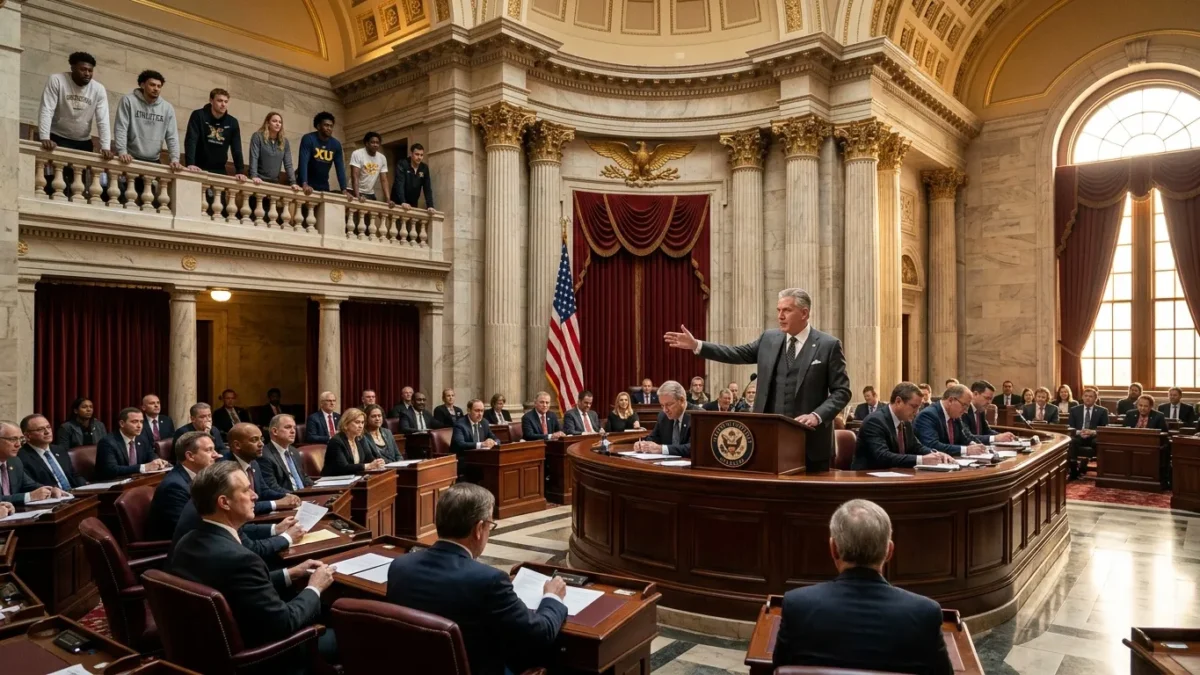
A bipartisan Senate bill co-authored by Ted Cruz and Maria Cantwell may finally give the NCAA what it has desperately needed for years : a real legislative lifeline. After countless false starts on Capitol Hill, Congress, the White House, and major sports stakeholders are now genuinely aligned — and that alignment changes everything.
A rare moment of political convergence around college sports reform
Let’s be clear about what makes this moment different. The Cruz-Cantwell bill isn’t just another piece of legislation gathering dust in committee. Republican and Democratic senators have been working together for at least two months to craft a bill that could actually reach the Senate floor — and this time, the White House is pushing alongside them.
A memo obtained by CBS Sports reveals that a presidential committee on college athletics is actively coordinating a unified letter of support for the bill. That committee, chaired by New York Yankees president Randy Levine and Florida Governor Ron DeSantis, was assembled by President Donald Trump in March 2026 specifically to drive systemic reform across college sports. Twenty-nine individuals from government, MLB, NBA, NFL, and college athletics sit on those committees — and they’ve already compiled a draft framework of preliminary reform ideas.
This level of institutional coordination hasn’t existed before. Previous efforts collapsed precisely because Congress moved without stakeholder buy-in, or stakeholders moved without Congress. Here, the three pillars — legislative, executive, and industry — are pulling in the same direction. Frankly, if this doesn’t move the needle on NCAA reform, nothing will.
The bill is expected to be officially announced as early as this Friday, with legislative language unveiled early the following week. Committee hearings are scheduled to follow in the coming weeks or months, and the stated goal is to push the process forward before Congress’s summer recess begins in August. That’s a tight but realistic window — if the political will holds.
What the Cantwell-Cruz bill could actually change for the NCAA
The SCORE Act, which has long been considered the NCAA’s best legislative vehicle, is set to appear on the House floor next week. But here’s the hard truth : lawmakers believe it won’t clear the 60-vote threshold required in the Senate. That’s why the White House is now backing this separate, bipartisan alternative — and why the Cruz-Cantwell bill is being described as the strongest shot yet at passing meaningful federal legislation for college sports.
So what could this bill actually do ? The exact language hasn’t been released, but the memo points to several key elements from the White House committee’s draft framework :
- Antitrust protections for the NCAA, shielding the organization from litigation that has repeatedly forced rule changes
- Explicit prohibitions on NIL-based salary-cap circumvention, targeting booster collectives that exploit loopholes
- Codification of NCAA rules into federal law, giving them a legal backbone they currently lack
- A potential cap on coaches’ salaries
- The creation of a Group of Six playoff structure
The $20.5 million compensation cap — already in place — has been systematically undermined by booster collectives using NIL deals as a workaround. This bill would, if passed, make that circumvention explicitly illegal. That’s a significant shift. The SCORE Act, by contrast, was primarily a rules-codification vehicle tied to the House settlement, and it lacks many of these more aggressive provisions.
| Feature | SCORE Act | Cantwell-Cruz Bill |
|---|---|---|
| White House backing | No | Yes |
| Antitrust protections | Limited | Explicit |
| NIL circumvention ban | Not included | Expected |
| Senate viability | Below 60 votes | Bipartisan support |
| Coaches’ salary cap | Not addressed | Under consideration |
Why college athletics can’t afford to wait any longer
The urgency here isn’t manufactured. College sports have been operating in legal and financial chaos since the Supreme Court’s unanimous ruling in NCAA v. Alston in 2021, which opened the door to athlete compensation and set off a cascade of antitrust lawsuits. The House v. NCAA settlement alone is expected to cost schools roughly $2.8 billion over ten years — and without federal legislation, more suits will follow.
Cantwell’s office declined to comment on the memo or the bill’s timing, which tells you something : the coordination is deliberate, the rollout is controlled. This isn’t a leak — it’s a signal. The political machinery around this bill is more sophisticated than anything college sports has seen from Capitol Hill in recent memory.
The real test isn’t the announcement. It’s what happens after the committee hearings, when lobbying intensifies and individual senators start calculating political risk. The bill still needs to clear the full legislative process before reaching the Senate floor — and that path, while clearer than ever before, remains genuinely uncertain. If you follow college athletics closely, watch the committee hearings scheduled for this summer : those sessions will reveal whether this bipartisan consensus can survive contact with real legislative pressure, or whether it fractures like every previous attempt at federal reform.
