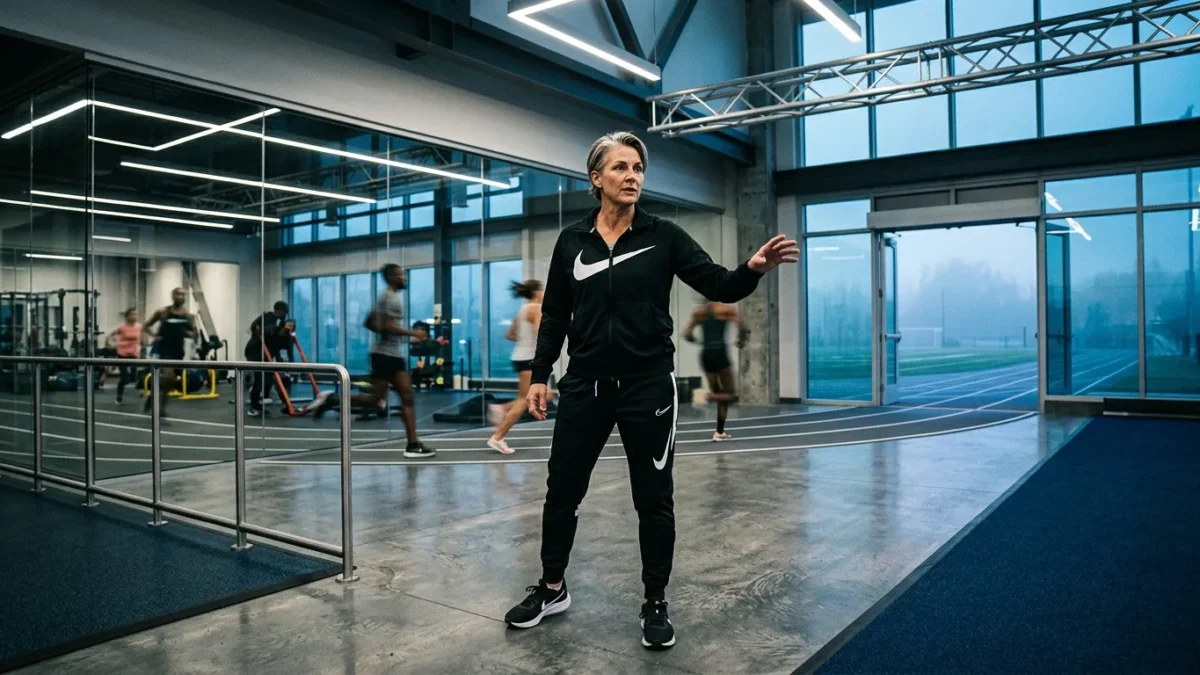
Before dawn on a February morning in Beaverton, Oregon, Amy Montagne is already on set inside the Serena Williams Building on Nike’s Philip H. Knight Campus. The camera crew adjusts the lights. She doesn’t wait — she’s already engaged, sharp, ready. Two takes. Applause. That kind of focused energy, sustained across 21 years and 12 roles at Nike, is exactly why Elliott Hill chose her as President of the Nike brand when he took over as NIKE, Inc. CEO in 2024.
From retail floors to Nike’s top seat : the making of a sport-first leader
Montagne’s career didn’t start in a boardroom. It started on a retail floor in Arizona, where a teenage version of her was already obsessing over buying habits — what people picked up, what they left on the shelf, and why. That curiosity never left. She studied at Santa Clara University, enrolled in the retail management institute, and graduated with a communications degree that sharpened the storytelling instincts she now deploys at global scale. Buyer training at Walmart headquarters, then an allocation analyst role at Gap Inc. in San Francisco — these early steps built a rare combination : data fluency and narrative instinct.
Her former coworker and longtime friend Janet Hayes, now CEO of Crate & Barrel, watched her evolve over decades. Early on, Montagne kept a strict wall between professional and personal. Work was work. That discipline served her, but it also kept people at a distance. Hayes describes a more recent shift : “I’m watching her become a different kind of leader who is braver and a little more vulnerable, and I think that’s an evolution that’s going to take her far.” The pandemic cracked that wall open. When everyone was struggling with the same crisis, pretending otherwise made no sense — and Montagne stopped pretending.
What she brought into the workplace wasn’t oversharing. It was authenticity. A difficult IVF journey. Triplets when she expected one child. Grief and family loss. These experiences didn’t distract from her leadership — they deepened it. “I am who I am because of the life experiences I’ve had,” she says. Charles Williams, Global Vice President of Footwear, puts it bluntly : “She’s a real one. You need that in this organization, because it shows people they can be themselves.”
Her husband Pete, a former Nike category manager who met her after they’d both graduated from the same college, calls her the hardest worker he’s ever met. He also notes something less obvious : the number of times she’s been the only woman in the room — and what she does about it. “What sets her apart is creating a culture of inclusivity. She cares about mentorship, about elevating people’s careers.”
The Nike Sport Offense : Amy Montagne’s strategic blueprint for the brand’s revival
When Elliott Hill returned to Nike as CEO in 2024, the situation was urgent. Upstart brands had been eroding Swoosh market share for years. The brand’s once-unambiguous identity — rooted in athletes, in sport, in performance — had blurred. Hill needed someone to lead what he called the Sport Offense, a full restructuring of Nike’s priorities by sport category. He chose Montagne without hesitation : “I picked Amy because of her passion for this brand and her experience. She creates inspiration, and she creates aspiration.”
Montagne took over her current role in May 2025. Within weeks, she led a brand retreat with her team to define a sharp, sport-anchored vision. The output wasn’t a vague mission statement — it was a concrete operating model built around more than a dozen distinct sport focuses, each with its own culture, aesthetic, and athlete insight. Running. Basketball. Global football. Golf. Tennis. Training. Each one treated as its own world.
| Sport category | Key aesthetic identity | Example athlete |
|---|---|---|
| Running | Personal style meets performance | Sha’Carri Richardson |
| Basketball | Culture and competition | A’ja Wilson, Caitlin Clark |
| Outdoor / ACG | Epic, unique legacy | Winter Games relaunch |
| Football (global) | Community and identity | JuJu Watkins |
Sha’Carri Richardson breaks world records with long nails and false lashes — not despite them, but because they let her show up as herself. That’s the philosophy Montagne has woven into Nike’s sport identity : authentic self-expression and peak performance aren’t in conflict. They reinforce each other. The ACG relaunch at the Winter Games illustrated the same principle — legitimate outdoor heritage, genuine innovation, and a distinct visual language.
Her strategic filter, according to Hill, is always the same question : How is this connected back to sport, back to the athlete ? It’s not rhetorical. It’s a discipline. And it traces back to something oddly specific : in high school, Montagne tried out for the basketball team and didn’t make it. Rather than quit, she became the team’s statistician. She learned to read the whole court, map individual strengths, and use data to make the team better. That’s still exactly what she does — just with a much larger court.
What Nike’s next chapter looks like under her watch
The demands on Montagne are relentless. Her days span athlete lunches, global brand strategy sessions, product reviews, and — yes — a photo with Kim Kardashian during the NikeSKIMS launch in New York. That last one earned her serious credibility with her teenage triplet sons. The range is part of the job description she wrote for herself.
Williams describes her management style in precise terms :
- She comes to your office as often as you come to hers — a small gesture that signals real respect
- She holds herself to the same standards she sets for her team
- She gives people tools, space, and clarity — then expects excellence
- She champions women visibly : a framed copy of Nike’s 1996 “If You Let Me Play” print ad sits on her desk
Hill frames the long-term bet plainly : “Amy’s the leader Nike needs right now.” The structure she’s built, the expectations she’s set, the sport-first clarity she’s imposed — all of it is designed to unlock what he calls “another wave of growth.” For a brand generating tens of billions in annual revenue, that’s not a small claim. But Montagne has never been interested in small ambitions. Her guiding question, unchanged across two decades, stays : How do we lead this brand to greatness ? The answer, increasingly, runs straight through sport.
