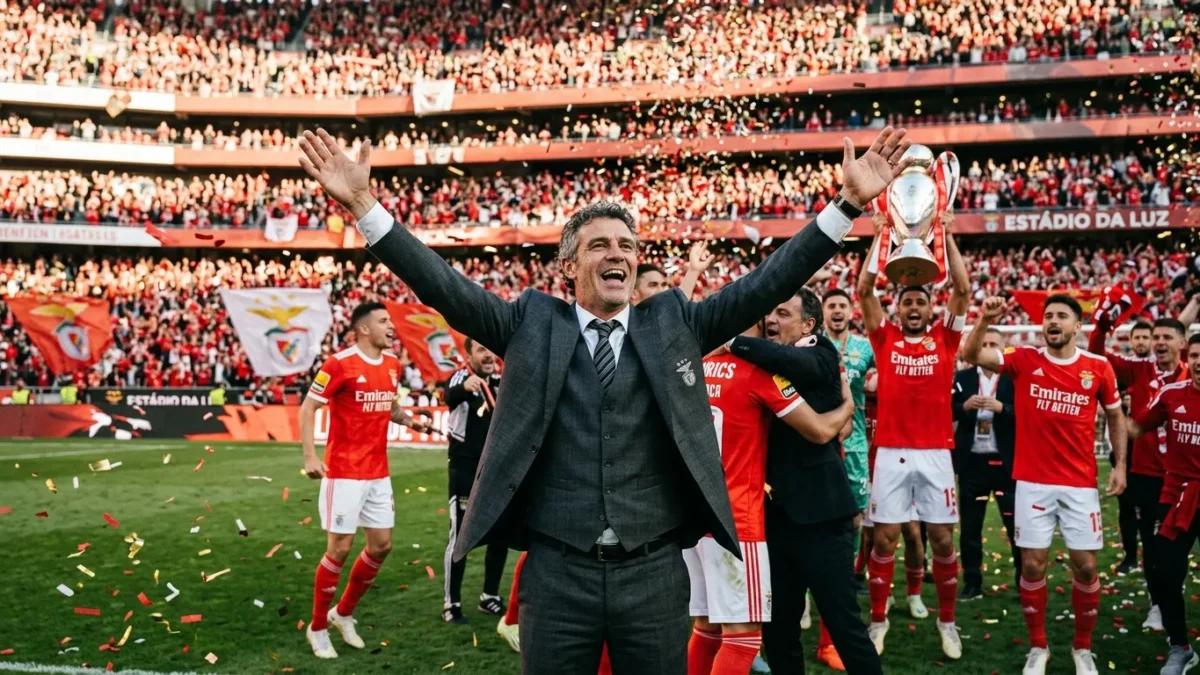
Unbeaten across 34 league matches, yet walking away without a title — that’s the paradox Jose Mourinho leaves behind at Benfica. On May 17, 2026, the Lisbon club wrapped up their Primeira Liga campaign with a 3-1 win over Estoril, confirming a record that few managers ever achieve and even fewer can fully celebrate.
An unbeaten run that still wasn’t enough
Benfica finished the 2025-26 season with 23 victories, 11 draws, and zero defeats. That’s a remarkable achievement by any measure. Yet Porto claimed the title with 88 points, leaving Mourinho’s side stranded on 80 — a gap of eight points that tells a brutal story about how competitive the Primeira Liga has become.
Sporting finished second on 82 points, which means Benfica ended up third despite never losing a single game all season. Frankly, that’s one of the most frustrating outcomes a manager can experience. You go through an entire campaign without losing, and you still finish off the podium of champions.
Here’s what the final standings looked like for the top three :
| Club | Points | Position |
|---|---|---|
| Porto | 88 | 1st (Champion) |
| Sporting | 82 | 2nd |
| Benfica | 80 | 3rd |
The win against Estoril on the final day was emphatic but ultimately symbolic. Mourinho guided his team to an invincible domestic campaign, and the result still felt hollow. That gap between performance and reward is what makes this season so difficult to categorize.
Mourinho and Benfica : a short chapter with a long legacy
The 63-year-old took over at Benfica in September 2025 on a two-year contract. His return to Portugal was seen as a homecoming of sorts — a chance to reconnect with the country that shaped him before he conquered Europe. And yet, the storyline has taken a sharp turn.
Florentino Pérez, Real Madrid’s president, reportedly wants Mourinho back at the Bernabéu, 13 years after his first spell with the Spanish giants ended in 2013. Negotiations are reportedly in their final stages, which means the victory over Estoril could well be Mourinho’s last match as Benfica manager. For a coach who managed Chelsea, Inter Milan, Manchester United and Tottenham between his two Real spells, returning to the Santiago Bernabéu would be a full-circle moment.
His time at Benfica was short but statistically outstanding. The question now is whether an unbeaten season without silverware counts as success or failure on his CV. My take ? It’s both — impressive as a feat, frustrating as an outcome.
A rare European club : the “invincible losers” in history
This isn’t the first time Benfica have gone through an entire league season undefeated and still ended up empty-handed. Back in 1977-78, Porto pipped them to the title on goal difference, with the Dragons drawing two fewer games. The pattern of near-misses is almost part of the club’s identity.
What makes the 2025-26 edition even more striking is the historical company Benfica now keeps. Only a handful of European clubs have completed a full league season unbeaten and still missed out on the title this century :
- FC Sheriff (Moldova, 2024-25) — unbeaten season, no title
- Red Star Belgrade (Serbia, 2007-08) — same cruel fate
- Benfica (Portugal, 2025-26) — the latest addition to this exclusive list
Three clubs. Three flawless campaigns. Zero championships. It’s a club no manager wants to join, and yet Mourinho now finds himself as its most famous member.
The 1977-78 precedent is particularly painful to revisit. Nearly five decades later, history has effectively repeated itself at the Estádio da Luz. Porto were simply more efficient, converting their draws into wins where Benfica couldn’t. Eleven draws over a season is the difference between celebrating and watching rivals lift the trophy.
What this season reveals about elite football’s fine margins
The Mourinho-Benfica episode teaches something precise about modern top-flight football : being unbeatable is not the same as being unstoppable. Porto won the title not because they were more consistent in avoiding defeat — they simply converted opportunities more ruthlessly.
For Mourinho, managing elite expectations has always been part of the job. At Inter Milan in 2010, he won the treble. At Real Madrid, he delivered La Liga in 2012 with a record 100 points. Trophyless invincibility is a new experience for him, and it’s one worth analyzing seriously.
If the move to Real Madrid materializes, Mourinho will arrive at the Bernabéu with a very specific recent track record : undefeated in 34 league games, but unable to convert that dominance into a title. That’s not necessarily a red flag — it speaks more to the structural depth of Portuguese football than to any tactical failure on his part.
The real test will come in the Champions League arena, where Mourinho has historically shone the brightest. Real Madrid’s ambitions are built around European glory, and if Florentino Pérez is willing to bring back the Special One, he clearly believes that the experience of a 63-year-old tactician outweighs the complications of their previous working relationship. Whether this second act at the Bernabéu produces the magic of 2011-12 or the friction of 2012-13 is the question that will define the next chapter of one of football’s most compelling careers.
