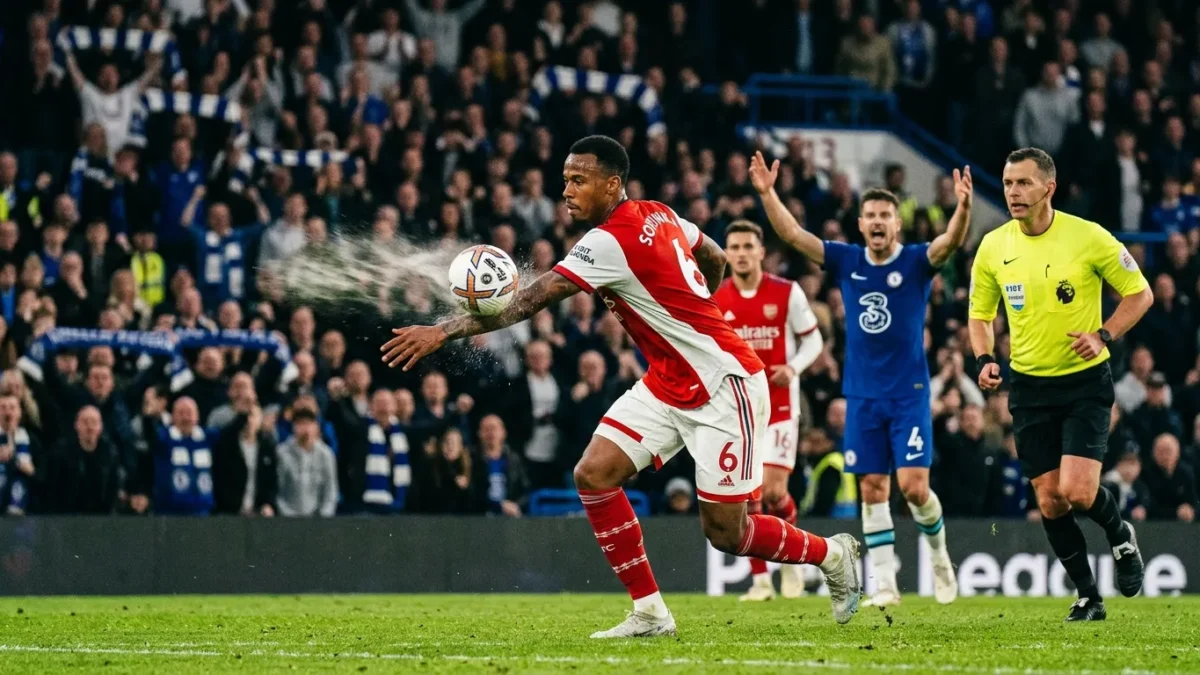
Football thrives on controversy, but few debates ignite quite as much fury as handball decisions. The Premier League handball rule has sparked yet another fierce argument, this time centred on Bryan Mbeumo. Referees, pundits and managers are once again at loggerheads — and frankly, it’s hard to blame them.
The Mbeumo incident and why it divides opinion
The Mbeumo handball call sits at the heart of a genuinely awkward situation. The ball struck his arm and was blocked — it didn’t lead directly to a goal. Because of that distinction, the decision could go either way under current rules. Had his shot gone in, the goal would have been automatically disallowed. Since it was stopped, the offence becomes a matter of subjective interpretation. That’s where referee Salisbury had room to reach a different verdict compared to what a goal scenario would have forced.
The crucial question referee and VAR officials must ask themselves is : “what would football expect ?” In the Mbeumo case, the ball would have moved away from him if his arm hadn’t intervened. That detail matters enormously. Awarding handball here was arguably the less controversial path — yet the decision still sparked outrage, which tells you everything about the impossible position officials find themselves in.
Former referee observer Cann put it bluntly : he sees both sides, but believes the current rulebook has grown too complicated. Too many clauses, too many conditions — and the result is exactly this kind of mess, match after match.
A brief history of chaotic handball rulings
This isn’t a new problem. Back in January 2020, West Ham’s stoppage-time equaliser against Sheffield United was disallowed via VAR because the ball had touched Declan Rice’s arm in the build-up. Rice was furious : “Anybody who has played football or been around the game knows it was a good goal,” said manager David Moyes. Rice himself described the dressing room as “fuming.” The goal had nothing to do with deliberate intent — and yet it was ruled out.
| Incident | Year | Outcome | Rule applied |
|---|---|---|---|
| Rice arm — West Ham vs Sheffield Utd | 2020 | Goal disallowed | Pre-2021 build-up rule |
| Lemina arm — Fulham (Josh Maja goal) | 2021 | Goal disallowed | Pre-2021 build-up rule |
| Rutter arm — Brighton vs West Ham | Dec 2025 | Goal allowed | Post-2021 rule (scorer only) |
| Mbeumo arm — Premier League 2026 | 2026 | Controversial call | Post-2021 rule (subjective) |
The Fulham case involving Mario Lemina was the breaking point. His accidental handball directly before Josh Maja scored led to the goal being chalked off — a decision so widely condemned that football’s lawmakers felt forced to act. In 2021, the rule was amended : accidental handball in the build-up would no longer automatically void a goal. Only the goalscorer’s own handball now triggers an automatic disallowance.
That change brought its own complications. The Brighton vs West Ham match in December 2025 illustrated this perfectly. Georginio Rutter’s arm was struck by the ball — but he didn’t score immediately after. The ball fell to Jan Paul van Hecke, who set up Rutter to finish. Legal ? Yes, under current law. Fair ? Nuno Espírito Santo thought not, and he made his feelings clear. The goal stood regardless.
Is it time to go back to deliberate handball only ?
Cann’s argument is straightforward and, for me, hard to dismiss : return to deliberate handball as the sole criterion. Strip out the clauses about “unnatural arm positions” and build-up scenarios. If it’s clearly intentional, punish it. If not, play on.
Here’s what simpler handball law would actually solve :
- Eliminating endless VAR debates over arm position geometry
- Reducing the number of disallowed goals that infuriate fans and players alike
- Giving referees a cleaner, less ambiguous framework to apply under pressure
- Restoring a degree of consistency that the current system clearly cannot deliver
Critics of this approach argue that deliberate intent is itself subjective. True — but far less so than judging whether an arm is in a “natural” or “unnatural” position at 30 frames per second. At least intent has a more intuitive read for players, fans and officials. The current hybrid system, which mixes intentionality with anatomical criteria, satisfies nobody.
Lawmakers at IFAB — the International Football Association Board, which controls the Laws of the Game — have updated handball rules multiple times since 2019. Each revision has generated fresh controversy. At some point, the cycle has to stop. The solution might not be a new layer of complexity, but a genuine simplification. Football doesn’t need smarter rules. It needs clearer ones — rules that a fan in the stands can understand without needing a flowchart.
