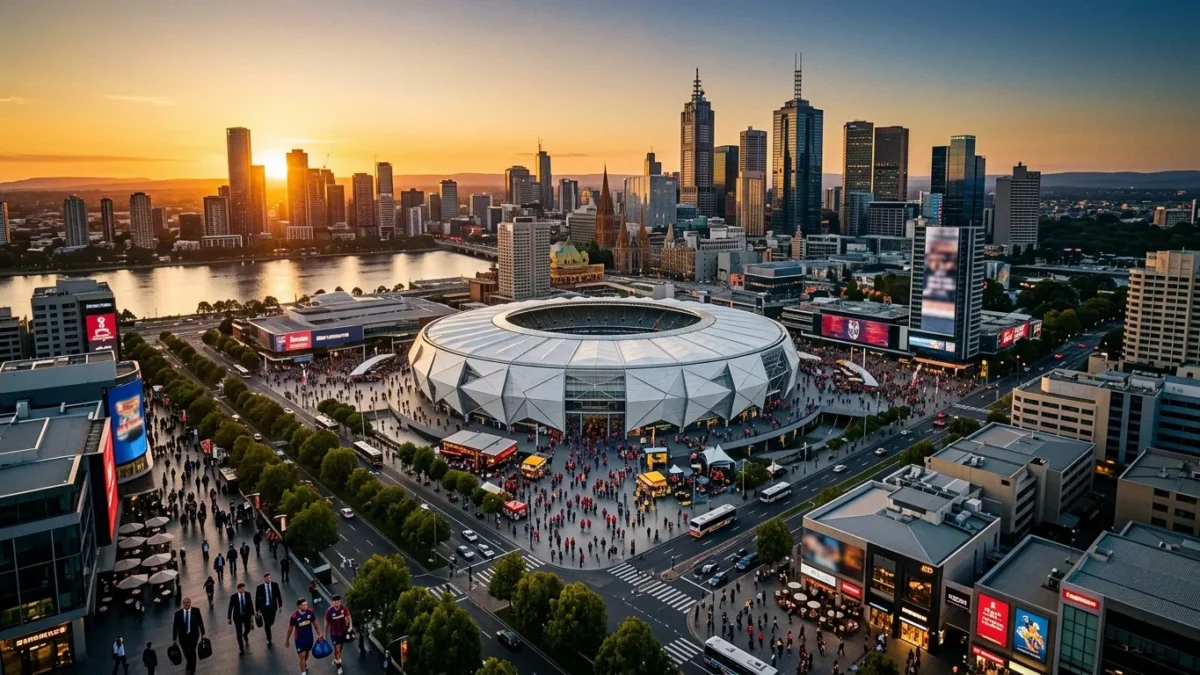
Atlanta didn’t become the top sports business city by accident. Sixty years ago, the city lured the Milwaukee Braves south with a brand-new ballpark — and that calculated move set the tone for everything that followed. Today, Atlanta’s sports business ecosystem is the benchmark every other market measures itself against. World-class venues, aggressive team ownership, deep-pocketed sponsors, and city officials who actually understand economic development have combined to produce something genuinely rare : a sustainable, diversified sports economy.
What makes a city a top sports business market
Ranking cities on their sports business performance isn’t just about counting franchises. Sports Business Journal’s fourth annual Best Sports Business Cities™ study analyzed 2,384 markets — every city hosting at least one professional team, a Division I college program, a permanent event, or a major industry stakeholder. The scope of the data is striking.
Here’s what the 2026 study tracked across all markets :
- 9,409 unique entities across all categories
- 520 active construction projects
- More than 1,000 naming rights deals, uniform patches, and on-field logos
- 1.48 billion in total attendance
- Over 300 sports industry B2B events
- 1,600+ sponsors across all markets
Those numbers reveal something important : the sports business industry operates at a scale most people underestimate. A city’s ranking reflects not just its teams, but the entire commercial infrastructure surrounding them — from construction pipelines to sponsorship density to event calendars.
Atlanta checks every single box. Mercedes-Benz Stadium, the College Football Hall of Fame, the Georgia World Congress Center, and Centennial Olympic Park form an urban sports and entertainment district that few cities can replicate. The aerial view alone tells the story : this is a city that invested deliberately, not reactively.
The 2026 top 10 sports business cities ranked
Frankly, the top of this list won’t surprise anyone who tracks the industry closely. What’s interesting is the mix of established powerhouses and cities punching well above their weight.
| Rank | City | Key strength |
|---|---|---|
| 1 | Atlanta | Venue infrastructure, sponsorship ecosystem, event diversity |
| 2 | New York City | Media market size, global brand exposure |
| 3 | Indianapolis | B2B events, convention-driven sports economy |
| 4 | Charlotte | Fast-growing market, strong corporate base |
| 5 | Minneapolis-St. Paul | Multi-sport presence, venue investment |
| 6 | Los Angeles | Entertainment crossover, franchise value |
| 7 | Las Vegas | Rapid expansion, destination event hosting |
| 8 | Phoenix | Year-round climate, franchise growth |
| 9 | Kansas City | Fan loyalty, stadium development momentum |
| 10 | Miami | International market access, luxury sponsorship |
Indianapolis at number 3 is the one that consistently surprises outsiders. The city has built a remarkably efficient sports economy centered on B2B events and convention infrastructure rather than raw market size. It’s a reminder that you don’t need to be New York to win at this game.
Las Vegas entering at number 7 reflects a seismic shift. The Raiders, the Golden Knights, and the incoming Athletics have transformed a tourism city into a legitimate multi-sport market in under a decade. That trajectory is almost unprecedented in modern sports geography.
Beyond the top 10 : the cities worth watching
The real insight in a ranking like this comes from positions 11 through 50. These are the markets where opportunity is most visible — where infrastructure is being built right now and where early movers in sponsorship and development still have room to operate.
Salt Lake City at 12 is a standout. The city is aggressively positioning itself ahead of the 2034 Winter Olympics, and that long-term event horizon is already attracting investment. Nashville at 15 continues its improbable rise, fueled by the NFL’s Tennessee Titans and a booming hospitality economy that makes sponsorship activation genuinely effective.
Further down the list, Research Triangle, North Carolina (ranked 23rd) and Greenville, South Carolina (45th) represent a different kind of sports business opportunity — markets where college athletics and minor league infrastructure create dense local ecosystems without the overhead costs of major-market operations. For brands looking for efficiency over reach, these cities deserve serious attention.
Columbus at 26 and Cincinnati at 34 show how the Midwest continues to produce undervalued sports business markets — cities with loyal fan bases, reasonable operating costs, and growing venue pipelines. Detroit at 29 is another one worth monitoring, particularly given ongoing stadium conversations.
Frisco, Texas at 46 and Fort Worth at 49 demonstrate that even within a single metro region, distinct sports business identities can develop. These aren’t just suburbs of Dallas — they’re building their own event infrastructure and attracting their own sponsor relationships.
How to use city rankings as a strategic business tool
If you’re a brand, an investor, or a venue developer, the Best Sports Business Cities™ ranking is a decision-making instrument, not just a league table to debate. The gap between rank 1 and rank 50 isn’t purely about market size — it’s about density of opportunity per dollar invested.
Atlanta at the top means the competition for sponsorship assets is fierce and prices reflect that. A brand entering that market in 2026 needs deep pockets and a clear differentiation strategy. Meanwhile, a city like Oklahoma City at 47 or Louisville at 48 offers naming rights and partnership opportunities at a fraction of the cost, with audiences that are arguably more engaged per capita.
The practical move ? Match your budget to the market tier where your category isn’t yet saturated. If you’re a regional financial services brand, Charlotte or Indianapolis will outperform New York City for your specific objectives — every time. The data makes that case clearly, and the 2026 rankings give you the map to act on it.
