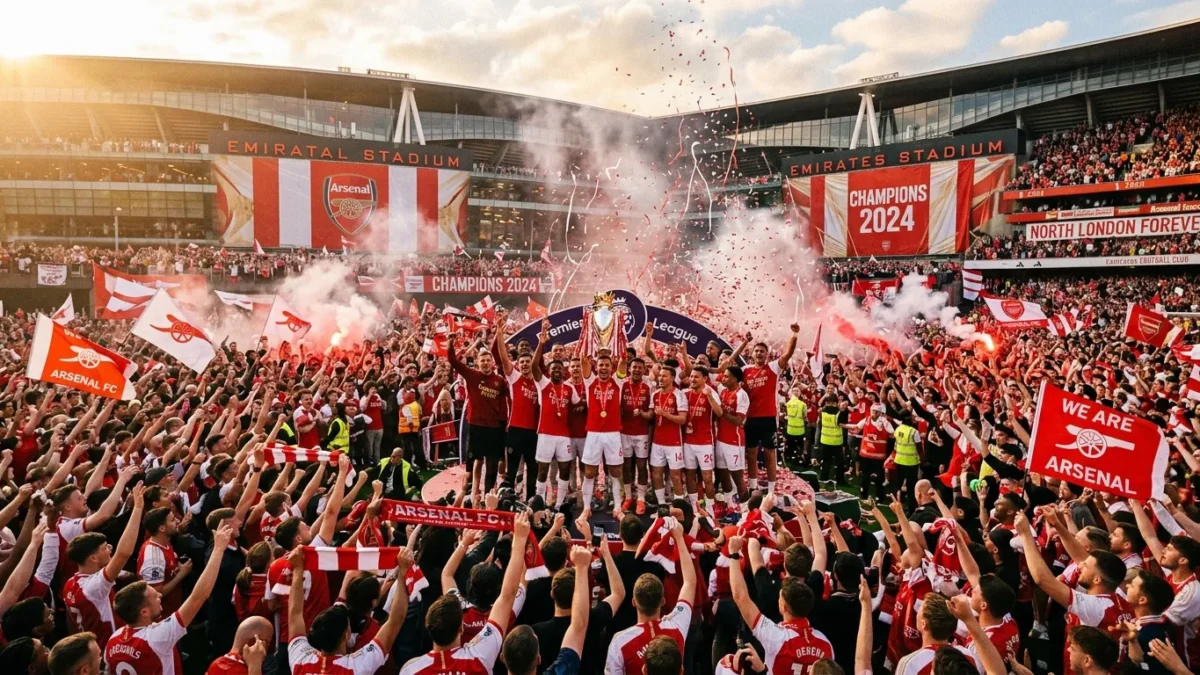
Twenty-two years of waiting ended on a Tuesday night in May 2026. Arsenal are Premier League champions again, and the manner of their title triumph — grinding, dramatic, occasionally controversial — tells you everything about what Mikel Arteta built at the Emirates. This wasn’t a procession. It was a battle fought across every matchweek, with City refusing to die until the very last weeks of the campaign.
A squad built to go the distance
Last season, Liverpool’s depth was what separated them from the rest. Arsenal watched and took notes. Over the summer of 2025, Arteta’s board sanctioned a spending spree exceeding £250m, bringing in eight new players while losing only out-of-contract Thomas Partey from the first-team core. That kind of net spend — with minimal returns from sales — was a serious statement of intent.
The headliner was Viktor Gyokeres, the Sweden striker who arrived from Sporting for £64m in July 2025. Gunners fans had been demanding a reliable number nine for years. Gyokeres delivered exactly that. Alongside him, central midfielder Martin Zubimendi crossed from Real Sociedad, adding composure and range to a midfield that had sometimes lacked creativity under pressure.
The additions didn’t stop there. Here’s a snapshot of the key arrivals :
- Viktor Gyokeres — striker, from Sporting (£64m)
- Martin Zubimendi — central midfielder, from Real Sociedad
- Piero Hincapie — centre-back, loan from Bayer Leverkusen
- Noni Madueke — winger, from Chelsea
- Eberechi Eze — attacking midfielder, from Crystal Palace
Eze, in particular, proved transformative. He nearly joined Tottenham before Arsenal moved decisively to sign him — a detail that made his contributions against Spurs all the sweeter. By November, he’d scored a hat-trick in the north London derby, sealing Arsenal’s biggest points advantage after 12 games in Premier League history. That moment felt symbolic : the right player, at the right club, at exactly the right time.
Dramatic turning points that defined the title race
Strip away the noise and a handful of moments genuinely decided where this trophy was going. Gabriel Martinelli’s 93rd-minute equaliser against Manchester City in September was the first of them. Arsenal were heading for defeat, trailing at home, with Pep Guardiola’s side comfortable and disciplined — even switching to a back five to protect the lead. That three-point swing, from a likely City win to a draw, proved enormous in the final standings.
Seven days later, Arsenal were celebrating in injury time again. A visit to St James’ Park had historically been brutal for Arteta’s teams — three losses and zero goals in the three previous trips. Newcastle led through Nick Woltemade, a VAR review had wiped out an Arsenal penalty, and the away end feared the worst. Then Mikel Merino headed level in the 84th minute. Then Gabriel nodded home from a corner in the 96th minute. With Liverpool dropping points at Crystal Palace the day before, Arsenal suddenly sat two points off top spot.
| Match | Moment | Impact |
|---|---|---|
| Arsenal vs Man City (Sept) | Martinelli 93′ equaliser | +3 swing in title race |
| Newcastle vs Arsenal (Sept) | Gabriel 96′ winner | Arsenal close to 2 pts off top |
| Arsenal vs Spurs (Nov) | Eze hat-trick | Six-point clear, record 12-game lead |
| Everton vs Man City (Apr) | Guehi backpass error | City drop two vital points |
City’s form collapse in early 2026 also played a decisive role. Four league games without a win in January — including stalemates against Sunderland, Chelsea and Brighton — allowed Arsenal to stretch their advantage to seven points despite their own inconsistencies. Patrick Dorgu’s goal for Manchester United in the derby felt like the final nail in City’s momentum.
Then came April’s clash at the Etihad. City won, with Haaland scoring the winner. But the match will be remembered for Gabriel’s near red card after a forehead clash with Haaland late on. The Norwegian striker stayed on his feet — a decision that effectively saved the Arsenal defender from suspension. Missing Gabriel for three games at that stage of a six-point title race could have been catastrophic.
When goalkeepers and video referees write history
The penultimate chapter of Arsenal’s title-winning season had everything : a brilliant save, a stoppage-time goal, a VAR reversal, and enough drama to last a decade. West Ham, fighting relegation, gave Arsenal their toughest examination of the run-in. Matheus Fernandes found himself six yards out with only David Raya to beat — and Raya flung out his right leg to make a save that, in hindsight, won the title.
Leandro Trossard fired Arsenal ahead in the 83rd minute, but West Ham substitute Callum Wilson bundled in what looked like a leveller deep into added time. The away end fell silent. Then the VAR screen lit up. After a lengthy review, the goal was ruled out : Pablo had his arm across Raya’s chest throughout the corner routine, constituting a foul. Several other penalty shouts — for or against Arsenal — were dismissed.
City had already dropped points at Everton in bizarre fashion the week before, Marc Guehi’s under-hit backpass gifting Thierno Barry an equaliser that sparked a 3-3 collapse. Two points lost there, two more dropped against West Ham. Arsenal held on. The title was heading back to north London for the first time since 2004 — and frankly, after three consecutive second-place finishes, they’d earned every last painful minute of it.
