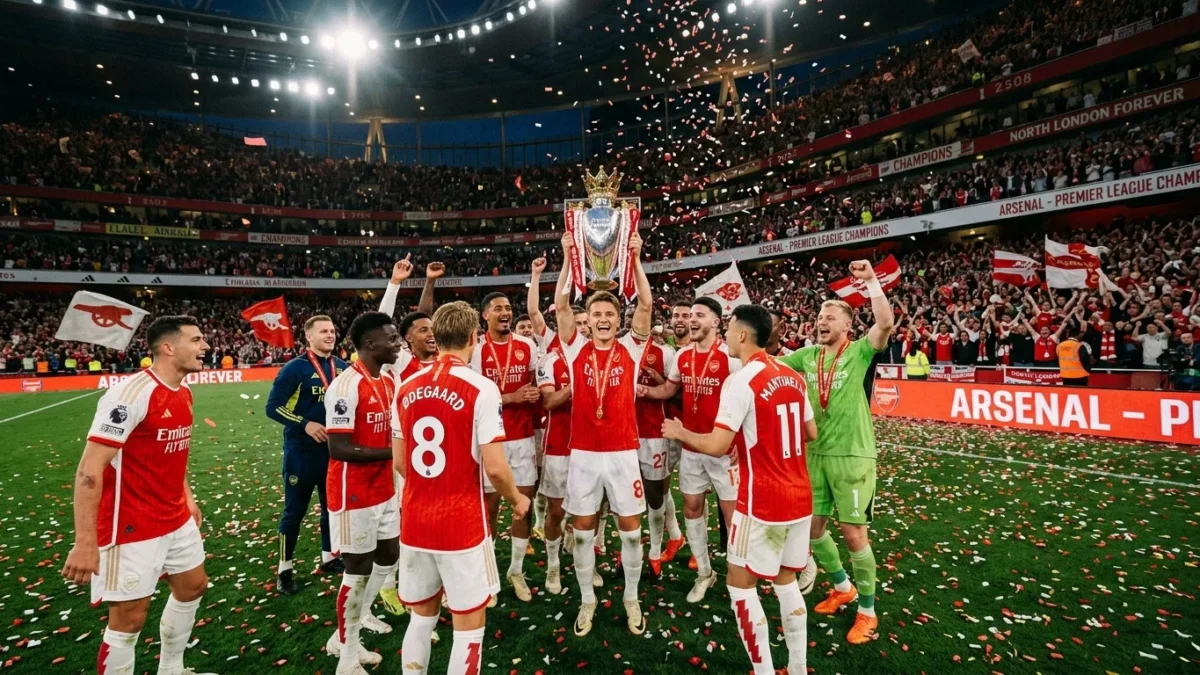
Twenty-two years of hurt, three consecutive runner-up finishes, and one relentless summer transfer window later — Arsenal are Premier League champions. Mikel Arteta’s side finally shook off the nearly-men label that had haunted the club since their last title in 2004, holding off Manchester City across a gruelling, drama-packed season. This is how it happened.
A summer overhaul that changed everything
The blueprint was clear after Liverpool strolled to the 2024-25 title with four games to spare, their squad depth proving decisive. Arsenal’s response was emphatic : eight new players signed, with only out-of-contract midfielder Thomas Partey leaving as a notable first-team departure. Total outlay exceeded £250 million — and almost none of it came back through sales.
The headline arrival was Sweden striker Viktor Gyokeres, who joined from Sporting for £64m in July 2025. Gunners fans had demanded a clinical centre-forward for years, and Gyokeres delivered exactly that. Alongside him came central midfielder Martin Zubimendi from Real Sociedad, a composed presence in the engine room Arsenal had long been missing.
The squad was further strengthened with real tactical flexibility. Bayer Leverkusen’s Piero Hincapie arrived on loan to reinforce the backline, while two cross-London transfers brought Noni Madueke from Chelsea and Eberechi Eze from Crystal Palace. By May, with a Champions League final still on the horizon, that spending looks like one of the smartest investment decisions in recent Premier League history.
| Player | Previous club | Role |
|---|---|---|
| Viktor Gyokeres | Sporting | Striker |
| Martin Zubimendi | Real Sociedad | Central midfielder |
| Eberechi Eze | Crystal Palace | Attacking midfielder |
| Noni Madueke | Chelsea | Winger |
| Piero Hincapie | Bayer Leverkusen (loan) | Centre-back |
The moments that defined Arsenal’s title-winning campaign
Forget the final day — this title was won in September. Gabriel Martinelli’s 93rd-minute equaliser against Manchester City was the kind of moment that reshapes a whole season. City had taken the lead through Erling Haaland and Pep Guardiola switched to a back five, sitting deep and banking on the clean sheet. For long stretches, it looked like working — Arsenal lacked the creativity to crack them open.
Then substitutes Eze and Martinelli combined in stoppage time, and suddenly a potential three-point swing became just one. Had City held on, Guardiola’s defensive masterclass would have been the story. Instead, Arsenal’s depth off the bench stole the headlines. A taste of things to come.
Seven days later, Arsenal were celebrating again in injury time — this time at St James’ Park, a ground that had yielded three straight defeats and zero goals in previous visits. Newcastle led through Nick Woltemade, a penalty had been overturned by VAR, and the atmosphere was hostile. Mikel Merino’s header in the 84th minute levelled things up. Then, in the 96th minute, Gabriel nodded in from a corner to complete a stunning turnaround. Liverpool had slipped at Crystal Palace the day before. Arsenal were suddenly two points off the top.
November brought the north London derby — and Eze’s finest hour. City had just lost 2-1 to Newcastle, handing Arsenal the chance to go six points clear. Tottenham were dispatched comprehensively :
- Arsenal led 2-0 at half-time
- A third goal arrived within seconds of the restart
- Richarlison pulled one back, but the outcome was never in doubt
- Eze completed his first senior hat-trick to seal it
It gave Arsenal their biggest advantage after 12 games in any Premier League season. For Eze, who had reportedly come close to joining Spurs before choosing Arsenal, the timing was delicious.
Dropped points, nerves, and the moments that nearly cost them
Manchester City’s dismal start to 2026 handed Arsenal breathing room they hadn’t expected. Guardiola’s side failed to win any of their first four league games in January — a stalemate at Sunderland, then dropped points at home to Chelsea and Brighton. Arsenal had their own slip-ups, but still extended their lead to seven points at the top of the table.
April’s trip to the Etihad was the defining test. City won it through a Haaland second-half winner, cutting the gap back to six points with a game in hand. The real talking point, though, was an incident between Haaland and Gabriel — the Arsenal defender moved his head forward after the pair squared up. Haaland stayed on his feet. Had he gone down, Gabriel would almost certainly have been sent off for violent conduct, ruling him out for multiple games at a critical moment. One of the luckiest escapes of the entire season.
City’s title push then unravelled at Everton. Leading through Jeremy Doku, they looked set for three points until Marc Guehi’s underhit backpass in the 68th minute let Thierno Barry equalise. David Moyes’ side scored three in 13 minutes. City clawed back a 3-3 draw deep into stoppage time, but two dropped points meant Arsenal held the advantage.
The final act came at West Ham. David Raya’s point-blank save from Matheus Fernandes proved pivotal — moments later, Leandro Trossard fired Arsenal ahead in the 83rd minute. West Ham thought they’d equalised through Callum Wilson in injury time. VAR disagreed : Pablo had held Raya’s arm from a corner, and the goal was correctly disallowed. Arsenal clung on. The title was theirs.
For any Arsenal supporter genuinely believing in this squad’s potential next season — and with a Champions League final already booked — Arteta’s work is far from finished. The 2025-26 title is a foundation, not a ceiling.
