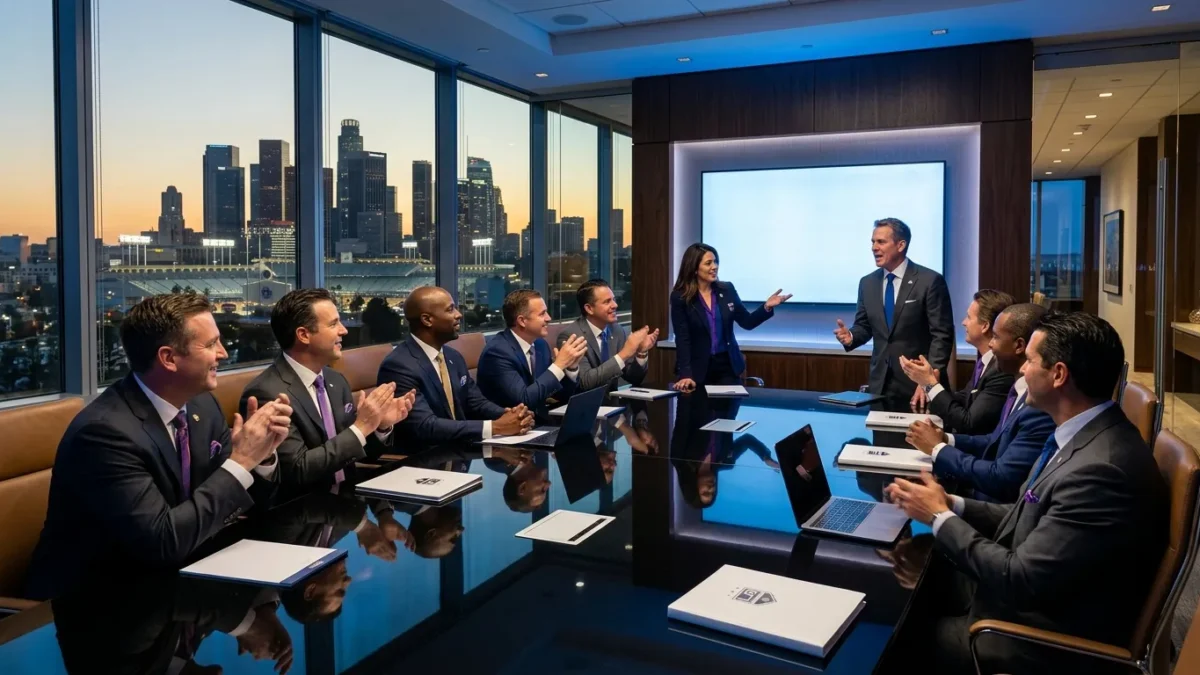
Mark Walter didn’t just buy a basketball team. When the Guggenheim Partners CEO became majority owner of the Los Angeles Lakers in October 2025, he brought with him a philosophy forged over more than a decade of reshaping the Dodgers into one of sports’ most formidable organizations. The question isn’t whether change is coming to the Lakers. It’s how deep that change will go.
The Dodgers blueprint : what made it work
Back in October 2014, Walter hired Andrew Friedman away from the Tampa Bay Rays to become the Dodgers’ president of baseball operations. Friedman had started his career as a private equity analyst at MidMark Capital, where his job was precisely to identify where organizations were weak, where they were strong, and where investment could shift the balance. That background proved transformative in baseball.
A few weeks after his arrival, Friedman brought in Farhan Zaidi — MIT degree, PhD in economics from Cal — from Billy Beane’s Oakland Athletics. Together, they built one of the most analytically sophisticated front offices in professional sports, with deep medical staffs, robust data infrastructure, and multiple experienced executives at every level. The result ? Three World Series titles in six years.
Alex Anthopoulos, now general manager of the Atlanta Braves, spent two years with the Dodgers after six seasons leading the Toronto Blue Jays. His verdict is unambiguous : “I became a better GM because of the two years I spent with those guys — and it has nothing to do with strategy or what type of players to sign.” He describes working with Friedman and Zaidi as “getting a PhD.” Their skills, he insists, are transferable to any industry.
Walter seems to agree. And he’s now betting that same blueprint can work in the NBA.
Lakers execs shake-up : diagnosing a lean operation
For years, the Lakers ran one of the NBA’s thinnest front offices. No assistant GMs. A tiny analytics team. A small medical and performance group. Even JJ Redick, hired as head coach in June 2024, reportedly told a friend he was surprised by how lean the organization was behind the scenes. For a franchise with 17 championships, that gap between glamour and infrastructure was striking.
Walter began evaluating the Lakers well before officially taking majority control. According to an agent at a major sports firm, “He and his Dodgers people called everyone before they bought the team.” Many of those calls came from Zaidi, who served as GM of the San Francisco Giants from 2018 to 2024 before returning as a special adviser to both the Dodgers and Walter in 2025.
Since the takeover, Friedman and Zaidi have worked largely in the background. Their focus has been structural. Around February 2026, Zaidi began contacting agents representing front office and medical personnel. The Lakers subsequently made an offer to Steve Senior, assistant GM of the Minnesota Timberwolves, for the role of executive vice president of basketball operations — a position he ultimately declined. Lakers president of basketball operations Rob Pelinka has since confirmed the team is hiring two assistant general managers, one focused on personnel, the other on strategy and analytics, with Friedman and Zaidi sitting in on interviews.
| Area | Lakers (before Walter) | Dodgers model (Friedman era) |
|---|---|---|
| Analytics staff | Minimal | One of baseball’s largest |
| Assistant GMs | None | Multiple experienced executives |
| Medical/performance | Small group | Robust, cutting-edge |
| Biomechanics lab | Not in place | Fully operational at Dodger Stadium |
Pelinka himself has been candid about the scale of ambition : “It’s a full rebuild and retool,” he told reporters after the Lakers were swept by the Oklahoma City Thunder in the second round. That framing matters — it signals not a cosmetic refresh, but a fundamental rethinking of how the organization operates.
Performance science, player development and what’s actually changing on the ground
One telling detail captures the direction of travel. During the 2026 playoffs, while Austin Reaves was rehabbing an oblique injury, the Lakers reportedly directed him to work with the Dodgers’ medical team at Dodger Stadium. That’s not a minor logistical footnote — it signals where Walter’s organization places its trust.
Pelinka confirmed that a biomechanics lab is being built in collaboration with the Dodgers. For context, check out the latest NBA trade rumors and basketball highlights to understand how player health infrastructure is increasingly shaping roster decisions across the league.
Friedman has always seen medical excellence as a recruiting lever, not just a support function. As he put it recently to Sports Illustrated : “The real guiding-light principle for us is trying to become a destination spot — where our own players don’t want to leave and players from other organizations want to come.” That culture, he argues, doesn’t just attract stars. It maximizes what those stars can actually deliver.
Here’s what the organizational upgrade concretely targets :
- Building a full-scale analytics and data science department from near scratch
- Hiring experienced basketball executives with front office depth
- Establishing a performance science infrastructure rivaling top NBA organizations
- Integrating biomechanics and injury prevention protocols borrowed from the Dodgers
Frankly, the Lakers have never struggled to attract talent. LeBron James didn’t move to L.A. for the analytics stack. But today’s NBA is won as much in the front office as on the court. The franchises consistently competing deepest into June — Boston, Golden State, Oklahoma City — all share one trait : organizational depth that outlasts any single superstar. Walter knows it. Friedman knows it. And now, whether the basketball world is ready or not, the Lakers are finally building for it.
