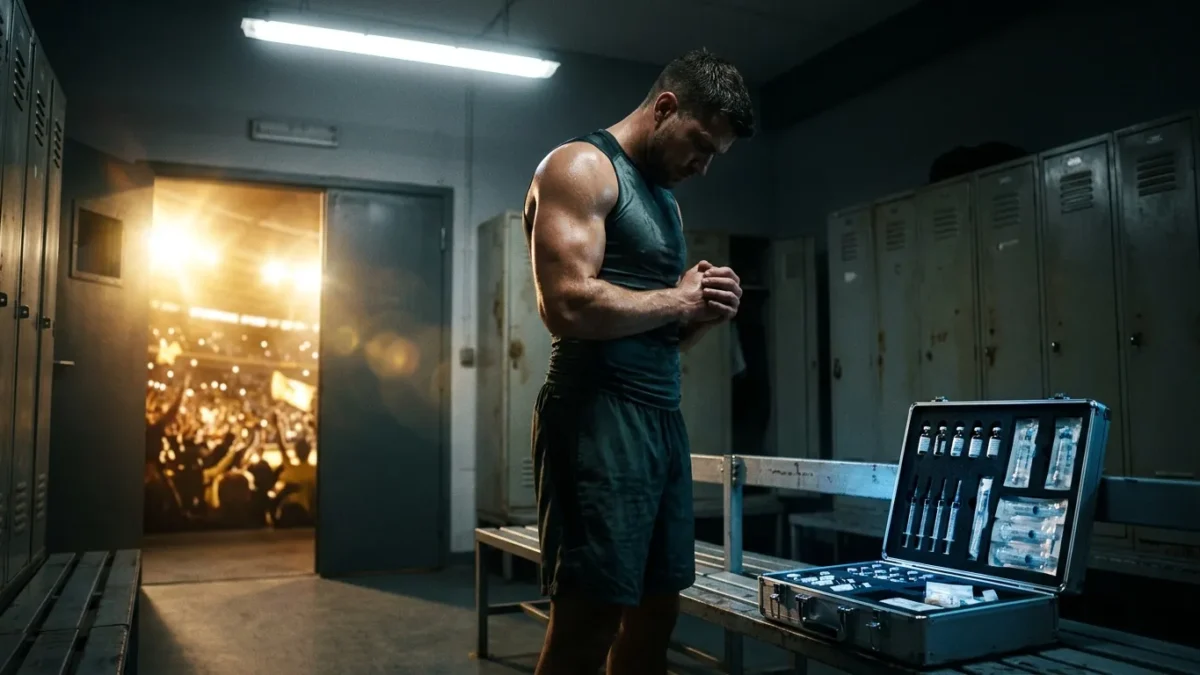
A one-day competition launched in Las Vegas this past weekend didn’t just push the boundaries of elite sport — it dismantled them entirely. The Enhanced Games, held in the shadow of a casino on May 22, 2026, openly welcomed the use of performance-enhancing drugs. Not tolerated. Not overlooked. Welcomed, supervised, and monetized. The reaction from the global sports establishment was swift and damning.
An event built entirely around doping
Forty-two athletes competed in this inaugural event, drawn from disciplines including swimming, sprinting, and weightlifting. Among them : past Olympic medalists such as American swimmer Cody Miller, Irish swimmer Shane Ryan, British sprinter Ben Proud, and U.S. sprinter Fred Kerley. Their presence alone guaranteed headlines. But what truly set this event apart was its explicit endorsement of substances that every major sporting federation bans.
Participating athletes were not forced to take drugs — but they could. Those who opted in followed a 12-week medically supervised program conducted in Abu Dhabi, where many also trained. The program offered access to five approved categories of substances :
- Testosterone esters
- Anabolic agents
- Peptides and growth factors
- Metabolic modulators
- Stimulants
Of the 36 athletes who participated in the clinical trial, 34 used PEDs. A report released by the organization this week revealed that 91% of doping participants used testosterone or testosterone esters, while human growth hormone was taken by 79%. These aren’t fringe supplements — these are the substances that get athletes banned from the Olympics for years.
Cody Miller summed up the philosophy bluntly on social media last month : “The old rulebook is gone.” That line captures the entire pitch of the Enhanced Games. Founder Aron D’Souza, a self-described entrepreneur on a mission to “build superhumanity,” secured backing from tech billionaire Peter Thiel and a venture fund linked to Donald Trump Jr. In May, the organization went public as the Enhanced Group, with plans to sell telehealth services and what it calls “performance medicine products” — including personalized testosterone and GLP-1s — directly to consumers.
The financial logic behind the controversy
One factor that attracted several athletes goes beyond ideology : money. Elite Olympic sports notoriously underpay their competitors. Shane Ryan, one of the most decorated swimmers in Irish history, told RTÉ Sport that his annual income from the sport amounted to just 18,000 euros — below minimum wage. “I did it for over a decade,” he said. That kind of economic reality makes a $250,000 prize per event look very different than it does to a well-funded federation official.
The Enhanced Games promised a total prize pool of $25 million, with an additional $1 million bonus for any world record broken on competition day. That bonus has precedent : Greek swimmer Kristian Gkolomeev earned exactly $1 million in a private Enhanced Games event after breaking the 50-meter freestyle world record following a supervised PED program. That result, and that payout, signaled what this organization was actually building.
| Athlete | Country | Sport | Notable fact |
|---|---|---|---|
| Cody Miller | USA | Swimming | Olympic medalist |
| Shane Ryan | Ireland | Swimming | Most decorated Irish swimmer |
| Fred Kerley | USA | Sprinting | Olympic medalist |
| Tristan Evelyn | Barbados | Sprinting | National record holder, 60m and 100m |
| Kristian Gkolomeev | Greece | Swimming | Broke 50m freestyle world record on PEDs |
Australian swimmer James Magnussen offered a cynical but coherent argument for joining : he believed the Enhanced Games represented “the first time there has been a level playing field” — a direct reference to the 2024 scandal in which Chinese swimmers reportedly tested positive for PEDs before the Tokyo 2021 Olympics yet were still allowed to compete. For athletes who feel the current system is already compromised, this framing lands differently than the anti-doping establishment would like.
Institutional backlash and the athletes caught in the middle
The response from global sport’s governing bodies left no room for nuance. WADA President Witold Bańka issued a statement calling the Enhanced Games “a dangerous and irresponsible concept” that “sends a dangerous message to young people around the world.” He questioned why athletes, coaches, and medical staff would risk their reputations by associating with organized doping. Athlete-led commissions representing both WADA and the International Olympic Committee jointly condemned the event in 2025, describing PED encouragement as “a betrayal of everything that we stand for.”
The consequences for individual participants have been immediate and personal. Some athletes lost their agents after signing up. Barbados sprinter Tristan Evelyn — a national record holder in the 60m and 100m who competed at the Olympics — faced public condemnation from Dr. Adrian Lorde, chairman of the Barbados National Anti-Doping Commission. “We are disappointed and we advise persons not to take part,” Lorde told Caribbean Broadcasting Corp. That kind of institutional rebuke can follow an athlete for years.
The Enhanced Games frame their approach as safe, responsible, and clinically supervised, explicitly distinguishing it from reckless or unmonitored doping. Whether that distinction holds up under scrutiny — medically, legally, and ethically — remains an open question. If you’re curious about this sport going viral that people are calling the dumbest ever created, this new brand of spectacle sport is pushing similar boundaries around what competition actually means.
The deeper question this event raises isn’t just about drugs. It’s about who gets to define what sport is for — clean competition, entertainment, financial reward, or something else entirely. The Enhanced Games have made their answer explicit. Now the rest of the sporting world has to decide how to respond.
