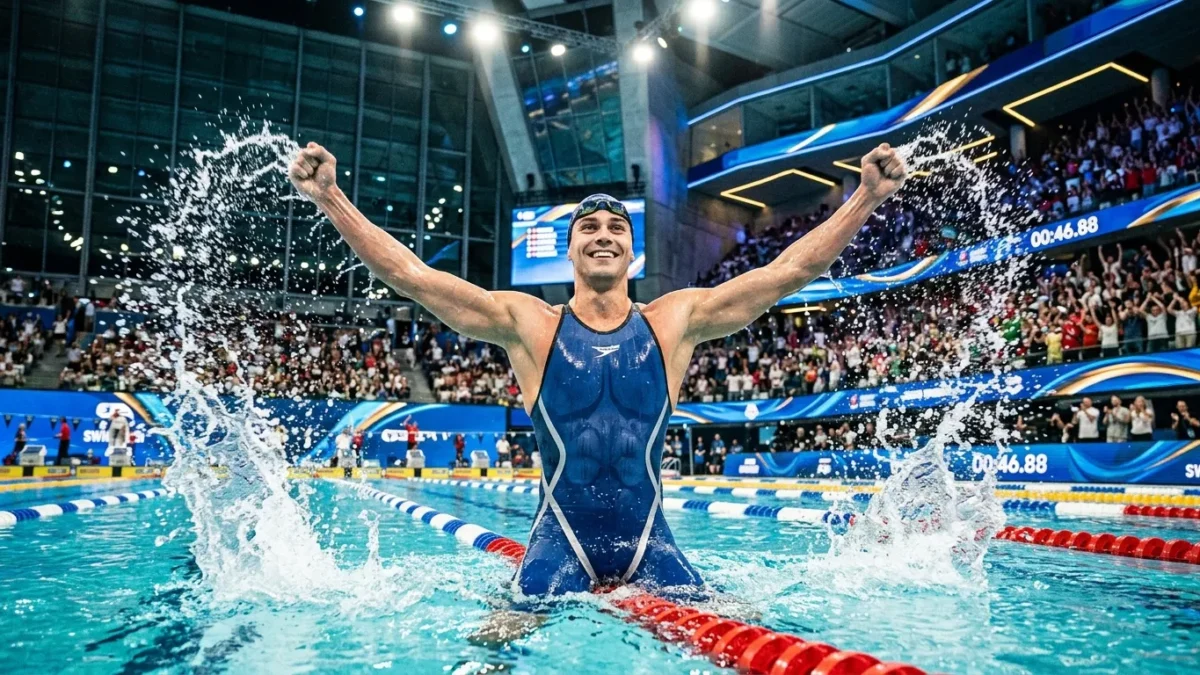
Greek sprinter Kristian Gkolomeev made history on the opening day of the Enhanced Games, clocking a stunning time in the men’s 50m freestyle that shattered the existing world record. This performance immediately confirmed what many had suspected : the inaugural edition of this controversial event would not lack for drama or raw speed.
Record-breaking performances and podium highlights
The Enhanced Games launched with a bang. Gkolomeev’s record swim in the 50m freestyle set the tone for a competition where the majority of the 42 participating athletes openly used performance-enhancing substances. Organizers reported that 13 athletes achieved personal bests across the various disciplines — a figure that speaks directly to the event’s founding philosophy.
British swimmer Ben Proud, a silver medalist at the 2024 Paris Olympics in the 50m freestyle, shifted discipline and won the 50m butterfly in 22.32 seconds — just 0.05 seconds behind Andrii Govorov’s standing world record, while surpassing his own personal best and British record of 22.74 seconds. “We all know what we came for. And that’s world records. And so to be that agonisingly close, it’s frustrating,” Proud admitted after his race.
Another British Olympic swimmer, Emily Barclay, claimed victory in the women’s 50m freestyle with a time of 24.09 seconds, finishing approximately half a second behind the world record. On the track, American sprinter Fred Kerley, a former world champion competing without any enhancement, won the men’s 100m in 9.97 seconds — solid, but well off his personal best of 9.76.
| Athlete | Event | Time / Result | World record ? |
|---|---|---|---|
| Kristian Gkolomeev | 50m freestyle | World record | Yes |
| Ben Proud | 50m butterfly | 22.32 sec | No (0.05s off) |
| Emily Barclay | Women’s 50m freestyle | 24.09 sec | No (~0.5s off) |
| Fred Kerley | Men’s 100m | 9.97 sec | No |
Hafthor “Thor” Bjornsson — known globally for his role as The Mountain in Game of Thrones — also competed in weightlifting. Despite the hype surrounding his participation, he could not surpass his own deadlift record of 510 kg, leaving that particular benchmark intact.
How the Enhanced Games work : substances, rules and access
The Enhanced Games operates under a framework unlike any other sporting event. All performance-enhancing substances used must be legal and approved by the US Food and Drug Administration (FDA). That list includes testosterone, growth hormone, peptides, and anabolic steroids — compounds that have been banned in mainstream sport for decades.
The event unfolded before a carefully curated audience of around 2,500 spectators. Tickets were not available to the general public. This selective access created an atmosphere closer to an exclusive showcase than a traditional sporting competition open to all.
The reasoning behind this model, according to the founders, follows a clear logic :
- Enhancement already exists quietly within elite sport
- Bringing it into the open allows for proper medical monitoring
- Transparency, they argue, makes the process safer for athletes
- FDA-approved substances provide a legal and regulatory framework
Whether you find that argument convincing or not, the structure does reflect a genuine attempt to distinguish this event from unregulated doping. Founders Aron D’Souza and Maximilian Martin, who launched the project in 2023, attracted high-profile financial backing from billionaire Peter Thiel and Donald Trump Jr. Martin had publicly predicted that athletes would break “quite a few” world records at this inaugural event.
A firestorm of opposition from global sporting bodies
The reaction from the mainstream sporting world was immediate and, frankly, brutal. The International Olympic Committee and WADA labelled the Enhanced Games “immoral” and described the concept as “dangerous and irresponsible.” World Athletics president Lord Coe went further, calling anyone who chose to participate “moronic” — a word that generated significant controversy on its own.
Multiple governing bodies have since moved to ban athletes who competed, with others issuing formal public rebukes. The message from traditional institutions is unambiguous : competing in the Enhanced Games carries serious professional consequences for athletes who still hope to participate in sanctioned competitions.
This tension puts athletes in a genuinely difficult position. Fred Kerley’s presence as a “clean” competitor at the event is telling — it shows the Games are not exclusively for enhanced athletes, but the reputational risk remains real for everyone involved. For Ben Proud, already a medalist at the Paris Olympics, the choice to compete signals a willingness to explore the outer edges of human performance, even at the cost of institutional disapproval.
What the opening day ultimately demonstrated is that the gap between enhanced and non-enhanced performance is measurable and significant. Gkolomeev’s freestyle record, Proud’s near-miss in butterfly, and Barclay’s winning freestyle swim all suggest that, under FDA-approved enhancement protocols with full medical oversight, human physical limits can be pushed considerably further than conventional competition currently allows. Whether sport is ready to have that conversation honestly remains the most important question this event raises — and it’s one that governing bodies can no longer simply dismiss.
