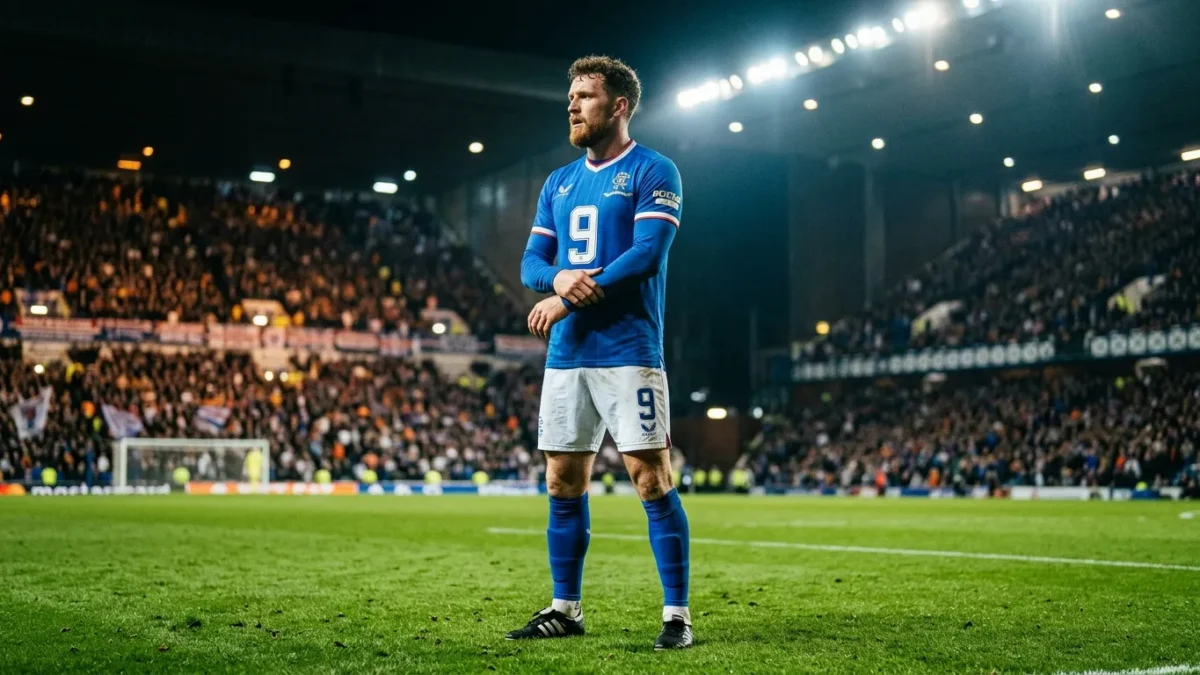
Lawrence Shankland has just completed a move to Rangers, and the question is already burning on every Scotland fan’s lips : has Steve Clarke’s side finally found its World Cup striker ? The numbers alone make a compelling case. Shankland registers a goal involvement every 104.8 minutes at international level — a figure that puts every other forward in the Scotland squad firmly in the shade.
A goal involvement rate that changes the conversation
Compare that 104.8-minute average with the rest of Clarke’s attacking options and the gap is striking. Lyndon Dykes averages a goal involvement every 205.4 minutes, Che Adams every 209 minutes, and George Hirst every 299 minutes. Ryan Stewart, meanwhile, has accumulated just 34 minutes of Scotland action across two caps without a goal or an assist to his name.
| Player | Goal involvement (avg. minutes) |
|---|---|
| Lawrence Shankland | 104.8 |
| Lyndon Dykes | 205.4 |
| Che Adams | 209.0 |
| George Hirst | 299.0 |
These aren’t minor differences. Shankland’s output is roughly twice as frequent as Adams or Dykes, and nearly three times better than Hirst’s. For a national team still hunting a reliable number nine ahead of a World Cup qualifying campaign, that kind of consistency is not a luxury — it’s a necessity.
Clarke has always demanded more than goals from his forwards. Work rate, physicality, the ability to hold a defensive line high and link intelligently with midfield — these are the traits the Scotland manager prizes above almost everything else. For years, Shankland’s reputation as a pure finisher made him an awkward fit for that profile. The assumption was simple : he scored, but he didn’t do the rest. That assumption no longer holds.
How Hearts transformed Shankland into a complete striker
Steven Naismith has seen this evolution from two very different angles. First as a teammate, then as the Hearts head coach who worked directly with Shankland during some of the former Kilmarnock man’s most productive seasons at Tynecastle. His verdict is unambiguous.
“I first came across him as a forward here when I was a player and he was a finisher,” Naismith explained. “Not real game knowledge or intelligence or a real work rate.” The picture he paints of the early Shankland is of a penalty-box predator — effective, but limited. Someone you trusted to put the ball in the net, not to organise a press or bring others into play.
What changed ? The responsibility of the captaincy at Hearts appears to have been the catalyst. Leading a club through Scottish Premiership campaigns, making decisions under pressure week after week — it shaped a different kind of footballer. Naismith’s assessment after working with him as a coach is almost the reverse of that initial impression :
- Game intelligence now rated at top level
- Leadership skills described as excellent by someone who has managed him
- Decision-making in big moments consistently high
- Willingness to sacrifice personal stats for collective benefit
That last point matters more than it might seem. Naismith recalled a specific moment from Scotland’s match against the Netherlands in 2024. Shankland had the chance to shoot but instead laid the ball off to Scott McTominay. Naismith — still at Hearts at the time — sent him a text : “at Hearts, you shoot there.” His read was that Shankland hadn’t yet fully trusted himself in the international environment. The Shankland who has just signed for Rangers is a different proposition entirely. “Now,” Naismith said, “I think he’s at the point where he thinks, ‘no, I’ll do what I need to do to contribute for the team’.”
Rangers, the World Cup and the weight of the number nine shirt
Signing for Rangers raises the stakes considerably. Ibrox is not a place where quiet, steady performances go unnoticed — everything is amplified, scrutinised, debated. For Shankland, that pressure cuts both ways. Get it right and he becomes the frontman Clarke builds his World Cup attack around. Struggle, and the doubts resurface fast.
Frankly, the profile fits. A striker who combines clinical finishing with genuine leadership, who has grown into a player capable of performing in high-pressure moments — that’s exactly what Scotland have been missing at the top of the pitch for the better part of a decade. The question was never really whether Shankland could score. He’s been doing that consistently for years. The question was whether he could become the focal point of a national team’s attack in a World Cup cycle.
The evidence from his time as Hearts captain, combined with a goal involvement rate that dwarfs his international rivals, suggests the answer is yes. At 29, he enters what should be his peak years at a club where competing for major honours is the baseline expectation. If he replicates his Tynecastle form at Ibrox, Clarke will have a very straightforward selection decision to make.
Watch how Shankland handles the first Old Firm derby. That will tell you everything about whether the transformation Naismith describes is real — or whether the pressure of Rangers strips it back to the finisher who used to shoot when he should have passed.
