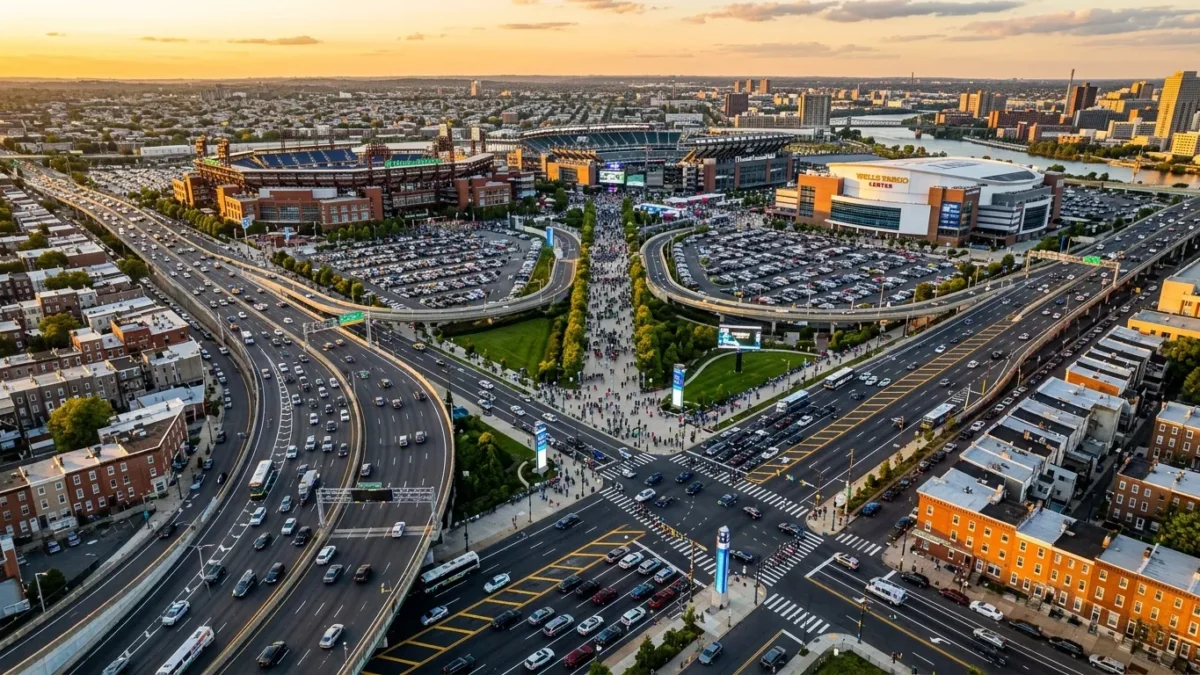
Every game night in South Philadelphia, thousands of fans crawl through the same gridlocked streets, missing first pitches and tip-offs while stuck in traffic. John Middleton, owner of the Phillies, has heard it constantly. “Year after year, this is the number one frustration from residents, fans, and even team executives,” he said plainly. That frustration is now triggering serious government action — to the tune of $30 million.
A $30 million commitment to untangle South Philly’s traffic nightmare
On May 28, 2026, Governor Josh Shapiro, alongside PennDOT and leadership from all four major Philadelphia sports franchises — the Phillies, Flyers, Sixers, and Eagles — formally announced a coordinated infrastructure overhaul targeting the sports complex traffic crisis that has plagued the area for decades. This isn’t a vague promise. It’s a structured, funded, multi-phase plan with hard deadlines and measurable outcomes.
The scale of the problem is easy to underestimate until you live it. On any given game night, the narrow grid around Broad Street and Packer Avenue absorbs tens of thousands of vehicles with infrastructure that was never designed for modern event volumes. The result : dangerous bottlenecks, frustrated residents, and fans who think twice before buying tickets.
What makes this announcement different from past pledges is the direct involvement of PennDOT Secretary Mike Carroll and sitting state officials. The money is allocated, the timeline is defined, and the projects are already sequenced. South Philadelphia is finally getting the upgrade its traffic grid has needed for years.
AI signals and new ramps : the concrete fixes already in motion
The plan breaks down into three distinct infrastructure upgrades, each targeting a specific bottleneck in the area’s road network. Here’s what’s on the table :
- A new I-76 Westbound ramp from 7th Street and Packer Avenue, estimated at $15 million, expected to open before 2030
- AI-powered traffic signals along Broad Street, backed by a $6.6 million investment, designed to synchronize flow in real time
- Two new turning lanes from Front Street onto I-95 North, already completed and operational
Governor Shapiro was blunt about the signal situation : “Those signals were off. AI is going to fix that in a big way. Have those signals coordinated, have the traffic flowing.” That directness reflects the broader tone of this initiative — no more band-aid fixes.
The I-76 ramp alone will handle roughly 800 vehicles per hour once complete in 2028, according to PennDOT Secretary Carroll. The already-open Front Street turning lanes add capacity for approximately 500 more vehicles per hour onto I-95 North. These aren’t soft projections — they’re engineering targets built into the project specs.
| Project | Investment | Capacity added | Target completion |
|---|---|---|---|
| I-76 Westbound ramp (7th & Packer) | ~$15 million | ~800 vehicles/hour | 2028 |
| AI-timed signals on Broad Street | $6.6 million | Optimized flow, no fixed cap | TBD |
| Front Street to I-95 North turning lanes | Included in total plan | ~500 vehicles/hour | Already open |
The AI signal system deserves particular attention. Traditional fixed-cycle traffic lights along a major urban corridor like Broad Street create predictable congestion waves — especially when tens of thousands of fans pour out simultaneously after a Sixers game or an Eagles match. Adaptive signal technology reads real-time vehicle density and adjusts green-light timing on the fly. Cities like Pittsburgh and Los Angeles have deployed similar systems with measurable reductions in post-event congestion. Philadelphia is catching up, and the $6.6 million price tag is modest compared to the economic drag that gridlock creates for local businesses every season.
What this means for fans, residents, and the 2030 arena opening
The timing of these improvements isn’t accidental. The new basketball arena for the Sixers is scheduled to open in 2030, and city planners clearly want the road network ready before that added load hits. The I-76 ramp, completing in 2028, gives a two-year buffer to test and adjust before the arena’s first season. That’s smart sequencing — build the infrastructure before the demand spike, not after.
For residents of South Philadelphia who live near the complex year-round, the stakes go beyond game nights. Post-event traffic bleeds into residential streets, backing up side roads for hours. The combination of a new highway ramp and synchronized signals should pull more vehicles onto controlled routes faster, reducing that neighborhood spillover. Frankly, this is the part of the plan that matters most to people who aren’t even sports fans.
Fans themselves should notice the difference most on high-traffic event nights — playoffs, double-headers, or back-to-back events at different venues in the complex. With the turning lanes already operational on Front Street, some improvement is visible right now. The full picture won’t be clear until the I-76 ramp and AI signals are both live.
One angle worth watching : how these upgrades interact with the broader $2.5 billion redevelopment vision for the South Philly Sports Complex. A transformed venue district only delivers on its potential if people can actually get there and leave without losing an hour in standstill traffic. Infrastructure investment isn’t glamorous, but it’s the foundation everything else depends on. Get the traffic right, and the rest of the development story writes itself much more easily.
