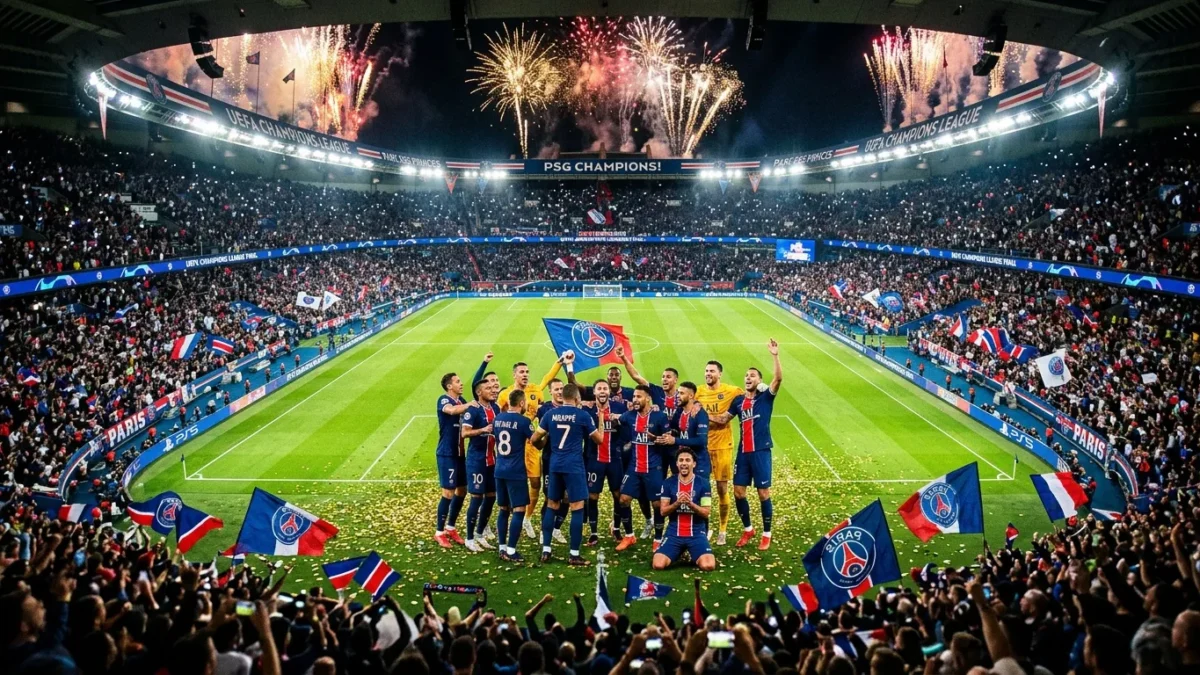
Back in 2011, Paris Saint-Germain were a club in contradiction. One of Europe’s great capitals, yet a football institution with no stars, no clear philosophy, and no credibility on the continental stage. The arrival of Qatari Sports Investments changed everything — but not immediately, and not without serious collateral damage along the way.
From zero to bling : the chaotic birth of a new PSG
The first years under QSI ownership were defined by one word : spending. Critics coined the term bling-bling era to mock the approach, but inside the club it was seen as the only viable shortcut. You can’t build prestige slowly when you’re starting from scratch in a market already dominated by Real Madrid, Barcelona, and Bayern Munich. Sometimes you have to buy your way into the conversation first.
And PSG did exactly that. Zlatan Ibrahimovic, Neymar, Kylian Mbappé, Lionel Messi — the club assembled one of the most expensive rosters in football history. The 2017 signing of Neymar alone cost a world-record €222 million. These signings generated headlines, shifted the global perception of the club, and produced consistent Ligue 1 dominance. Yet the deeper you look, the messier the picture gets.
Before that transformation could even begin, the club had to navigate a painful cultural reset. The ultras were expelled from the Parc des Princes following violence that led to the death of a supporter. For five years — until 2016 — PSG’s most passionate fanbase watched from the outside. President Nasser Al-Khelaifi eventually reversed the ban, arguing the majority shouldn’t pay for the violence of a few. It was a symbolic turning point, but the atmosphere had already been fractured.
Like Manchester City and Newcastle United, PSG faced persistent accusations of sportswashing — the practice of using elite sport to rehabilitate the image of a state. Qatar’s ownership has never fully escaped that scrutiny, and it remains part of the club’s public narrative whether they like it or not.
When superstars overshadow the team : the limits of the star model
Signing global icons solves one problem and creates several others. Inside PSG’s dressing room, the hierarchy of stars distorted the collective. Tactical decisions were influenced by individual preferences. Training schedules became battlegrounds. Even something as routine as penalty-taking turned into a diplomatic incident.
Two anecdotes say everything about this era. When Kobe Bryant visited PSG’s former training ground, Neymar and Mbappé pushed to train — with suddenly rediscovered enthusiasm — rather than rest as then-manager Unai Emery had planned. Emery held his ground and won that particular battle. But the fact that it was even a battle reveals how fractured the power dynamic had become between staff and players.
The second anecdote is more structural. Mbappé’s arrival at 18 came with conditions : his family reportedly required guarantees he would play every single match. Neymar, meanwhile, had it written into his contract that he reserved the right to skip certain away fixtures entirely. These weren’t rumours — they were symptoms of a model where commercial value trumped sporting logic.
| Player | Arrived | Transfer fee (approx.) | Key tension |
|---|---|---|---|
| Zlatan Ibrahimovic | 2012 | €20m | Dressing room dominance |
| Neymar | 2017 | €222m | Contract clauses, availability |
| Kylian Mbappé | 2017 | €145m (rising) | Play-time guarantees |
| Lionel Messi | 2021 | Free transfer | Performance & fitness levels |
The result ? Deep Champions League runs without a trophy. Brand recognition without European legitimacy. PSG became globally famous and domestically untouchable, but the ultimate prize kept slipping away. The star-centric model had a glass ceiling, and the club kept hitting it at the semi-final stage.
Luis Enrique’s PSG : building a team that actually functions
The appointment of Luis Enrique in 2023 represented a philosophical U-turn. Out went the era of indulged superstars. In came a structured, pressing-based system where collective performance takes priority over individual brilliance. The Spanish coach had done it before with Barcelona, winning the treble in 2015. His track record wasn’t theoretical — it was proven at the highest level.
The key pillars of his approach are worth naming clearly :
- High-intensity pressing from the front, suffocating opponents early
- Positional fluidity rather than rigid star-shaped hierarchies
- Youth and hunger over established status — Mbappé’s departure to Real Madrid in 2024 was, paradoxically, liberating
- A non-negotiable training culture with no exceptions for anyone
The transformation didn’t happen overnight. Losing Mbappé after years of building around him could have been catastrophic. Instead, it forced the club to develop a genuine squad identity. Players like Ousmane Dembélé, Vitinha, and Fabian Ruiz have thrived in a system that demands movement and discipline rather than individual spotlight moments.
Reaching the Champions League final in 2026 is the clearest validation yet that this new model works. Whether PSG lift the trophy or not, they’ve already proved something more important : you can rebuild a dysfunctional superclub into a coherent footballing unit without needing Messi, Neymar, or anyone of that magnitude. The lesson for every ambitious club chasing instant success through marquee signings ? Sometimes the bravest move is letting the stars go.
