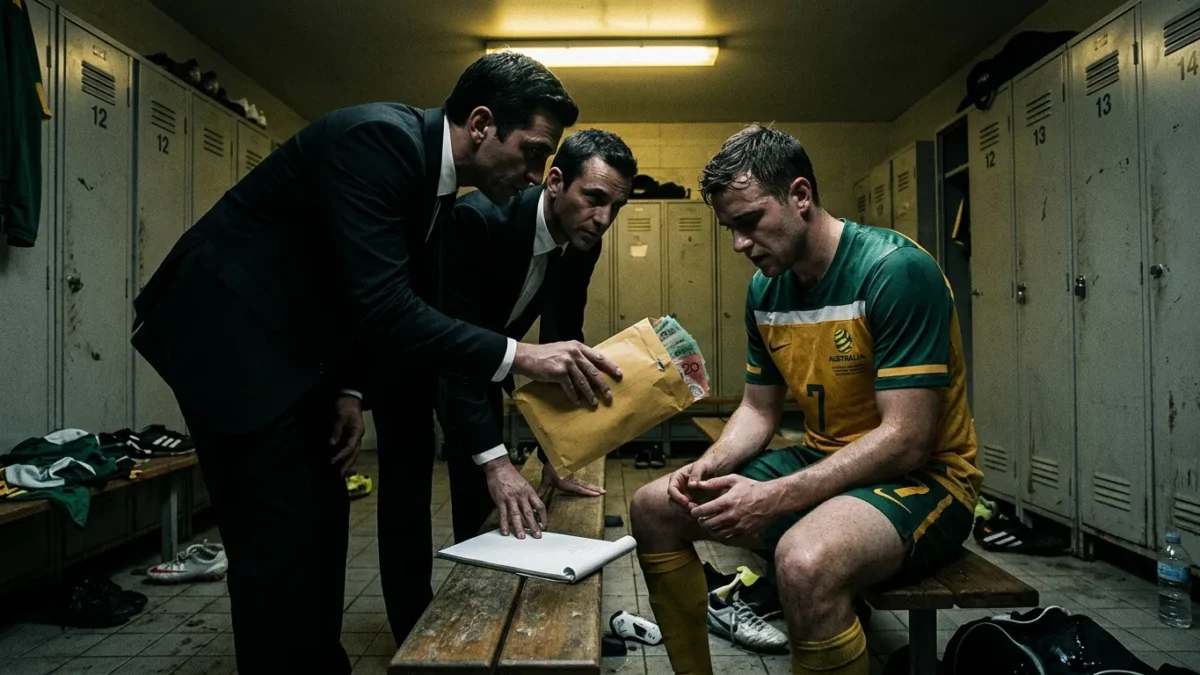
In December 2023, 50 simultaneous bets were placed on a single outcome through international platform BetPlay — all wagering that Macarthur FC would receive more than 3.5 yellow cards in an A-League match. The total stake reached nearly A$66,000. The scheme worked. The total payout hit A$226,941. This wasn’t opportunism. It was organised, deliberate, and connected to networks far more dangerous than a few footballers cutting corners.
When a captain becomes the fixer’s link in the chain
Ulises Davila wasn’t a marginal figure. He was Macarthur FC’s captain, the 2021 Johnny Warren Medal winner — the A-League’s best player that year — and a former Chelsea signing. His story is genuinely tragic before it becomes criminal. His wife Lily, diagnosed with Arteriovenous Malformation affecting blood flow in the brain, died in May 2022 after an unsuccessful surgery in Mexico. She was 31.
Davila returned to Australia, grieving and still playing. Teammates grew close to him. Matthew Millar, a 27-year-old right-back, was among them. When Millar complained about the “astronomical” cost of his upcoming wedding, Davila saw an opening. His pitch was almost casual : “This sort of thing happens all the time overseas in Europe and Spain. We’re not actually affecting the outcome of the game.” Millar declined initially, then agreed on December 7.
The fix required yellow cards — not goals, not results. The Colombian contact known only as J Col managed the market side. When odds shifted two days later, three bookings weren’t enough. Four were needed. Davila called Millar in a panic. Clayton Lewis, a New Zealand international and known gambler, was recruited. By 11 :26am on match day, the bets were placed. By full time, four yellow cards had been collected — including one from Kearyn Baccus, referred to in Davila’s texts to J Col as ‘The Butcher’.
The financial breakdown tells its own story :
| Transaction | Amount (AUD) | Detail |
|---|---|---|
| Total stake placed | A$66,000 | 50 simultaneous bets via BetPlay |
| Total payout | A$226,941 | Profit over A$161,615 |
| Millar’s cut | A$10,000 | Hugo Boss suit + A$8,200 transfer |
| Baccus cover story | — | Fake sale of a VW Golf to Davila |
Baccus claimed Davila had bought his car. Lewis asked for half his share labelled “Xmas gift.” Millar drove to Bondi Junction with Davila’s Visa card and bought a suit. Six days before Christmas, the players involved held a beach party — where Jed Drew, a 21-year-old winger who had been kept out of the loop, heard what had happened and said : “Why didn’t you include me ? Do it for me next time.”
Australia’s exposure : geography, gambling, and organised crime
James Moller, head of strategy and international policy at Australia’s sport integrity body, puts the scale plainly. In 2025, Australia recorded the second-highest number of games flagged for suspicious activity globally — 68 alerts, behind only India’s 90, according to Group of Copenhagen data. Twenty-seven of those alerts came from Australian youth football alone.
The country’s timezone is part of the problem. Few evening matches worldwide fall within the Australian schedule, but those hours align precisely with peak betting windows across South East Asia. “Generally people like to bet on things they can watch,” Moller explains. “There are significant volumes of wagering across South East Asia, often in our timezone, where the matches are of high quality and known for having strong integrity.” High-quality leagues in a convenient timezone — fixers find that irresistible.
This isn’t new. A decade before the Macarthur scandal, Moller himself worked the Southern Stars case — a second-division Victorian club infiltrated by an offshore organised crime syndicate. European and UK players were recruited under the guise of sponsorship, given flights and accommodation, then ordered to manipulate results week after week. The ringleader, Malaysian national Gerry Subramaniam, received three years in prison. The coach and players were banned for life.
The Macarthur fix traced back to Colombia, with winnings initially paid in Mexican pesos — a strong indicator of cartel involvement. J Col referenced problems with “Peruvians” in his messages to Davila. When a later fix attempt was cancelled and the April agreement fell apart, J Col’s final message read : “You let me down mate.”
The violence lurking behind these networks isn’t theoretical. In September 2025, Ecuadorian footballer Jonathan Gonzalez was killed in a drive-by shooting after being pressured to throw a match. He was 31. He is the fifth Ecuadorian footballer fatally shot that year. This is the environment that produces Davila’s message to J Col during a later failed fix : “I don’t want to get us killed.”
Fixing corruption in football : prevention, education, and structural reform
Beau Busch, co-chief executive of Professional Footballers Australia, argues that the current approach to player education is dangerously inadequate. His assessment is blunt : “If you look at the preventative education being done in the A-League at the time, it amounted to an online video being put on in a clubhouse.” No in-person sessions, no follow-up, no interaction — and often delivered mid-season rather than at preseason.
The structural vulnerabilities that fixers exploit are well-documented. Here’s what makes players particularly exposed :
- Late or missing salary payments — Western United’s Riku Danzaki, banned for seven years in 2025, played for a club “not paying their players on time”
- Gambling addiction — Sporting Chance, the British clinic for professional athletes, reports 60% of its caseload involves gambling
- Social pressure from senior teammates, who control dressing room dynamics
- Language and cultural barriers, particularly for non-English-speaking players
- Lack of targeted, culturally adapted integrity education
The darts case of Billy Warriner — banned for a decade after manipulating 17-year-old Leighton Bennett into deliberately losing matches — shows how addiction drives fixers as much as greed. Warriner admitted to the tribunal : “I am powerless over gambling and my life had become unmanageable.” Bennett was banned for eight years.
Davila, Baccus, and Lewis all pleaded guilty. Baccus and Lewis received two-year conditional release orders, A$10,000 repayment orders, five-year Football Australia bans, and 200 hours of community service — reducible by 12 months. Davila awaits sentencing. The real lesson isn’t just about punishing players — it’s about recognising that without serious investment in prevention, financially vulnerable athletes will keep receiving calls from captains who say the whole thing is perfectly harmless.
