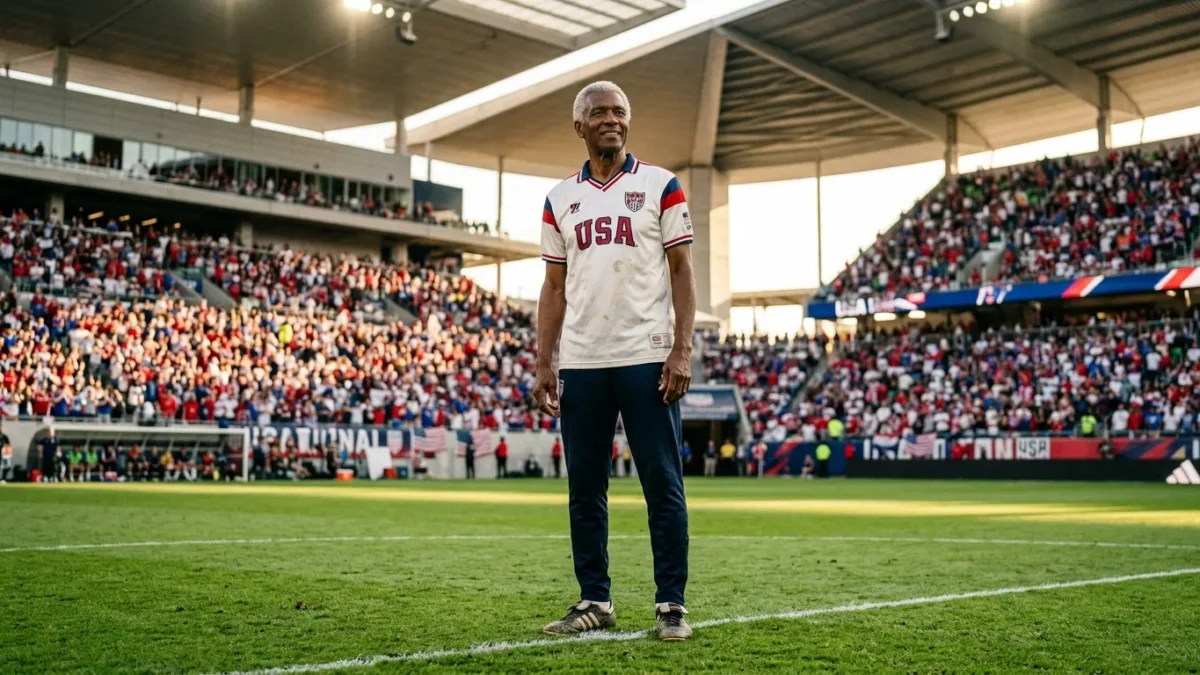
The 1990 World Cup in Italy marked a turning point for American soccer. Desmond Armstrong was part of that story, but understanding what he actually built requires going back to a suburban living room in Maryland.
From a Washington DC suburb to the soccer field
Armstrong grew up in Southeast Washington DC before his family relocated to a predominantly white neighborhood in Maryland. That move changed everything. He befriended the son of a local soccer coach, and one afternoon that coach pointed him toward the television screen. On it : Pelé in a New York Cosmos jersey, gliding across the pitch with the ball at his feet.
“His movement reminded me of the point guards I watched playing basketball, but he was doing it with a ball at his feet,” Armstrong later recalled. The connection went deeper than technique. Pelé was one of very few Black players on the Cosmos squad. That representation mattered. For a young Armstrong trying to find his place in a sport that barely reflected him, seeing Pelé on screen was the spark that lit the fire.
Armstrong himself was clear-eyed about how fragile that moment was : “If my folks didn’t move to the suburbs, hands down I’m not playing soccer.” One zip code, one afternoon, one television set. That is how thin the line was between a pioneering career and nothing at all.
Frank Dell’Apa, who spent 40 years covering football for the Boston Globe and witnessed the original North American Soccer League (NASL) era firsthand, puts it bluntly : “This is the simplest game with the easiest access.” Everywhere else in the world, kids play it barefoot, with no money, no equipment. In the United States, the opposite dynamic took hold. The American youth development model ran on a pay-to-play system that consistently favored affluent families. Unlike Ajax or FC Barcelona, which invested directly in young talent through academies, American clubs required families to cover significant costs or seek sponsorship just to get their kids into organized competition.
That structural barrier made Armstrong’s trajectory remarkable. Socioeconomics could have blocked him entirely. It nearly did.
The NASL collapse and the road to Italy 1990
Armstrong entered college during the dying years of the NASL. The league folded in 1985, just as he and his generation were entering their peak developmental years. Professional pathways dried up almost overnight. “For me, personally, that was crushing,” he said. The players who should have been transitioning into a domestic professional outdoor league found themselves with nowhere to go.
Rather than abandon the sport, Armstrong pivoted to the Major Indoor Soccer League. His performances there earned him a call-up to the US Men’s National Team in 1987, followed by a place in the squad for the 1988 Seoul Olympics. Standing on that field, hearing the national anthem play, he described thinking : “This is where I’m supposed to be.”
The context around that achievement is important. In 1988, FIFA awarded the United States the right to host the 1994 World Cup, the first time the tournament had been staged outside Europe or South America. Suddenly, a nation with no elite outdoor professional league was under a global microscope.
| Year | Key milestone |
|---|---|
| 1985 | NASL folds, leaving US players without a professional outdoor league |
| 1987 | Armstrong earns his first USMNT cap |
| 1988 | Seoul Olympics appearance; FIFA awards 1994 World Cup to the USA |
| 1990 | USA qualifies for and competes at the World Cup in Italy |
The US Soccer Federation responded to the structural gap with an unorthodox solution : it placed a core group of national team players on full-time contracts, effectively turning the USMNT into the country’s de facto professional setup. Dell’Apa remembers those players competing on artificial turf, fighting for stadium access, struggling to even secure a consistent practice field. “They had to fight to get into line-ups, to get a playing field, to get a stadium,” he said.
To lead this patchwork squad, the federation brought in Bob Gansler, a German-Hungarian coach tasked with turning a fragmented mix of college graduates, semi-professionals, and indoor league veterans into a competitive international side. Armstrong stood at the center of that experiment.
What Armstrong’s legacy actually means for World Cup 2026
With the 2026 World Cup now set to unfold across the United States, Canada, and Mexico, Armstrong’s journey offers more than nostalgia. It provides a direct line of accountability. The structural flaws he navigated, the pay-to-play model, the absence of professional pathways, the underrepresentation of Black and working-class players, have not disappeared. They have evolved, but the core tension remains.
Here is what made Armstrong’s contribution genuinely significant :
- He succeeded despite the system, not because of it
- His visibility as a Black player in a predominantly white American soccer landscape challenged the sport’s demographics
- His willingness to play indoors kept his career alive when the outdoor infrastructure collapsed
- He helped prove that an underfunded national program could still reach a World Cup
The 2026 tournament arrives with a $5 billion projected economic impact for the US alone. The infrastructure question now is not about finding a stadium to train in. It is about whether the access gap that almost cost Armstrong his career still filters out entire generations of talent before they ever reach a scout’s radar. That is the real legacy worth examining : not the career Armstrong had, but the careers the system never allowed to exist.
