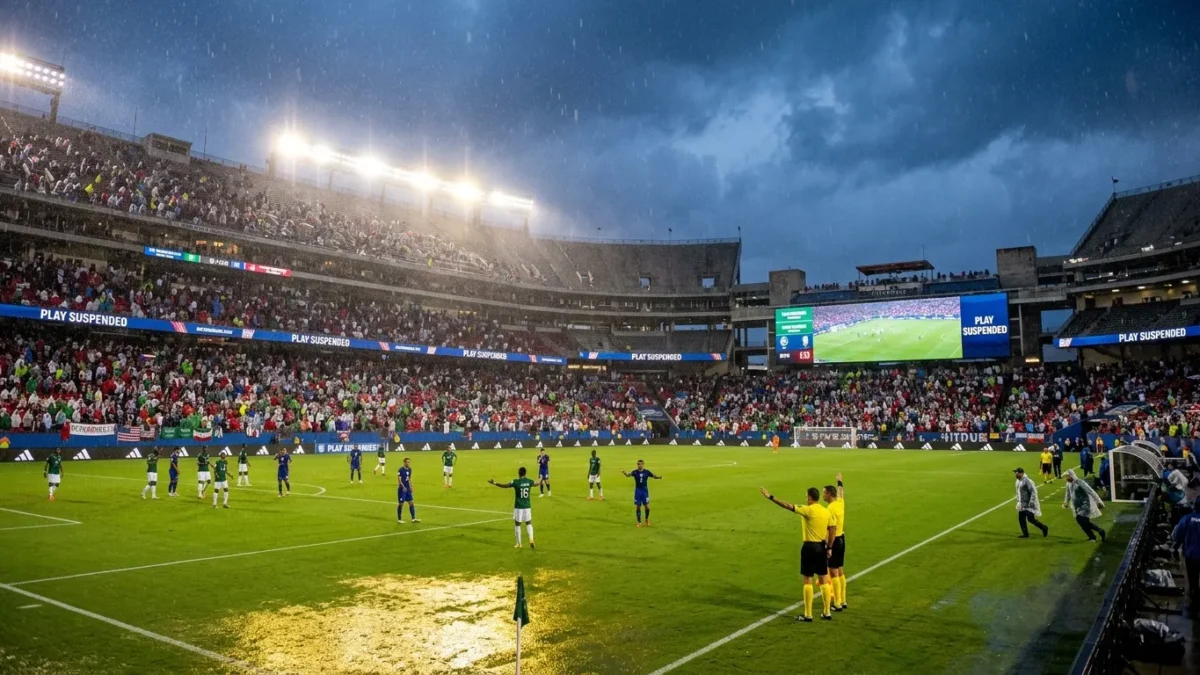
Lightning doesn’t wait for kick-off. Saudi Arabia’s pre-World Cup friendly against Puerto Rico at Q2 Stadium in Austin, Texas, was brutally interrupted in the 21st minute on June 6, 2026, when a violent thunderstorm rolled in and forced both teams off the pitch. The suspension lasted nearly two hours before play could safely resume. Saudi Arabia eventually won 3-0, but the real story wasn’t the scoreline.
This incident puts a sharp spotlight on one of the most pressing logistical concerns surrounding the 2026 FIFA World Cup, which officially kicks off on June 11 across the United States, Canada, and Mexico. Texas in summer isn’t just hot. It’s electrically dangerous.
A game stopped dead by Texas thunderstorms
The storm that hit Austin wasn’t a mild shower. Multiple lightning strikes forced stadium officials to halt the match and broadcast urgent shelter warnings to fans inside Q2 Stadium. Under FIFA’s established safety protocol, any lightning strike detected within eight miles of a venue triggers an immediate suspension. From that moment, a mandatory 30-minute countdown begins. Each new strike within that radius resets the clock entirely back to 30 minutes. The result ? A cascading delay that can stretch well beyond a single interruption.
That’s exactly what happened here. Saudi Arabia and Puerto Rico sat in their respective dressing rooms, waiting, while Austin’s skies put on a dangerous light show. It took close to two hours before conditions cleared enough for the referee to restart the match.
This kind of disruption isn’t unprecedented. During the 2025 Club World Cup in the United States, Chelsea’s last-16 tie against Benfica in Charlotte ran for four hours and 39 minutes total because of repeated weather suspensions. Summer thunderstorms across the American Southeast and South are not rare events. They’re a near-daily feature of the season.
The timing of the 2026 World Cup puts several host cities squarely inside peak thunderstorm season. For organizers, this isn’t a surprise. It’s a calculated risk with contingency protocols baked in.
Texas host stadiums are better equipped than Q2
Here’s a critical distinction : Q2 Stadium in Austin will not host any World Cup matches. It served purely as a warm-up venue for this friendly. The two Texas stadiums actually on the World Cup schedule are a different matter entirely.
| Stadium | City | Matches scheduled | Retractable roof |
|---|---|---|---|
| Houston Stadium | Houston | 7 matches | Yes |
| Dallas Stadium | Dallas | 9 matches | Yes |
Both venues feature retractable roofs, which significantly reduce weather exposure during play. Dallas Stadium alone hosts nine matches, including England’s group-stage clash against Croatia. That roof won’t eliminate all weather-related risk, but it drastically changes the calculus compared to an open-air ground like Q2.
Seven matches in Houston and nine in Dallas represent a substantial chunk of the tournament’s group phase. The infrastructure investment in those two venues reflects exactly why FIFA chose them despite Texas’s volatile summer climate.
Saudi Arabia’s World Cup road ahead and the heat problem
For Saudi Arabia, Tuesday’s friendly against Senegal (Wednesday 00 :00 BST) is the final dress rehearsal before the tournament begins. Their Group H campaign opens against Uruguay at Miami Stadium on June 15 (23 :00 BST). Two more fixtures follow :
- June 21 : Saudi Arabia vs. Spain, Atlanta (17 :00 BST)
- June 26 : Saudi Arabia vs. Cape Verde, Houston (01 :00 BST on June 27)
That’s a demanding schedule across multiple climate zones. Miami’s humidity, Atlanta’s summer heat, Houston’s notorious combination of both. Players will need to manage their physical condition carefully across three very different environments in less than two weeks.
And heat isn’t a secondary issue here. Researchers have flagged that temperatures at 14 of the 16 World Cup stadiums could exceed dangerous threshold levels during the tournament. That’s not a vague concern. It’s a concrete warning backed by environmental data, and it applies to players, officials, and the tens of thousands of fans packed into stands across the US.
The combination of extreme heat and sudden violent thunderstorms creates a uniquely difficult operating environment. Tournament organizers have their lightning protocols in place. But managing cumulative heat stress over weeks of competition is a slower, harder problem to solve with a single rulebook entry.
What the Austin delay reveals about the tournament’s biggest vulnerability
Forget the 3-0 scoreline. The real takeaway from Austin is that weather management will be one of the defining operational challenges of the 2026 World Cup. No tournament of this scale has been staged in the continental United States during peak summer. The 1994 edition ran from June to July, but it lacked the extreme heat forecasts researchers are projecting for 2026’s specific venues.
Practically speaking, fans traveling to matches in Texas, Florida, or Georgia should treat weather preparation as seriously as they treat their match tickets. Check local forecasts obsessively. Arrive early enough to reach your seat before any potential delay begins. Carry water. Know where the shelter zones are inside the stadium before you need them.
Tournament officials would be wise to extend the public communication around lightning protocols well before the first group matches kick off on June 11. Austin just demonstrated, in real time, how quickly a football afternoon can turn into a two-hour waiting game. The World Cup stage will only amplify that pressure.
