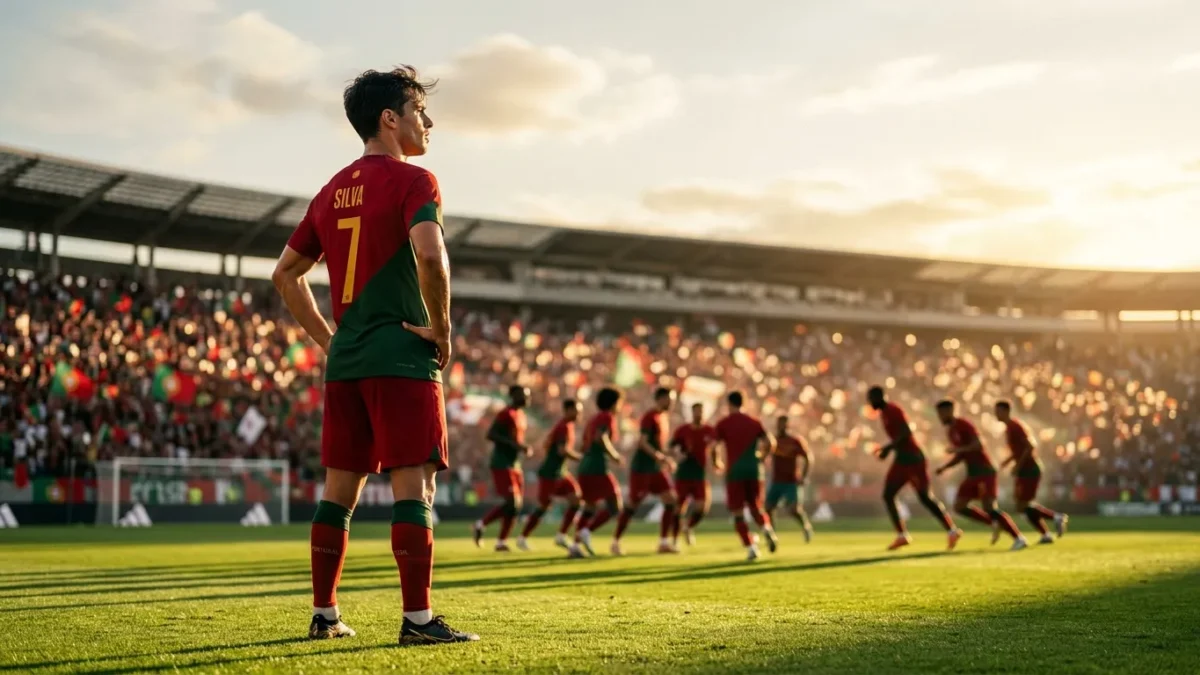
On August 20, 2003, a barely memorable friendly against Kazakhstan, played in front of just 8,000 spectators in Chaves on a pitch so worn the grass had to be painted green, marked the start of something no one could have predicted. A 18-year-old kid from Madeira stepped onto that field for the senior Portugal squad. Nobody in the stands that night imagined he would still be wearing the Seleção shirt at a sixth World Cup, 23 years later.
Ronaldo’s legacy : rewriting what Portugal believed was possible
143 international goals. No player in the history of football has scored more for their country. That number alone tells you Cristiano Ronaldo hasn’t just been a footballer for Portugal. He’s been a cultural shift. Joao Aroso, who worked with him at both Sporting and the national team, put it plainly to BBC Sport : “We are a small country that rarely has global impact outside football. Cristiano allows our small country to be known worldwide for something great.”
Before Ronaldo, Portugal had one truly iconic generation : the 1966 World Cup side built around Eusébio, who finished third in England. Decades passed without a moment of comparable global resonance. Then came the boy from Madeira, who didn’t just score goals, he completely rewired how an entire nation perceived itself on the international stage.
Now 41, he arrives at the 2026 World Cup alongside Lionel Messi and Mexico’s Guillermo Ochoa as one of only three players to appear at six editions of the tournament. That feat alone deserves respect. But respecting a career and debating a player’s current utility to his team are two entirely different conversations.
Here’s a quick look at Ronaldo’s World Cup scoring record heading into 2026 :
| Tournament | Goals scored |
|---|---|
| Germany 2006 | 1 |
| South Africa 2010 | 1 |
| Brazil 2014 | 1 |
| Russia 2018 | 4 |
| Qatar 2022 | 1 |
| Total | 8 |
Eight World Cup goals, just one short of Eusébio’s all-time Portuguese record. The target is clear. But whether chasing that record serves Portugal’s best interests is precisely what divides opinion right now.
The debate that no longer feels like treason
For years, questioning Ronaldo’s place in the squad was almost taboo in Portugal. Critics kept their voices low. That has changed sharply since Qatar 2022, and the shift in tone is striking.
Antonio Simões, a member of the legendary 1966 squad, didn’t hold back : “He doesn’t play to win, he plays to be the main figure. Do you understand that it’s the opposite of Eusébio ? Let’s call things by their name.” That’s not a fringe opinion from a pundit chasing clicks. That’s a man who played in a World Cup semi-final speaking from experience.
The core argument from those who believe Portugal could perform better without Ronaldo comes down to team dynamics. A front line built around younger, more mobile forwards like Rafael Leão or Gonçalo Ramos could offer more pressing intensity and positional flexibility. The system wouldn’t need to orbit a single player. Spaces would open differently. The team could breathe.
Those who defend his inclusion, including coach Roberto Martínez, point to raw numbers. In his last 31 appearances for the Seleção, Ronaldo scored 25 goals. Martínez has repeated that stat consistently in every press conference touching on the subject. His position is unambiguous : “We are talking about the greatest player of all time. He is here because he is still performing at a very high level.” Calling the wider debate “lift talk” is his polite way of saying it’s noise.
Both sides have a point. Here’s what’s actually fueling the tension :
- Ronaldo’s scoring record for Portugal remains extraordinary at 41.
- His Al-Nassr performances, though impressive statistically, come in a less competitive league.
- Portugal’s squad depth in attack is arguably the strongest it has ever been.
- Questions about pressing contribution and defensive tracking are legitimate at this stage of his career.
The honest answer is that neither camp is entirely wrong. Ronaldo still delivers goals. The tactical cost of building around him is also real.
Beyond the Ronaldo question : what Portugal actually needs to win in 2026
Whatever your view on Ronaldo’s role, Portugal’s World Cup ambitions in 2026 go far beyond one player. Frankly, the squad assembled by Martínez is arguably the most balanced in the country’s history, and that’s what should excite Portuguese supporters most.
The midfield spine, built around Vitinha and Bernardo Silva, offers technical quality and pressing that didn’t exist in previous generations. Defensively, Portugal conceded just 0.8 goals per game across their qualifying campaign. That’s not a team relying on a single striker to rescue them.
The real question for Martínez isn’t whether to include Ronaldo. It’s how to integrate him without making the whole system predictable. Using him as a super-sub, deploying him in specific match-ups, protecting his legs while leveraging his finishing inside the box : these are the tactical decisions that will define Portugal’s tournament, not the binary “Ronaldo in or out” debate that dominates headlines.
One final angle worth considering : every World Cup Ronaldo has attended, he’s scored. Five tournaments, five times on the scoresheet. If he reaches Eusébio’s Portuguese record of nine World Cup goals in 2026, the conversation will shift overnight. Goals have a habit of silencing even the sharpest critics.
