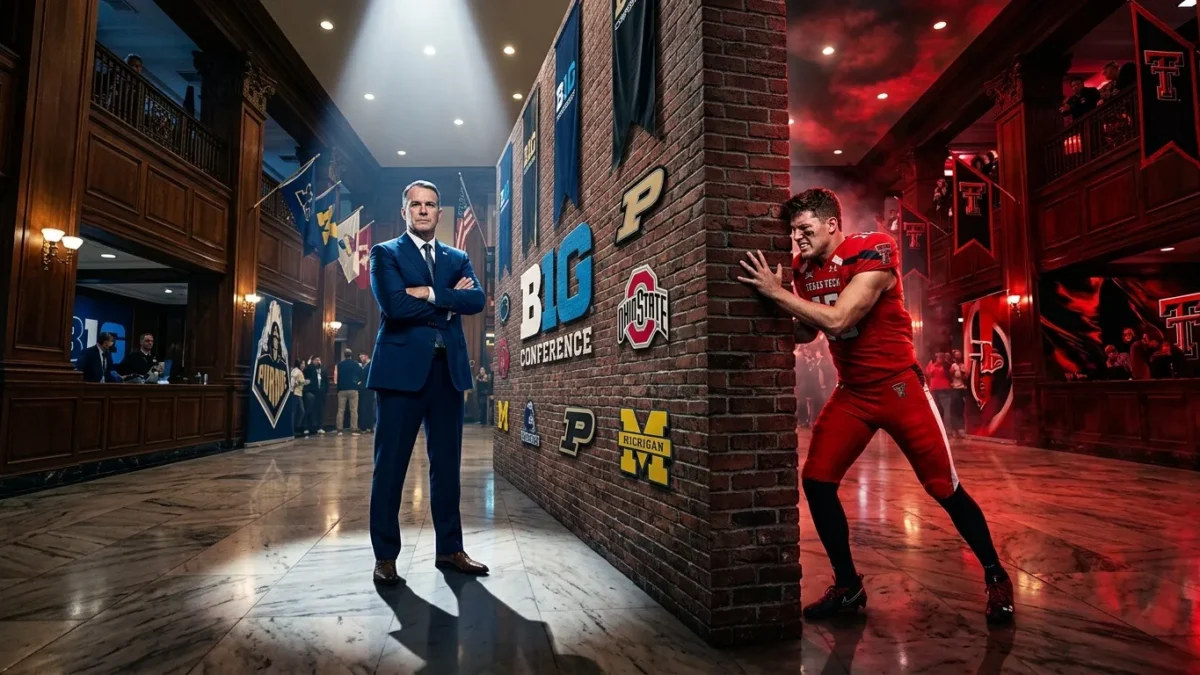
The college sports world woke up to a significant shake-up on June 9, 2026. Big Ten commissioner Tony Petitti and the conference’s athletic directors are set to meet Wednesday to formally discuss a league-wide ban on scheduling Texas Tech across every sport. Two sources within the Big Ten confirmed the story to The Athletic. This isn’t a minor procedural debate, it’s a direct response to a judicial ruling that many athletic departments view as a threat to the integrity of collegiate competition.
The Sorsby ruling that triggered a national reaction
At the center of this storm stands Brendan Sorsby, the Texas Tech quarterback who received a temporary injunction from a Texas judge, allowing him to play college football this fall despite a documented history of sports betting. The critical detail : Sorsby admitted to betting on games involving his own team in 2022, when he was playing for the Indiana Hoosiers. That’s not a gray area. Wagering on a team you actively compete for is one of the clearest violations in the NCAA rulebook.
The injunction essentially bypasses the NCAA’s authority, at least temporarily. The NCAA has already filed a notice of appeal, signaling it won’t accept this precedent quietly. But in the meantime, institutions aren’t waiting for courts to resolve what they see as a straightforward integrity issue. They’re acting unilaterally.
Georgia moved first. Georgia’s compliance director Will Lawler sent a memo to coaches and staff Monday afternoon, hours after the injunction was granted. His message was unambiguous : Georgia Athletics would not schedule future contests against Texas Tech “until further notice.” Coaches with active scheduling discussions or existing matchups were told to notify their sports administrator immediately. The directive was “effective immediately,” with any exception requiring prior approval from the athletic department. Georgia officials declined to comment publicly, but the memo, obtained from a source at the school, left little room for interpretation.
Nebraska and the Big Ten prepare their own response
Georgia’s move came from the SEC side. Inside the Big Ten, Nebraska was the first institution to put something in writing. Deputy athletic director Haven Fields sent a note to Nebraska coaches instructing them that the program “will not schedule any contests vs. Texas Tech in any sport.” Coaches who already had future matchups locked in were directed to contact athletic director Troy Dannen immediately. That note, also obtained by The Athletic, confirmed that no Nebraska-Texas Tech football games are currently on the books for 2026 or beyond.
The Wednesday meeting between Big Ten ADs and Petitti takes this individual stance and potentially scales it conference-wide. Here’s what that could mean in practical terms :
- Football scheduling flexibility lost for Texas Tech in one of the sport’s most visible conferences
- Non-revenue sports like volleyball, swimming, or track suddenly cut off from Big Ten opponents
- Recruiting perception damage for Texas Tech, which belongs to the Big 12
- A coordinated multi-conference pressure campaign that could force the legal issue back into focus
Frankly, the speed of these decisions is remarkable. Athletic departments rarely move this fast. The fact that both an SEC program and Big Ten schools acted within 48 hours of the injunction shows how seriously they’re treating the betting admission at the core of this case.
| Institution | Conference | Action taken | Football games vs. Texas Tech scheduled |
|---|---|---|---|
| Georgia | SEC | Full scheduling ban, effective immediately | None |
| Nebraska | Big Ten | Internal directive, all sports | None for 2026 |
| Big Ten (conference-wide) | Big Ten | Discussion scheduled for Wednesday | N/A (pending decision) |
What this pressure campaign could actually change
The scheduling bans themselves won’t overturn a Texas court’s injunction. That’s not their purpose. The real mechanism here is institutional isolation. When major conferences refuse to put Texas Tech on their schedules, the financial and reputational pressure compounds quickly. Non-conference matchups generate revenue, exposure, and recruiting visibility. Cutting those off across multiple conferences creates consequences the courts can’t simply erase with a ruling.
Georgia’s volleyball and women’s soccer programs, which had already released their fall schedules, don’t have Texas Tech listed as an opponent. That made enforcement straightforward for those sports. Other programs with more complex future scheduling commitments face a messier situation, which is exactly why both Nebraska and Georgia told coaches to surface any existing agreements immediately.
For Texas Tech, the situation raises uncomfortable questions that go beyond one player’s eligibility. If the Big Ten formalizes a conference-wide ban, Texas Tech athletic director Kirby Hocutt and school leadership will need to decide how aggressively they want to defend Sorsby’s participation given the mounting institutional cost. The 2022 betting incident, involving wagering on Indiana while Sorsby was rostered there, wasn’t a rumor. It was an admission.
The NCAA’s appeal means the legal process isn’t finished. But universities have made clear they’re not sitting on their hands while that plays out. Coordinated scheduling bans represent a form of collective enforcement that doesn’t require a court’s permission. Whether Wednesday’s Big Ten meeting produces a unanimous directive or a more fragmented response will signal just how united major college athletics intends to stand on this issue. Either way, the pressure on Texas Tech is real, growing, and unlikely to ease before fall camp opens.
