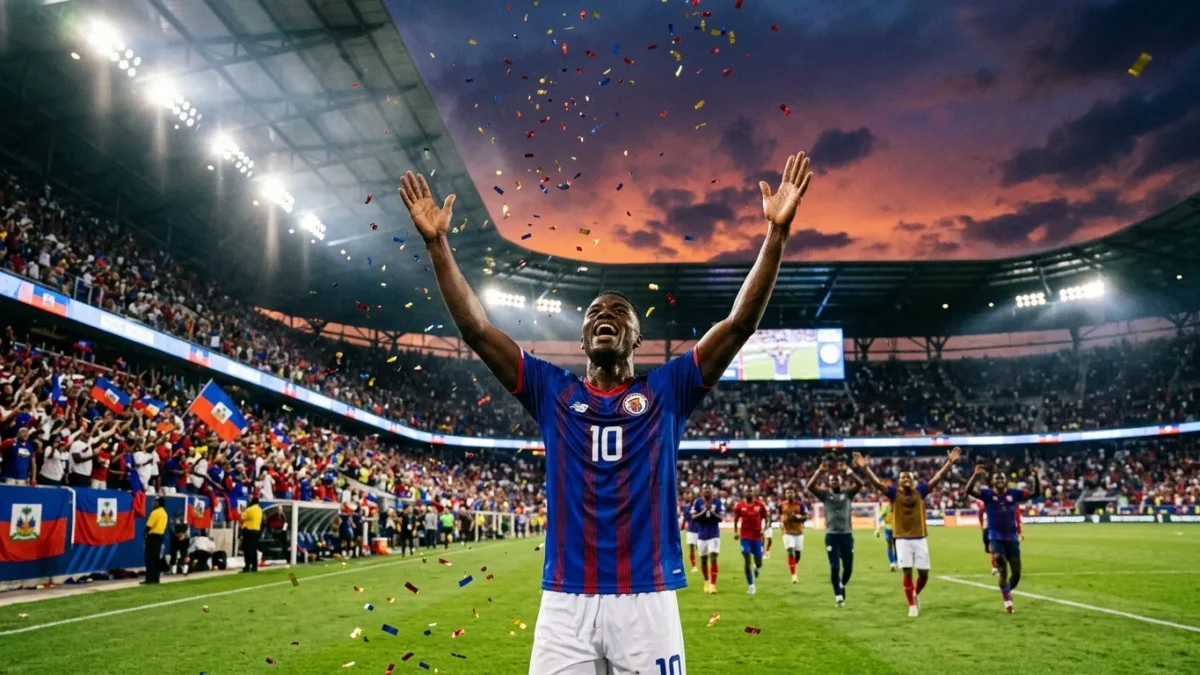
Haiti’s presence at the 2026 World Cup finals is nothing short of extraordinary. The Caribbean nation ranks among the world’s most economically fragile countries, yet here they are, competing on football’s grandest stage for only the second time in their history, their first appearance dating back to 1974. This isn’t just a sporting achievement. It’s a statement.
A squad built across borders and five countries
Look at the numbers and they tell you everything. Sixteen of Haiti’s 26 players were born outside the country, spread across five different nations. The squad itself represents 25 clubs operating in 15 separate countries. No other team at these finals comes close to that level of geographic dispersion. This isn’t a football team in the conventional sense. It’s a diaspora assembled into a starting eleven.
The man responsible for turning this patchwork into a functioning unit is Frenchman Éric Sékou Chelle… no, actually, the coach in question is Marc Collat… Let’s be precise : the source identifies him simply as Migne, a Frenchman who served as Cameroon’s assistant coach at the Qatar 2022 World Cup. That background matters. He has seen a major tournament from the inside, and he brought that experience directly to Port-au-Prince’s cause.
What’s striking about his approach is the simplicity of his philosophy. Midfielder Midy described him plainly : “He’s a magical coach. When I’m watching the games of Haiti, I cannot explain how he does it.” When Midy pushed him for a secret, the coach’s answer was disarmingly honest : put your heart in it. No tactical masterclass, no revolutionary system. Just full commitment from every man on the pitch.
Here’s a quick overview of what makes this squad structurally unique compared to a typical World Cup side :
- Players born in at least five different countries outside Haiti
- Club representation spanning 15 nations across multiple continents
- Several players who switched international allegiance to Haiti only recently
- Home matches played in Curaçao, roughly 500 miles from Port-au-Prince
That last point deserves a pause. Haiti hasn’t even been able to host their own home fixtures on home soil. They’ve been playing in Curaçao due to the security situation in the country. And they still qualified. That context reframes everything.
Nazon and Delcroix : two stories of identity and belonging
Two players in particular capture what this Haiti World Cup campaign means beyond football results. The first is forward Nazon, born in France to Haitian parents. He has scored 44 goals in 80 international appearances, but Midy insists the statistics aren’t what defines him in the eyes of Haitian supporters.
“We call him the chuchu of Haiti,” Midy said, using a French term of endearment. The point he’s making is precise : Haitian fans see in Nazon someone who chose to be Haitian, someone who carries that identity with a fiercer pride than many who were born and raised there. That kind of emotional investment from a player resonates deeply with a population that has endured so much.
| Player | Country of birth | Previous international | Year switched to Haiti |
|---|---|---|---|
| Nazon | France | None (senior) | N/A (long-term commitment) |
| Hannes Delcroix | Haiti | Belgium (1 cap, 2020) | 2025 |
Then there’s Hannes Delcroix, the former Burnley defender. His story runs in almost the opposite direction. Born in Haiti, he was adopted by a Belgian family at age two and grew up entirely in Europe. He earned one senior cap for Belgium in 2020, then made the deliberate decision to switch allegiance to Haiti in 2025. Cynics will note the timing : Haiti were on the edge of World Cup qualification when he committed. That’s a fair observation.
But Delcroix’s account goes further than opportunism. He has never physically met his biological mother or sisters. Their relationship exists only through phone calls, something he describes as “a strange feeling in the beginning because you don’t have any bond.” His first concern when they connected wasn’t football, it was simpler : is she OK, is everyone safe, is there anything I can help with ? The 27-year-old treats his time with the Haiti squad as a form of cultural education. He doesn’t speak Creole yet, but he wants to learn.
“When I’m with the Haitian team, it helps a lot to understand more about the culture,” he said. That’s not the language of someone chasing a shortcut to a World Cup medal. It reads like someone genuinely trying to understand where he comes from.
What Haiti’s rare finals appearance signals for Caribbean football
Haiti’s qualification shifts the conversation about Caribbean and CONCACAF football in a meaningful way. The region has historically been dominated by the United States, Mexico and, more recently, Canada. A Haitian side reaching the finals, despite playing home games abroad and drawing players from a scattered global diaspora, challenges assumptions about which nations can compete at this level.
Frankly, the lesson here isn’t just inspirational. It’s tactical. Diaspora recruitment, when handled with genuine cultural investment rather than pure pragmatism, can produce cohesive squads that outperform their resources. Haiti’s setup also raises a pointed question for other small football federations : are you actively engaging your diaspora populations, or leaving talent scattered across club rosters in countries that will never call them up ?
For Haiti specifically, this tournament is a rare window of global visibility. Every match is a chance to present the country as something other than crisis headlines. Whether the results go their way or not, the story of this squad will outlast the scorelines.
