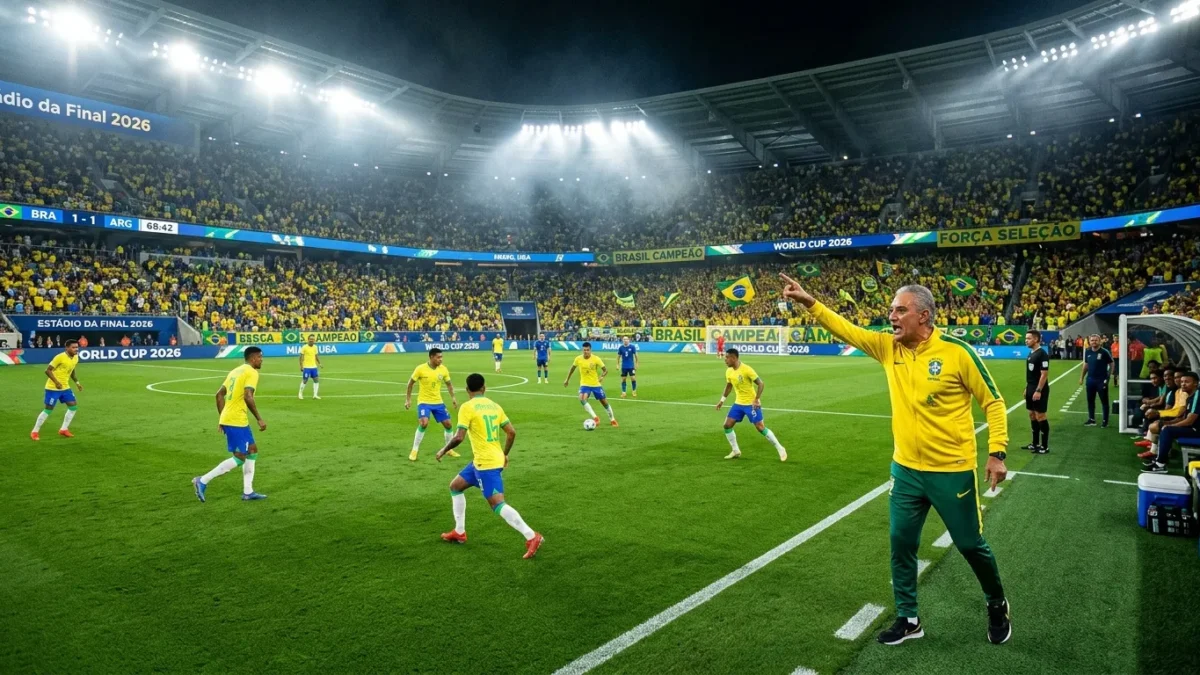
The 4-4-2 is back. Not as a curiosity or a nostalgic experiment, but as one of the defining tactical shapes of the 2026 World Cup. If you watched Premier League football in the early 2000s, you already know this formation instinctively : two banks of four, two strikers, and a structure built on width and balance rather than positional complexity. What’s surprising isn’t that some teams are using it. It’s how many.
Why the 4-4-2 is dominating World Cup 2026 tactical setups
Look at the teams lining up in this shape out of possession and the list reads like a cross-section of the entire tournament : Ecuador, Ivory Coast, Morocco, Brazil, Haiti, Scotland, Japan. Seven nations, from wildly different footballing cultures, converging on the same structural answer. That’s not coincidence.
The explanation is partly environmental. The heat and humidity at many 2026 venues make sustained high-intensity pressing genuinely unsustainable across 90 minutes. Mexico, Morocco, and Germany have all demonstrated that a well-timed press can yield goals quickly after forcing turnovers, but doing it continuously is physically punishing in these conditions. So teams are making a pragmatic choice : pick your moments, press in bursts, and spend the rest of the game defending in a structured mid-block.
That mid-block is the key detail. The 4-4-2 positions a team in the middle third of the pitch, neither deep nor high, occupying the space between their own penalty area and the opposition’s half. It provides wide coverage and a balanced defensive shape without demanding the same physical output as a high press. For international squads with limited training time together, that simplicity matters enormously.
Here’s why the 4-4-2 mid-block appeals to so many coaches at this level :
- It requires less positional drilling than a high-press system
- It suits players from different club systems who must integrate quickly
- It offers natural cover across wide areas, reducing exposure on the flanks
- It creates a compact shape that forces opponents to play in front of the block
- It preserves energy in high-temperature conditions
Frankly, the coaching argument here is solid. When you have three weeks to prepare a squad drawn from twenty different clubs, simplicity isn’t a compromise. It’s a strategy.
The risk teams accept by defending in a mid-block
There’s a real trade-off, and it would be dishonest to ignore it. Sitting in a mid-block surrenders control of the game, particularly against stronger nations. If Brazil, Spain, or France spend extended periods circulating the ball around your penalty area, you’re essentially giving them the exact match they want to play. That’s not neutral management. That’s handing the initiative to the opponent.
Compare the three main defensive approaches currently visible at this tournament :
| Defensive approach | Territory defended | Energy cost | Control conceded |
|---|---|---|---|
| Deep block | Own penalty area | Low | Very high |
| Mid-block (4-4-2) | Middle third | Medium | Moderate |
| High press | Opposition half | Very high | Low |
The mid-block sits between two extremes and that balance explains its popularity. A deep block is defensively passive and invites sustained pressure near your own goal. A high press is effective but brutal on the body, especially past the 60th minute in 30-degree heat. The 4-4-2 mid-block offers a workable middle ground, but it comes with a structural weakness that sharper teams have already identified.
Between the two lines of four, there are gaps. The space between the midfield four and the defensive four is precisely where technical teams have been finding pockets of play. When an attacking player receives the ball facing forward in that zone, the 4-4-2 can be pulled apart quickly. Brazil, whose adoption of this shape is particularly telling given their tradition of more fluid systems, will need to manage this exposure carefully in the knockout rounds.
What Brazil’s tactical shift reveals about modern international football
Brazil adopting a 4-4-2 defensive structure is genuinely significant. The Seleção built their identity on fluid positional play, creative freedom, and individual expression in tight spaces. Watching them organize in two rigid banks of four is a departure. It signals that even the most technically gifted squads are now prioritizing structural reliability over expressive chaos in high-stakes knockout football.
There’s a broader point here about how international football has evolved. The gap between club and international level has widened considerably. At club level, elite teams like Manchester City or Real Madrid drill their systems for months. International coaches get roughly 30 days per year with their squads. A system like the 4-4-2 survives that constraint because it’s readable, recognizable, and doesn’t demand elaborate positional understanding from players who barely train together.
The early 2000s Premier League comparison isn’t just aesthetic. That era produced open, vertical football partly because tactical complexity hadn’t yet filtered down to every squad. What we’re seeing now at the 2026 World Cup is different : teams are choosing simplicity consciously, not because they lack sophistication, but because the environment demands it. The real tactical question for the second half of this tournament is whether the teams exploiting the gaps between those two lines of four can do so consistently enough to eliminate the 4-4-2 adopters. My bet is on the teams who can play in that half-space with one touch. Watch how quickly the knockout stage answers that.
