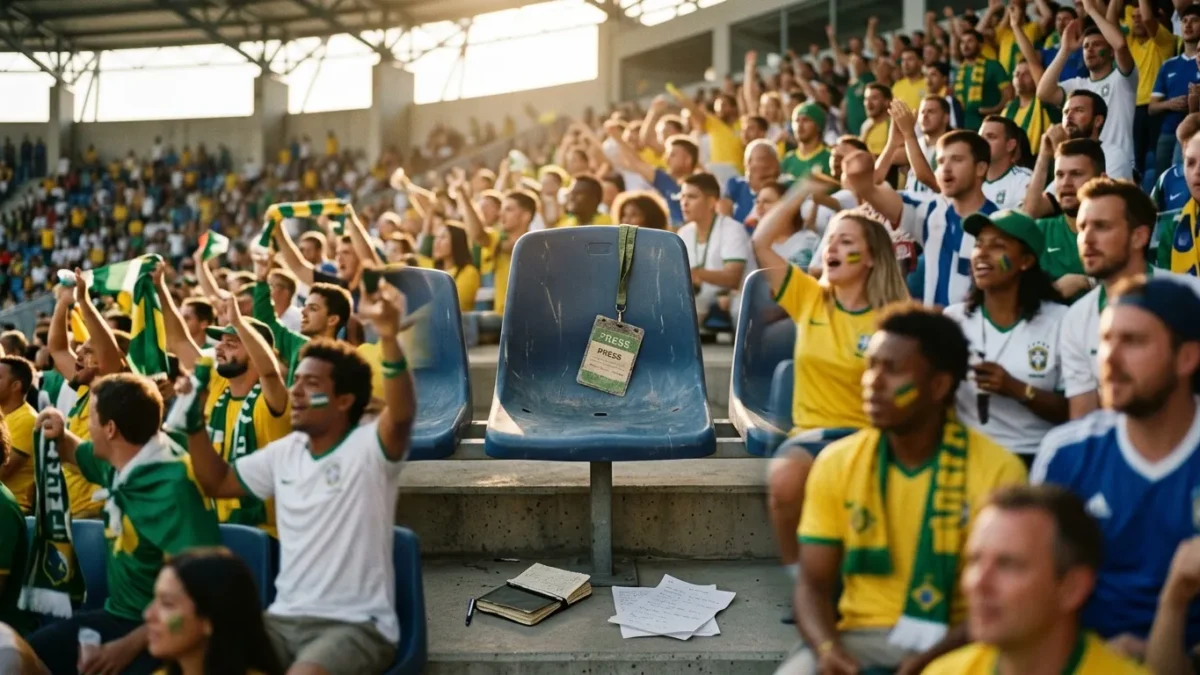
A chair sits empty in the World Cup 2026 press box. Not by accident, not by oversight, but as a deliberate act of solidarity for Romain Gleizes, a French sports journalist currently imprisoned in Algeria. This symbolic gesture, carried out by French media and football officials alike, has turned a seat into a statement that echoes far beyond the stadiums of North America.
A journalist detained for doing his job
Romain Gleizes traveled to Algeria in May 2024 for what seemed like a straightforward assignment : reporting on JS Kabylie (JSK), a football club based in Tizi Ouzou, in the heart of the Kabylie region. What followed was anything but routine. Algerian authorities detained him shortly after his arrival, and the case quickly escalated into an international press freedom scandal.
The charges brought against him were startling. A court found him guilty of maintaining contact with a supporter of self-determination for the Kabyle minority, a Berber people indigenous to northern Algeria. In other words, a journalist was convicted for the sources he spoke to while covering a football story. That alone should set off alarm bells for anyone who cares about how journalism works.
This case is not an isolated incident in the broader landscape of press freedom in Algeria. The country ranked 121st out of 180 nations in Reporters Without Borders’ 2024 World Press Freedom Index, reflecting a deeply uncomfortable reality for journalists operating there. Gleizes became the human face of that statistic.
Around 40 French media organizations publicly condemned his imprisonment after sentencing. Their joint statement was unambiguous : “the imprisonment of a journalist for carrying out his profession is a red line that must never be crossed.” Forty newsrooms speaking with one voice is rare. It underlines just how seriously the French media industry is taking this case.
How the World Cup 2026 became a platform for his release
Football’s biggest tournament, co-hosted by the United States, Canada and Mexico, opened in June 2026. France arrived as one of the title contenders. But the French delegation brought more than tactics and squad depth to the tournament. They brought a cause.
| Gesture | Location | Organized by |
|---|---|---|
| Empty seat in the press box | Match venues | French media representatives |
| Empty chair at press conferences | France team media room | French Football Federation |
| Question asked on his behalf | Didier Deschamps press conference | Vincent Duluc, L’Équipe |
Vincent Duluc, a journalist at L’Équipe, France’s leading daily sports newspaper, took the initiative a step further. During a press conference on Monday, he posed a question to France head coach Didier Deschamps on behalf of Gleizes. The question itself, about hydration breaks during matches, was mundane. The act of asking it in his name was anything but.
Deschamps responded with visible emotion : “I hope for his sake and his family’s that he can be here as soon as possible and ask his questions himself.” A football coach, usually focused entirely on tactics and performance, using a press conference to advocate for a detained journalist. That moment captured something genuine.
These symbolic acts serve a clear purpose :
- They keep Gleizes’s name in the international spotlight throughout the tournament
- They apply indirect diplomatic pressure on Algeria through sustained media visibility
- They signal to authorities worldwide that jailing journalists for professional activity carries reputational consequences
- They remind the global press corps that solidarity across borders still exists
What this means for press freedom at major sporting events
The World Cup 2026 is the largest sporting event on the planet, broadcast to over five billion viewers across multiple tournaments combined. Using that platform to spotlight an imprisoned sports journalist is tactically smart and morally necessary. Gleizes’s case demonstrates a troubling pattern : journalists covering grassroots or regional sports stories can walk into legal traps simply by speaking to the wrong person, according to the host country’s definition of “wrong.”
French media’s response deserves credit. Rather than issuing a single statement and moving on, they built a sustained, visible campaign around an empty chair. It is a low-tech, high-impact form of advocacy. Every time a camera pans across that vacant seat in the press box, a question hangs in the air : where is the journalist who should be sitting there ?
Frankly, the football world does not do enough of this. Sporting events regularly take place in countries with troubling human rights records, and the media pack often adjusts without comment. The mobilization around Gleizes is the exception, not the rule, and it should inspire more consistent pressure from press organizations attending future tournaments.
For working journalists covering international sport, Gleizes’s situation raises a practical and urgent question : what legal protections exist when reporting from countries with restricted press freedoms ? Organizations like Reporters Without Borders and the Committee to Protect Journalists offer pre-trip briefings and legal support, but awareness among sports reporters remains low. His case is a hard reminder that a football assignment can become a detention case with terrifying speed, and that preparation before travel is not optional.
