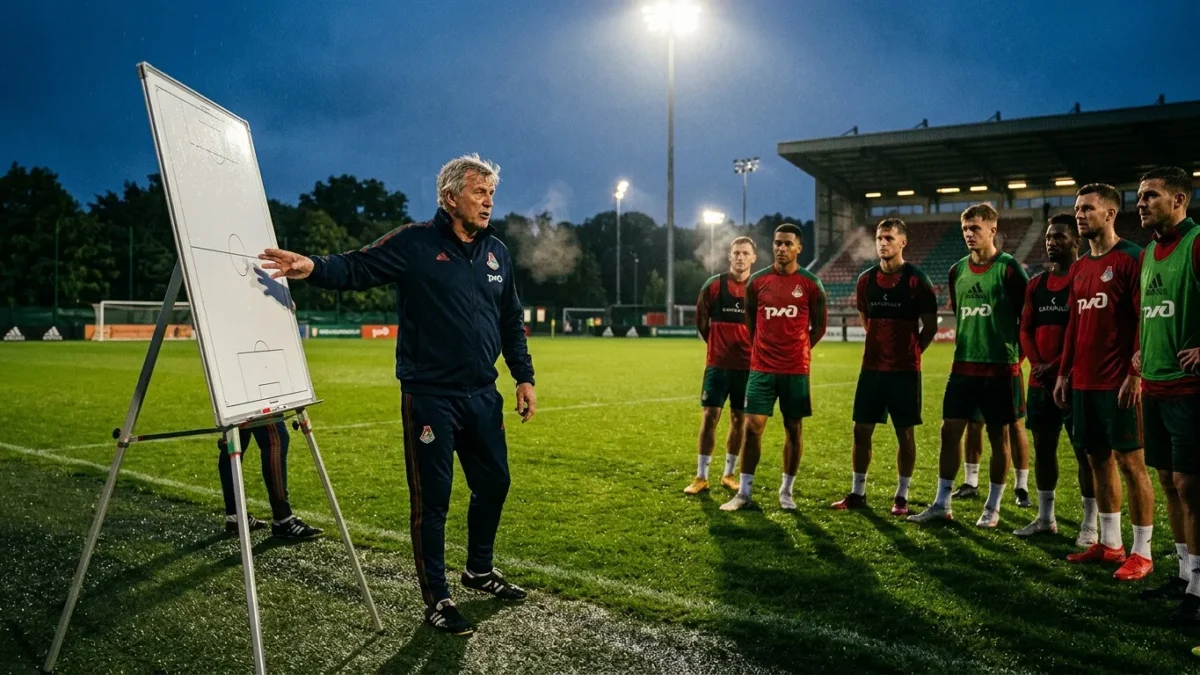
Austin MacPhee doesn’t look like your typical football analyst. The long blonde hair, the restless energy on the touchline, he cuts a striking figure whenever he steps out of the dugout to orchestrate a dead-ball situation. But Portugal’s 2026 World Cup campaign could hinge on precisely what this Scottish coach does best : turning set-pieces into decisive weapons.
A career built on detours, not straight lines
MacPhee’s path through football reads like something nobody would have scripted. His playing career started in Forfar Athletic’s youth system before taking him across the Atlantic to play college football with the Wilmington Seahawks in the United States. From there, Romania, then Japan. Three continents, minimal fanfare, maximum experience.
His coaching journey proved just as unconventional. He didn’t start at a Premier League academy or a continental giant. He began managing Cupar Hearts, a Scottish amateur side he guided all the way to the Scottish Amateur Cup final. That achievement alone tells you something about his ability to organise a group and extract more than expected from limited resources.
The stops that followed reveal a coach building specific, deliberate expertise :
- Cowdenbeath (Scotland)
- St Mirren (Scotland)
- Hearts (backroom staff, including caretaker manager role in 2019)
- Midtjylland (Denmark), one of European football’s most renowned laboratories for set-piece innovation
- Northern Ireland national team (six years under Michael O’Neill)
- Scotland national team (three years under Steve Clarke)
That stint at Midtjylland deserves particular attention. The Danish club has become a genuine reference point for dead-ball specialists across Europe, and MacPhee absorbed that culture thoroughly before bringing it into international football.
The set-piece specialist who shaped two national teams
Before Portugal trusted him with their World Cup preparation, MacPhee had already left a measurable mark on international football. His contribution to Northern Ireland’s qualification for Euro 2016 was significant, working alongside Michael O’Neill for six years in a role that blended tactical analysis, opposition scouting and dead-ball choreography.
O’Neill was unambiguous in his assessment : “Austin brings a high level of knowledge on the opposition, a creative way to train and he’s creative in how he brings information to the players.” That’s not a throwaway compliment from a manager protecting a member of staff. That’s a precise description of a specific skill set.
What makes MacPhee unusual is the breadth of his football intelligence. In 2014, he was in Brazil scouting for Mexico at the World Cup, gathering data and analysing opponents for a national federation on the other side of the world. That international exposure, combined with his set-piece expertise, makes his profile genuinely rare.
| Tournament | Role | Outcome |
|---|---|---|
| Euro 2016 qualification | Assistant / set-piece coach (Northern Ireland) | Historic qualification achieved |
| 2014 World Cup (Brazil) | Scout for Mexico | Intelligence gathering role |
| Euro 2024 qualification | Set-piece coach (Scotland, under Steve Clarke) | Scotland qualified for the finals |
| 2026 World Cup | Set-piece coach (Portugal) | Campaign ongoing |
His time with Scotland under Steve Clarke also produced results : Scotland qualified for Euro 2024, their second consecutive major tournament after a 23-year absence. MacPhee’s dead-ball routines were a tangible part of that success. The partnership with Clarke ended with a memorable moment at the German finals, where the two were spotted in a heated pitchside exchange. Clarke, typically dry, deflected questions about it : “He’s got long blonde hair, but I’m not going to give him a cuddle.” Classic Scottish understatement masking what was clearly a working relationship built on directness.
Why the criticism he faced was misplaced
MacPhee was briefly in the frame for the Hearts head coach position in 2019 while serving as caretaker. The scrutiny he received during that period was, frankly, disproportionate and often rooted in superficiality. His appearance attracted more commentary than his track record. That says more about Scottish football’s occasional myopia than about MacPhee’s credentials.
Consider what he was doing simultaneously during his Hearts years : running a sports travel company, managing a community football club, and working in international football. That level of multitasking points to someone with organisational intelligence far beyond the average coaching candidate.
The criticism faded, and the opportunities kept growing. Portugal, one of the world’s top-ranked nations and led by Cristiano Ronaldo heading into what may be his final World Cup, have placed their set-piece strategy in Scottish hands. That’s a statement of trust backed by evidence, not sentiment.
What Portugal’s World Cup run could reveal about the modern set-piece coach
Portugal rank among the favourites for the 2026 World Cup, co-hosted by the United States, Canada and Mexico. With a squad packed with elite technical players, their attacking threat from open play is obvious. But tournaments are frequently decided by marginal gains, and dead-ball situations account for roughly 30% of goals in major international tournaments, a figure that has increased steadily over the past decade.
MacPhee’s job is to exploit that percentage ruthlessly. The meticulous preparation he brings, honed across amateur Scottish football, Danish innovation at Midtjylland and years of international exposure, positions him as exactly the kind of specialist modern tournament football demands. His profile challenges the assumption that elite football coaching only emerges from elite football academies.
If Portugal lift the trophy in July 2026, the man with the striking blonde hair will have earned his share of the credit. Watch the corners. Watch the free-kicks. Austin MacPhee will be the one who designed them.
