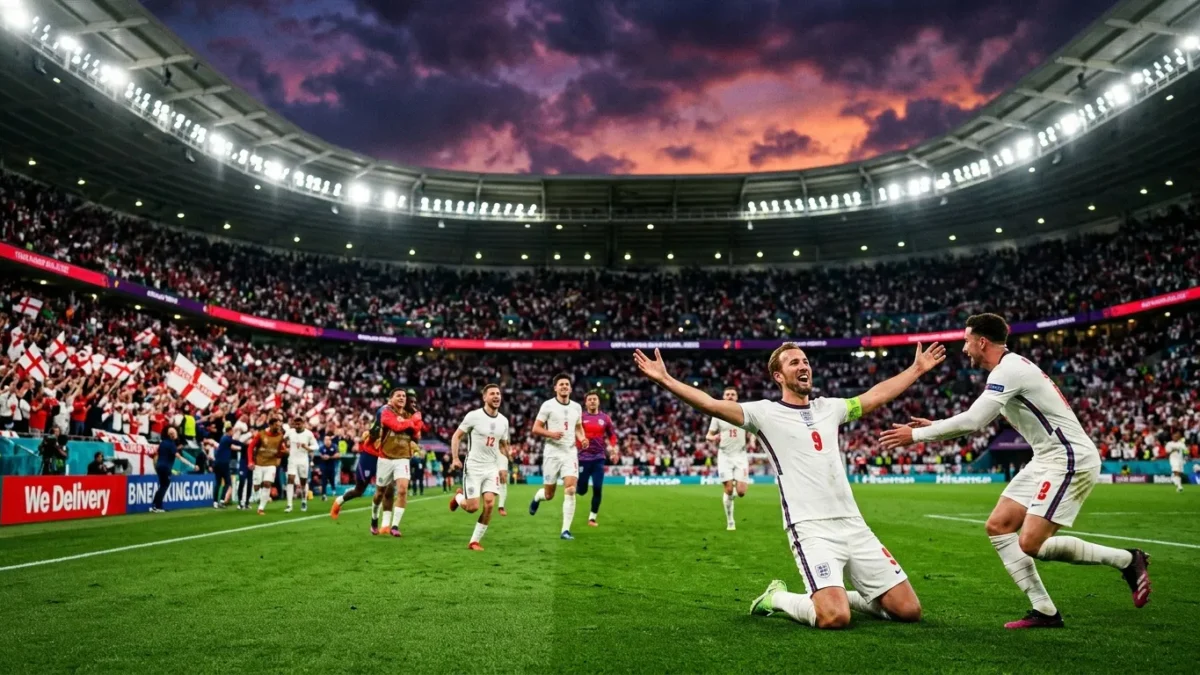
Seven points from three games. That’s what Thomas Tuchel’s England needed to secure top spot in Group L, finishing ahead of Croatia, Ghana, and a Panama side that never really threatened. The Three Lions drew with Ghana but defeated both Croatia and Panama to book their place in the last 32. Now the real tournament begins, and the route to MetLife Stadium in New Jersey is both navigable and genuinely daunting.
England’s first knockout test : DR Congo in Atlanta
The reward for topping Group L is a round-of-32 fixture in Atlanta on Wednesday 1 July, kick-off 17 :00 BST. The opponents are DR Congo, who came third in Group K after a mixed campaign : a draw with Portugal, a defeat to Colombia, and a win over Uzbekistan. Don’t let that group record mislead you.
The Leopards are ranked 46th in the world, yet they conceded just three goals across those three fixtures. Their squad carries serious Premier League pedigree : Newcastle forward Yoane Wissa, West Ham defender Aaron Wan-Bissaka, Burnley centre-back Axel Tuanzebe, and Sunderland left-back Arthur Masuaku. That’s four top-flight English players who know exactly what pressure looks like.
Historically, this is only DR Congo’s second World Cup appearance. They qualified in 1974 under their former name Zaire, becoming the first Sub-Saharan African nation to do so. Reaching the knockouts in their comeback appearance is already a landmark. Frankly, England cannot afford to underestimate them, particularly after DR Congo were edged out by Algeria only in the last 16 of the Africa Cup of Nations in January.
The brutal gauntlet from the last 16 to the semi-finals
Should England get past DR Congo, the path ahead escalates quickly. Here is how the potential opponents stack up round by round :
| Round | Date (BST) | Potential opponent | Key detail |
|---|---|---|---|
| Last 16 | Mon 6 July, 01 :00 | Mexico or Ecuador | Estadio Azteca, 7,000+ feet altitude |
| Quarter-final | Sat 11 July, 22 :00 | Brazil, Ivory Coast or Norway | Venue : Miami |
| Semi-final | Wed 15 July, 20 :00 | Argentina, Colombia or others | Back to Atlanta |
The last-16 fixture, if England progress, takes place at Mexico City’s Estadio Azteca, a venue with an 87,500 capacity and one very uncomfortable feature : it sits more than 7,000 feet above sea level. Altitude at that height causes shortness of breath, elevated heart rate, and accelerated fatigue, especially for players unaccustomed to those conditions. Mexico, ranked ninth in the world, played all three group games at home and have not lost a competitive match since a 2-0 defeat by Honduras in November 2024, a run of 12 unbeaten fixtures. Ecuador are also a credible threat, having not conceded more than one goal in any match across 26 consecutive games, including a dramatic 2-1 win over Germany in the group stage’s final round.
The quarter-final picture is where things get genuinely complicated. Brazil, five-time world champions under Carlo Ancelotti, are in England’s section of the draw. Vinicius Jr. scored four goals and added an assist during the group stage, though Brazil’s 1-1 draw with Morocco revealed vulnerability when pressed. Japan are their last-32 opponents and present a real danger : tactically sharp, technically refined, and unbeaten in their last 16 matches, including a 1-0 friendly win over England at Wembley in March. The other quarter-final candidates are Ivory Coast and Norway. Ivory Coast have the attacking talent to hurt anyone, with RB Leipzig teenager Yan Diomande, Inter’s Ange-Yoan Bonny, and Manchester United winger Amad Diallo all capable of decisive moments. Norway, making their first World Cup appearance since 1998, bring Erling Haaland, and that alone demands respect.
- Argentina : won all three group games, with Lionel Messi scoring five goals in the month he turned 39, now the all-time top scorer in World Cup history, surpassing Miroslav Klose’s previous record
- Colombia : topped their group ahead of Portugal, winning two of three matches, potential semi-final rivals
- Switzerland, Algeria, Ghana : all sit in the same half of the draw as England and could realistically advance
A semi-final appearance would bring England back to Atlanta for what could be a defining 90 minutes against Messi’s Argentina or an in-form Colombia. That’s not a scenario to take lightly.
A final in New Jersey and what England must prepare for now
The World Cup final takes place on Sunday 19 July at MetLife Stadium in New Jersey, in front of 82,500 supporters. For England, getting there would mean a third major tournament final within a single decade, a historic benchmark for a programme that has worked hard to build tournament consistency under successive managers.
The entire opposite half of the draw is filled with credible final opponents. France and Germany could meet as early as the last 16, with the winners likely facing Spain in the semis. The Netherlands face Morocco in a difficult last-32 tie. Portugal could play Spain if both sides win their openers. Sweden, Belgium, the USA, Canada, South Africa, Paraguay, Bosnia-Herzegovina, and Senegal complete that half of the bracket.
The tactical homework Tuchel’s staff must complete right now centres on one specific priority : managing altitude adaptation ahead of a possible trip to Mexico City. That is the most controllable variable England can prepare for. Beyond that, the bracket offers a realistic path to the final, but only for a squad that executes with consistency from the very first minute in Atlanta.
