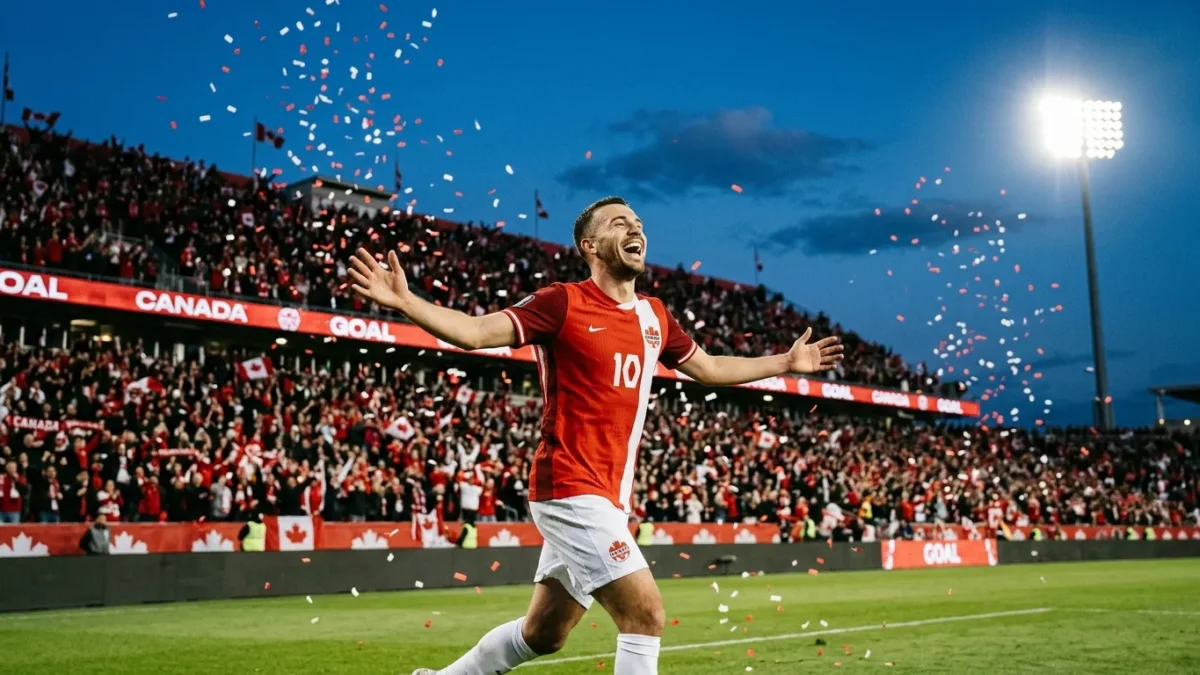
Tears in Toronto. That image says everything. Alphonso Davies, one of the most decorated players in European football, stood in awe watching thousands of Canadians dressed in red and white flood the stadium for their opening group game against Bosnia-Herzegovina. “It was surreal,” he admitted. “I’ve never seen so many Canadians at a football match before. It brought tears to my eyes.” For a man who plays Champions League nights in front of 75,000 fans at the Allianz Arena, that reaction tells you exactly how significant this World Cup moment is for Canada.
From forgotten co-host to historic last 16 qualifier
Let’s be honest : Canada entered this tournament in the shadow of its two co-hosts. Mexico staged the opening match, the United States will host the final, and Canada ? Canada was largely treated as the polite afterthought. The media spotlight stayed firmly on its neighbours, and the broader football world barely paid attention.
That changed on Sunday. Canada defeated South Africa to reach the last 16 of a World Cup for the first time in their history, a result that sent shockwaves through a country still widely associated with ice hockey. This wasn’t just a win. It was a statement.
Coach Jesse Marsch has never been shy about his ambitions. When he took charge two years ago, his stated mission was to make Canada a genuine football nation. At the time, it seemed like wishful thinking. Forty-eight hours after that final whistle, it looks like a promise delivered ahead of schedule.
| Match | Result | Stage |
|---|---|---|
| Canada vs Bosnia-Herzegovina | Win | Group stage |
| Canada vs South Africa | Win | Group stage (knockout-round qualifier) |
The shift in atmosphere around the squad has been palpable. Where earlier matches felt cautious, Sunday’s victory carried a different weight. The belief was visible. Players fought for every ball, the bench erupted after the final whistle, and Marsch gathered the entire group in a tight huddle to deliver words few will forget : “Canadian heroes.” Not a gimmick. A verdict.
Jesse Marsch, the architect of a football shift
Marsch is known for emotional, high-impact statements. You can debate his style, but his results here are harder to argue with. His core message after the South Africa win cut right to the point : “The future of the sport in this country is huge because of you.” Grandiose ? Perhaps. But watch the fan reaction in Toronto and tell me he’s wrong.
His task when arriving was clear : build a team capable of competing on home soil while simultaneously growing the game’s footprint nationally. Those two objectives don’t always align. Marsch pursued both without compromise.
What’s driving this transformation ? Several factors are working in tandem :
- A squad built around elite European talent, led by Alphonso Davies of Bayern Munich
- A home tournament generating unprecedented media coverage and public interest
- A generational fanbase seeing its national team succeed for the first time
- An identity shift, with many Canadians now using the word “football” rather than “soccer”
That last point is more symbolic than it sounds. Language reflects culture. One supporter outside the stadium told BBC Sport before the South Africa match : “It is starting to become known as football now, not soccer. Canada is becoming a football nation.” That kind of organic shift doesn’t happen overnight. It happens when a team gives people something worth believing in.
Alphonso Davies and the emotional heartbeat of a nation
Davies has spent his career performing at the highest level in European club football. He is accustomed to packed stadiums, hostile atmospheres and knockout football under enormous pressure. None of that prepared him for what he saw in Toronto.
Seeing his compatriots fill a stadium wearing Canadian colours moved him to tears. That image, a Bayern Munich starter genuinely overwhelmed by domestic support, captures something profound about this World Cup moment for Canada. The country is catching up fast with its own star player.
His captaincy has given the squad a figurehead the public can rally around. At 25, Davies carries the technical quality and the emotional intelligence required to lead a team through historic territory. He knows how to manage the weight of expectation while keeping the squad focused on the next match.
The knockout stages now await. Canada has never been here before, and that novelty cuts two ways. There’s no blueprint, no experience to lean on. But there’s also no fear of failure built into their DNA yet. That can be an advantage.
What reaching the round of 16 actually means for Canadian football
Strip away the emotion for a second and look at what this result practically delivers. Qualifying for the last 16 on home soil guarantees at minimum one more game in front of Canadian supporters. For a sport still building its roots in the country, every additional match is a recruitment event, a chance to convert casual observers into committed fans.
Youth participation figures matter here. According to Canada Soccer, registered youth players reached approximately 847,000 in 2024, a number that tournament success could push significantly higher over the next two seasons. The infrastructure is there. What was missing was a national team worth following.
That argument no longer holds. Canada has now won a knockout-round berth at a World Cup. The team exists, the talent exists, and the appetite is growing match by match. Marsch’s next challenge is not convincing Canadians that football deserves their attention. It’s managing the expectations that come with having already earned it. The round of 16 is not the destination. For this squad and this country, it may only be the beginning.
