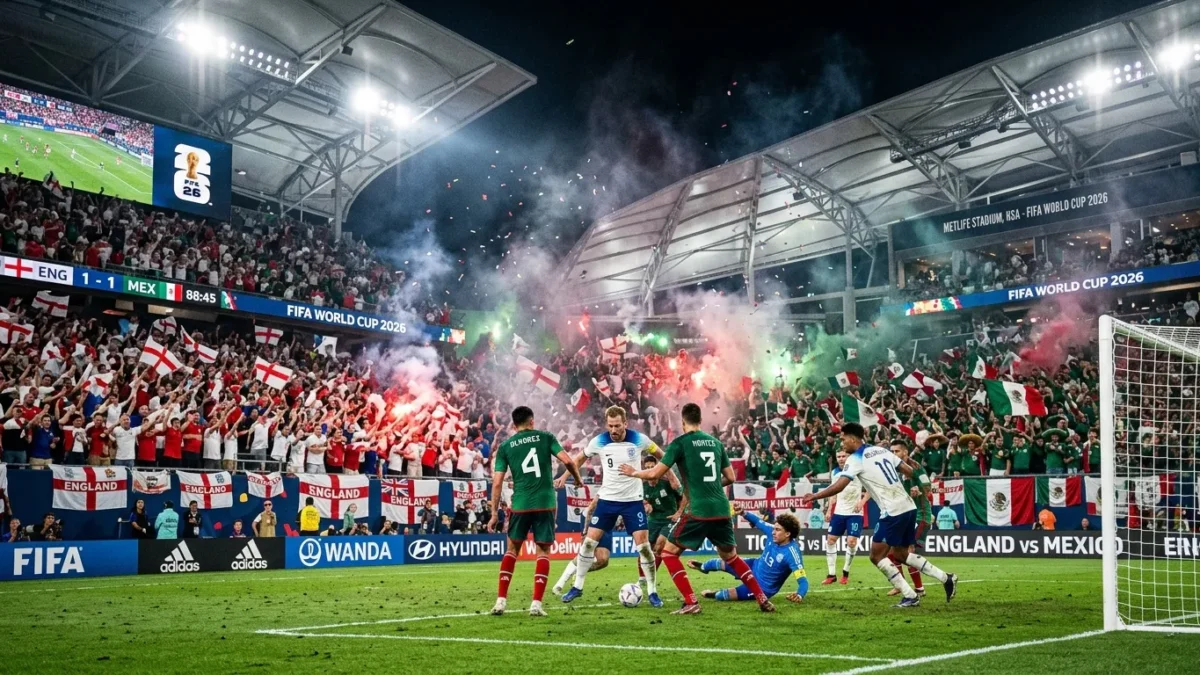
Five and a half hours. That’s all it took to turn a straightforward round of 16 fixture into one of the most baffling administrative episodes in World Cup history. On Friday 4 July 2026, England fans preparing for a late-night alarm were suddenly told their match against Mexico might start six hours earlier than planned. Then it wasn’t. The England vs Mexico chaos at the 2026 World Cup exposed deep flaws in how FIFA handles crisis decisions at its own tournament.
How the England-Mexico scheduling crisis unfolded
It started innocuously enough. Around 18 :30 BST, reports from Mexican journalists began circulating that FIFA was seriously considering moving the Azteca kick-off from 18 :00 local time to 12 :00. The stated reason : severe thunderstorms forecast for Sunday evening in Mexico City. FIFA was reportedly worried about lightning strikes and potential flooding disrupting the match.
The Football Association had absolutely no idea this was coming. When BBC Sport journalists started asking questions, the FA was caught completely off guard. That alone tells you something important about FIFA’s communication process. An organisation running the biggest sporting event on the planet was apparently planning an unprecedented last-minute schedule change without informing the competing nations first.
Meanwhile, England’s squad was finishing an open training session in Kansas. Morgan Rogers and Marcus Rashford faced the media shortly after and handled the situation with composure, insisting the uncertainty wouldn’t affect their preparation. At approximately 21 :30 BST, the squad boarded their charter flight to Mexico City still not knowing what time their game would start. That is not a normal situation.
Mexico’s manager Javier Aguirre didn’t hold back. He called the proposed change “a kick in the gut”, which frankly seems like an accurate description. Both national associations were furious that FIFA was floating a six-hour schedule alteration less than 48 hours before kick-off. The logistical consequences were enormous.
| Time (BST) | Key event |
|---|---|
| 18 :30 | First reports of potential kick-off change emerge from Mexican media |
| 20 :00 | FA officially informed of FIFA’s intention to alter the schedule |
| 21 :30 | England squad flies to Mexico City without confirmed kick-off time |
| 22 :00 | Reports suggest FIFA is considering reversing the decision |
| Just before 00 :00 | Confirmed : match stays at 18 :00 local time (01 :00 BST Monday) |
By 22 :00 BST, the tide was turning. Mexican journalist Gibran Araige posted that FIFA appeared to be backing down. Just before midnight, sources confirmed to BBC Sport that the original kick-off time would stand. England fans could stop refreshing their screens. The answer was : stay up very late or set the alarm for 01 :00 BST on Monday morning.
The real reasons behind FIFA’s U-turn on the World Cup fixture
So why did FIFA reverse course ? Several factors piled up simultaneously, and frankly the governing body had underestimated all of them from the start. The England Supporters’ Travel Club had received an allocation of 3,000 tickets, all sold out at the ballot stage back in December. Many of those supporters had specific travel plans built around an 18 :00 local kick-off.
Two flights from Atlanta were landing in Mexico City on Sunday morning, at 09 :55 and 11 :55 local time. Any supporter on those flights would have missed a 12 :00 kick-off entirely. That’s not a minor inconvenience; it’s thousands of pounds wasted on a trip they can’t complete in time. FIFA couldn’t ignore that once it was spelled out clearly.
There was also a knock-on effect on other fixtures. Moving the England-Mexico game to 12 :00 would have created a scheduling conflict with the Brazil vs Norway tie, originally set for 21 :00 BST on Sunday. Avoiding fixture overlap in the same tournament is basic logistics. The fact that this wasn’t checked immediately suggests the initial proposal was rushed.
The key factors that killed the schedule change were :
- Thousands of supporters with non-refundable travel plans based on the original time
- Two transatlantic flights arriving after the proposed new kick-off
- Strong pushback from both the English and Mexican football associations
- Scheduling conflicts with other last-16 fixtures on the same day
Weather was the original justification, but it’s worth understanding the nuance here. BBC lead weather presenter Ben Rich explained that while an earlier kick-off would have reduced the risk of severe thunderstorms, it was far from a guarantee. Daily thunderstorms are normal in Mexico City in July, but Sunday’s risk was rated as particularly high, with atmospheric troughs expected in the middle and upper layers above central Mexico.
Altitude, heat and what actually matters for the players on Sunday
Beyond the scheduling drama, there’s a genuine sporting question worth taking seriously. The Estadio Azteca sits at roughly 2,240 metres above sea level. Dr Barney Wainwright, senior research fellow at Leeds Beckett University, told BBC Sport that maximum aerobic capacity drops around 10% at that altitude. That’s not trivial for a knockout match.
Would playing at 12 :00 rather than 18 :00 have changed anything ? Wainwright’s take is blunt : probably not significantly from a purely altitude-based perspective. But he flagged one important point. Heat compounds the effects of altitude because both reduce the oxygen available to muscles and the brain. Decision-making, visual processing and sustained effort all suffer. An earlier kick-off in higher temperatures might have created a double whammy effect, as Wainwright put it, even if the thunderstorm risk was lower.
There’s also the question of sleep. Altitude disrupts rest patterns, and demanding players wake earlier for a 12 :00 kick-off removes any possibility of recovery time. The evening slot actually gives both squads a better chance at proper rest and preparation, even if it raises the thunderstorm risk. If stoppages do occur Sunday evening, Wainwright noted that brief breaks could paradoxically help England manage the physiological strain of playing at altitude.
The match goes ahead as planned. But FIFA owes every stakeholder involved a proper review of how it nearly derailed one of the tournament’s biggest ties through poor communication and an underprepared contingency process.
