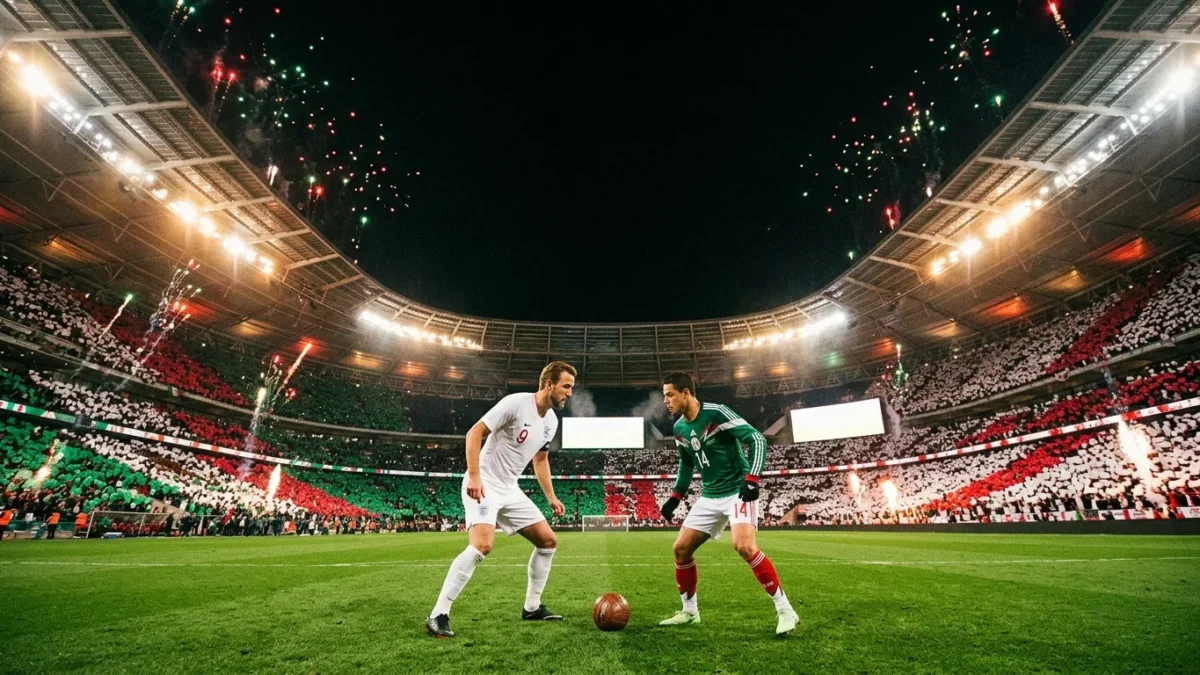
At 1am BST on Monday, England face Mexico at the Estadio Azteca in Mexico City, and that kick-off time is now set in stone. After a chaotic Friday evening of backroom negotiations, Fifa confirmed it was abandoning plans to bring the match forward by six hours. What started as a quiet proposal from football’s governing body turned into a diplomatic storm between three football associations and one governing body that, frankly, handled the situation poorly from start to finish.
Fifa’s U-turn : what actually happened on Friday night
The chaos began when Fifa floated the idea of moving the England vs Mexico last-16 tie from 18 :00 local time (01 :00 BST) to 12 :00 local time (19 :00 BST on Sunday). The stated concern was the weather. Mexican government meteorologists had flagged that atmospheric troughs in the middle and upper layers of the atmosphere would make conditions particularly unstable on Sunday afternoon and evening, increasing the risk of severe thunderstorms, frequent lightning, and even hail. An earlier kick-off, at least in theory, would have allowed the game to be played before the worst of those storms developed.
BBC Sport first reached out to the FA at 19 :00 BST on Friday, after local Mexican media broke the story. At that point, the FA had not received any official communication from Fifa. Within 30 minutes, that changed. Fifa confirmed it was “exploring the possibility” of rescheduling. The reaction from both the FA and the Mexican Football Association was swift and, by all accounts, furious. Both associations pushed back hard, raising legitimate concerns about player preparation, fan travel, and the sheer logistical complexity of moving a match of this scale at such short notice.
The FA specifically requested time to review the weather forecast more carefully before any decision was taken. Fifa, which had appeared ready to publish a formal statement confirming the change, ultimately reversed course. The fixture stayed at its original time. Interestingly, Fifa regulations for World Cup 2026 explicitly grant the governing body the right to “cancel, reschedule or relocate” matches at its sole discretion, but exercising that power here would have been a serious overreach, and they knew it.
The Azteca at altitude : what England face on Sunday night
The Estadio Azteca sits at 7,220 feet (2,240 metres) above sea level. Mexico have won 87 of their 89 matches at that stadium. Those two numbers tell you almost everything you need to know about what England are walking into. At that altitude, barometric pressure drops, air becomes thinner, and the body absorbs less oxygen with each breath. For professional athletes, that translates directly into faster fatigue, elevated heart rate, and more intense dehydration, even during a 90-minute match.
Had the kick-off shifted to midday local time, temperatures would have reached around 23°C. At the original evening time, forecasts put the temperature closer to 20°C. A three-degree difference might sound trivial, but combined with altitude and a thunderstorm risk that, according to meteorologists, peaks in the late afternoon and early evening, the original 18 :00 local time was arguably the more reasonable choice anyway.
| Factor | 12 :00 local kick-off | 18 :00 local kick-off (confirmed) |
|---|---|---|
| Temperature | ~23°C | ~20°C |
| Storm risk | Lower (but not zero) | Higher (peak storm window) |
| Altitude impact | Same | Same |
| Fan disruption | Very high | Minimal |
Mexico have already dealt with weather disruption in this tournament. Their last-32 match against Ecuador was delayed by a full hour due to lightning in Mexico City. France’s group-stage game against Iraq in Philadelphia ran more than two hours late because of adverse conditions. Fifa introduced mandatory three-minute hydration breaks midway through each half specifically because of extreme heat concerns, breaks that have continued even when temperatures were perfectly manageable.
Players, fans, and a 1am alarm call across England
England’s players were wrapping up training at their Kansas City base when news of the potential rescheduling broke. Marcus Rashford, asked directly as he left the pitch, called it “not ideal” but said the squad would adapt. “I think for us it’s the same how we prepare for the game,” he said. “It has to be the same.” Morgan Rogers echoed that pragmatism : “We’ll be ready regardless of the time.” Straightforward, professional, no drama. That’s the right attitude.
Mexico manager Javier Aguirre was less composed before the U-turn was confirmed. The 67-year-old told radio station Grupo Formula that the proposed change felt like “a kick in the stomach”. He hadn’t been consulted, and said so bluntly : “They didn’t even ask for my opinion. Fifa organises, Fifa decides, and I comply.” He also confirmed the earlier time would not actually benefit his team’s preparation.
Back in England, Prime Minister Sir Keir Starmer had already pushed through emergency legislation allowing pubs in England and Wales to stay open until 5am for the match. Over 3,000 England supporters are expected inside the Azteca, which holds 87,000. The following watch options are available for UK fans :
- BBC One and BBC iPlayer (live broadcast)
- BBC Radio 5 Live and BBC Sounds (audio commentary)
- BBC Sport website and app (live text and updates)
Thomas Tuchel, England’s head coach, had already told parents to “write an excuse for school” so children could watch. The government’s response was measured : parents decide, but kids should be in school Monday. That tension, between a nation wanting to celebrate and the practicalities of a 1am kick-off, captures exactly why Fifa’s chaotic handling of this situation caused such widespread anger in the first place. Set the fixture time, stick to it, and let everyone plan accordingly.
