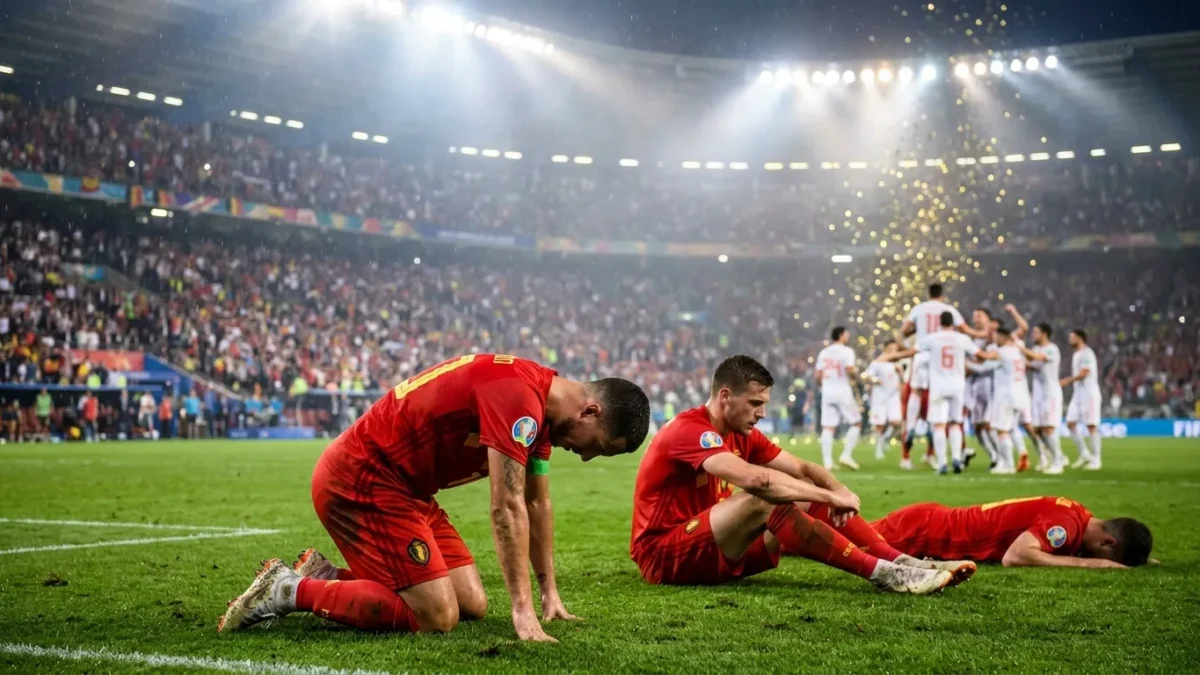
Belgium’s World Cup 2026 campaign is over. Beaten by Spain and eliminated from the tournament, the Red Devils leave behind a bittersweet legacy that stretches more than a decade back to that famous summer in Brazil. Twelve years on from the dazzling 2014 squad that lit up Group H, the curtain has finally come down on an era.
A defeat that marks the end of a cycle
The loss to Spain confirmed what many had suspected since Belgium’s group stage exit in Qatar 2022 : this generation of players, however gifted, has reached its final chapter on the world stage. Manager Rudi Garcia was candid after the final whistle. “I took a team that I wanted to take as far as possible,” he said. “My veteran players, who are maybe on their way out, I wanted them to have one last hurrah.” His words carried genuine emotion, not the polished deflection you sometimes hear from coaches after a defeat.
Several players almost certainly wore the Red Devils shirt for the last time in this World Cup. Leandro Trossard (31), Brandon Mechele (33), Timothy Castagne (33), Hans Vanaken (33) and Thomas Meunier (34) all feature on that list. These are men who gave years of service to a national team that frequently carried the weight of impossible expectations. Garcia added : “It is a shame because I think everyone deserves to go far in this World Cup.” Frankly, it is hard to disagree.
The defeat to Spain hurts more precisely because this Spanish side is so sharp, so dominant. Getting knocked out by a team that could genuinely win the whole tournament softens the blow slightly, but only slightly.
What this golden generation actually achieved
Let’s put the record straight, because the narrative around Belgium’s “underachieving” golden generation is more complicated than it looks. Critics have long argued that a squad featuring Courtois, De Bruyne, Lukaku, Hazard, Witsel, Kompany, Dembele, Mertens and Fellaini should have lifted a major trophy. That 2014 side that dismantled Algeria 2-1 in their opening game read like a fantasy football dream team. But here is the context that gets conveniently forgotten :
| Tournament | Belgium’s result |
|---|---|
| World Cup 2014 | Quarter-finals |
| Euro 2016 | Quarter-finals |
| World Cup 2018 | Third place |
| Euro 2020 | Quarter-finals |
| World Cup 2022 | Group stage |
Belgium topped their group at the 2014 World Cup, their first appearance since 2002. They then reached the semi-finals in Russia 2018, finishing third. For a country of fewer than 12 million people, that is a remarkable run by any measure. Spanish football journalist Guillem Balague put it well : “They were third in the 2018 World Cup and that seems to have been forgotten. I’m not sure how much more you could ask for.” He also pointed out the broader picture with uncomfortable clarity : “To be a golden generation you have to win some gold, and then you can be called that.”
Balague’s broader point deserves attention. England had their own so-called golden generation around the mid-2000s that won precisely nothing. Italy managed to harness experience and talent at exactly the right moment to win Euro 2020. Spain themselves are now on a fresh upward curve after dominating European football between 2008 and 2012. Demanding a title from Belgium, given that geopolitical and footballing reality, was perhaps always setting the bar at an unreachable height.
The transition that Belgium must now face
This exit raises an urgent question : what comes next ? With De Bruyne, Trossard, Vanaken and Castagne all either ageing or stepping back from international duty, Belgium face a genuine rebuilding phase. The pipeline of talent is not empty, but it does not yet carry the same star power as the squad that walked into the 2018 semi-final against France.
Consider what the Red Devils need to address before the next major tournament cycle :
- Identify a new creative fulcrum to replace De Bruyne’s vision and range of passing
- Develop a reliable goalscorer with Lukaku’s physical presence and finishing rate
- Build defensive solidity around a younger back four
- Give Garcia or his successor time to implement a clear tactical identity
Garcia himself seemed aware of this transition. His disappointment after the Spain defeat was not just about this tournament. It was about closing one chapter and acknowledging how difficult the next one will be to write. “I’m disappointed for those that maybe might not come back with the national team,” he said. That phrase alone summarises the moment.
Belgium’s football federation now faces decisions that go beyond tactics. Investing in youth development, backing a long-term project and resisting the temptation to demand instant results from the next generation are all critical. The golden generation set a bar that took years to build. Replacing that collective quality overnight is not realistic, and any serious observer knows it. What Belgium can do is channel the lessons of this era : that raw talent alone never guarantees silverware, and that sustainable success demands patience, structure and a willingness to evolve. The Spain defeat stings today, but it could also be the moment Belgium’s next chapter genuinely begins.
