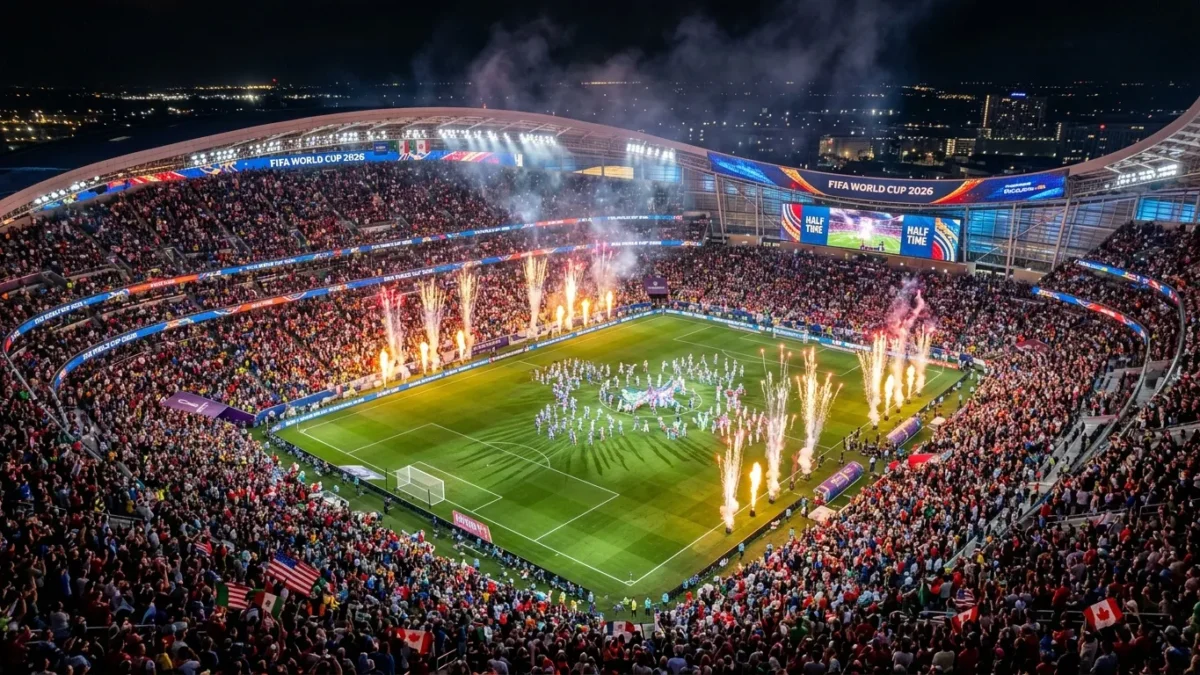
Twenty-five minutes. That’s potentially how long players will sit in the locker room during the 2026 World Cup final half-time break, more than half again the standard 15-minute interval written into football’s rulebook. FIFA is stretching the boundaries of tradition, and frankly, it’s hard to argue against when you look at what they’ve planned for that interval.
A half-time show unlike anything football has seen
The show scheduled at New York New Jersey Stadium for Sunday’s final runs approximately 11 minutes. Co-headlined by Madonna, Shakira and K-pop supergroup BTS, it immediately positions itself as the most star-studded entertainment package ever attached to a football match. Justin Bieber was confirmed just days ago as an additional name on the bill, joining Burna Boy and classical conductor Gustavo Dudamel. Chris Martin of Coldplay has personally curated the full production, and his group will perform alongside the PS22 Chorus.
Sources close to FIFA’s organisation suggest the total interval duration will land around 20 minutes, though one scenario on the table keeps the standard 15-minute break intact and simply adds the 11-minute performance on top. Either way, players face a noticeably longer wait before the second half begins. That may matter tactically, especially if the game is tight and momentum is everything.
For context, look at what happened at last year’s Club World Cup final, also held in New Jersey and also organised by FIFA. The half-time break lasted a full 24 minutes, owing to a live set featuring Coldplay, J Balvin, Doja Cat, Tems and Emmanuel Kelly. Nobody seemed to complain. The precedent is set.
Here’s something worth knowing : under IFAB regulations (the International Football Association Board, which governs the laws of the game), players are formally entitled to a half-time break not exceeding 15 minutes. Any extension requires specific agreement. FIFA isn’t breaking rules here, but it is bending the usual framework to accommodate entertainment ambitions on an entirely different scale.
Kick-off times, ceremonies and who’s performing before the match
The final gets underway at 15 :00 local time (20 :00 BST) on Sunday. Before a ball is kicked, a closing ceremony starts at 13 :30 local time (18 :30 BST), and the lineup for that segment is remarkable in its own right.
| Event | Local time | BST |
|---|---|---|
| Closing ceremony | 13 :30 | 18 :30 |
| Kick-off | 15 :00 | 20 :00 |
| Half-time show | ~16 :00 | ~21 :00 |
Tom Cruise, Laura Pausini, Nicole Scherzinger, Robbie Williams and internet personality IShowSpeed are confirmed for the pre-match ceremony. Jennifer Hudson will sing the United States’ national anthem. It’s a deliberately eclectic mix, designed to pull massive global audiences across every demographic imaginable.
The Super Bowl comparison is unavoidable and, for me, entirely intentional on FIFA’s part. American audiences expect spectacle woven into sport. By staging this final in the New York-New Jersey area and loading the day with performances, FIFA is making a direct play for US mainstream attention. Whether you find that exciting or uncomfortable depends on how purist your relationship with football is.
Who’s actually playing, and what’s at stake on the pitch
All this entertainment chatter risks overshadowing what actually matters : the football itself. Spain secured their final spot in dominant fashion, beating France 2-0 in the first semi-final played in Dallas on Tuesday. Their opponents will emerge from the second semi-final between England and Argentina, scheduled for Wednesday at 20 :00 BST in Atlanta.
Spain’s performance against France was clinical. Two goals, clean sheet, no drama. They look like the best team in the tournament right now, and anyone stepping onto that pitch against them on Sunday faces a serious test. Whether it’s England or Argentina, the tactical challenge is considerable.
The stakes couldn’t be higher. Consider what’s on the line for each possible finalist :
- Spain : a chance to add a fourth World Cup title to their collection, cementing a generation of players alongside the 2010 triumph.
- England : the opportunity to end a wait stretching back to 1966, which would be the most significant moment in English football history for 60 years.
- Argentina : defending champions seeking back-to-back titles for the first time since Brazil managed the feat in 1958 and 1962.
The athletic drama, the geopolitical rivalries, the generational talent on display… none of that disappears just because Madonna is performing at the interval. But FIFA clearly believes the two things can coexist, and Sunday will be the ultimate test of that bet.
What the extended break really means for the game
Coaches should start planning for this now if they haven’t already. A 20 to 25-minute break changes preparation rhythms compared to the standard quarter-hour. Muscles cool. Mental focus drifts. The tactical reset conversation gets longer, which could be an advantage or a problem depending on how structured a team’s coaching staff is.
From a physical standpoint, sports scientists at elite clubs have noted that breaks exceeding 20 minutes can require players to essentially re-warm up before the second half. That’s not a trivial detail when you’re talking about a World Cup final at 35°C in a July New Jersey summer. Expect both benches to have players doing light activation work in the tunnel before returning to the pitch, regardless of how spectacular the show is out on the grass.
The real question for football fans is simple : does the spectacle enhance the occasion or dilute it ? The 2025 Club World Cup showed that a longer interval didn’t damage match quality. That’s the strongest argument FIFA has going into Sunday.
