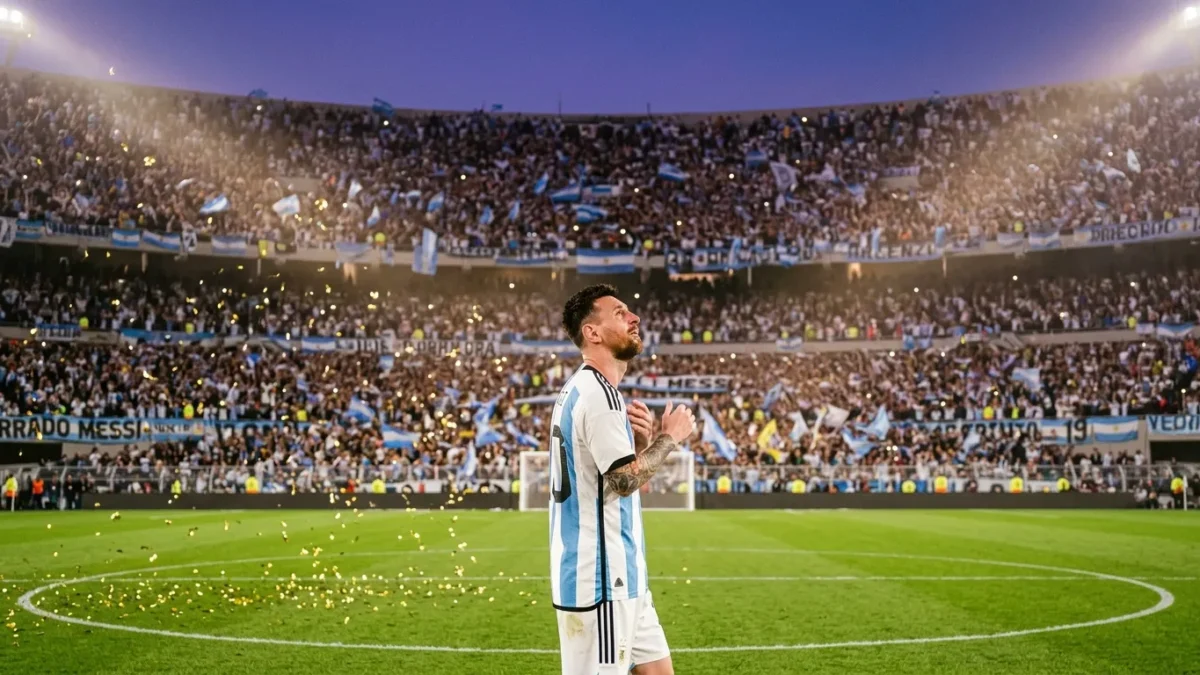
Eight goals in seven games. At 39 years old. In a World Cup final. Whatever happens on the pitch when Argentina face their opponents in the 2026 showpiece, Lionel Messi’s tournament has already defied every rational expectation. The question gripping football fans worldwide isn’t about tonight’s result, it’s about what comes next.
A late-career resurgence that rewrites the record books
Numbers rarely lie in football, and Messi’s 2026 World Cup statistics are staggering. Only Kylian Mbappé, the tournament’s top scorer, stands ahead of him with ten goals. Fifteen of Messi’s 21 World Cup goals have arrived since he turned 35, a fact that dismantles the tired narrative about ageing forwards fading into irrelevance.
Argentina coach Lionel Scaloni didn’t hold back after his side reached the final. “He is history, a legend,” Scaloni said. “The best footballer the world has ever seen, and reaching a final at 39 is something unbelievable. That is why I said we must enjoy him.” His words carry genuine weight, this isn’t hollow praise from a manager protecting his star player. It’s a frank acknowledgment that watching Messi right now is a privilege with an expiry date nobody can predict.
One particular detail stands out from the group stage. Against Cape Verde, tracking data showed Messi covered 6.5 kilometres in the first 90 minutes, with 62% of that distance at walking pace. Critics could dismiss that as evidence of decline. Spanish football journalist Guillem Balague reads it differently : Messi manages his energy with surgical precision, saves his explosive bursts for moments that matter, and still finishes 120-minute matches at an age when most outfield players have long retired. That is not decline. That is mastery.
What Messi himself said, and why you shouldn’t believe it
Before the 2022 World Cup final in Qatar, Messi was unusually candid. “I am very happy for finishing my journey in World Cups in a final,” he said. “I don’t think I will be able to do that again.” He spoke like a man drawing a curtain. Then he turned up in North America, joined Inter Miami, rediscovered his love for international football, and led Argentina to another final four years later.
This matters enormously when interpreting anything Messi might say after the 2026 final. His track record of retirement declarations is, frankly, unreliable. Balague, who has followed Messi’s career closely for years, is blunt about it : “Even if you hear it is the end, I doubt it, but we’ll see.” He added that he simply cannot picture Messi settling into a quiet MLS career at Inter Miami and closing the door on the national team while he still physically can compete.
Here is a quick look at Messi’s World Cup journey, to put the 2026 chapter in perspective :
| Year | Age | Goals | Result |
|---|---|---|---|
| 2006 | 18 | 1 | Quarter-final |
| 2014 | 26 | 4 | Final (lost) |
| 2018 | 30 | 1 | Round of 16 |
| 2022 | 35 | 7 | Winner |
| 2026 | 39 | 8* | Final |
*Goals scored before the final
The trajectory is clear. Messi’s best World Cup football has come in his thirties, not his twenties. Anyone writing off 2030 as an impossibility is ignoring the evidence sitting right in front of them.
The 2030 World Cup factor, and why Argentina changes everything
The 2030 World Cup carries a unique dimension that could prove irresistible for Messi. Six nations will co-host the tournament, with the bulk of matches split between Spain, Portugal and Morocco. But at least one match will take place in each of Argentina, Uruguay and Paraguay, to mark the centenary of the first-ever World Cup held in 1930.
Think about what that means concretely. Messi could walk onto a pitch in Buenos Aires or Rosario, wearing the light blue and white of Argentina, in front of a home crowd, at a World Cup. That scenario would be unlike anything professional football has produced before. Balague puts it plainly : “The passion is still there. All of that means he’s not going to leave the national side.”
For Messi to feature at 2030, he would need to be selected at 43 years old, which would make him the oldest outfield player in World Cup history. There is one caveat : if Cristiano Ronaldo continues with Portugal past 2026, the Portuguese forward would be 45 in 2030. The rivalry, absurdly, might not even be over yet.
Three reasons why dismissing Messi’s chances at 2030 is premature :
- He is physically completing full 120-minute matches at 39, with data supporting his endurance levels
- His goal output has increased with age, not dropped
- Playing in Argentina, on home soil, at a centenary World Cup, is a motivation no retirement speech can neutralise
Scaloni’s comparison to Diego Maradona is telling : “With Maradona, we still miss him, but Messi is still with us, so we must enjoy him.” That sentence doubles as a warning to fans : stop treating each Messi appearance as a farewell. Watch the football. Worry about goodbyes later.
